
Among Kenya’s most elegant wild animals are its gazelles. Often seen grazing across the open plains of the Masai Mara or standing alert beneath the African sun, gazelles in Kenya are an essential part of the country’s savannah ecosystems.
They may not receive the same attention as lions, elephants or rhinoceroses, but gazelles are among the most fascinating animals to observe on safari. Their speed, alertness and social behaviour have evolved in response to life in landscapes shared with some of Africa’s most capable predators.
For first-time safari travellers, gazelles can sometimes be difficult to distinguish from other antelopes. Their slender bodies, delicate legs and distinctive markings may resemble those of impalas or certain other small antelope species.
Kenya is particularly associated with two gazelle groups: Thomson’s gazelles and Grant’s gazelles. Both are commonly encountered in suitable open habitats, but they differ in appearance, size, feeding behaviour and habitat preferences.
Understanding these differences adds depth to a wildlife safari. Instead of seeing gazelles as simply another grazing animal, visitors begin to appreciate how they survive, communicate and interact with predators. This guide explores the gazelle species found in Kenya, their behaviour, habitats, conservation challenges and the best places to observe them.

What Is a Gazelle?
A gazelle is a type of antelope belonging to the family Bovidae. Gazelles are generally associated with open grasslands, savannahs and semi-arid environments, and they are known for their slender build, long legs and remarkable speed.
Most species have distinctive facial markings and horns, although horn size and shape vary. Gazelles are herbivores whose diets include grasses, leaves and other plant material depending on species and habitat, and they are also important prey animals. Lions, cheetahs, leopards, hyenas and other predators may hunt gazelles, and their role in the food web makes them essential to the ecological balance of Kenya’s wildlife areas.
Main Gazelle Species Found in Kenya
1. Thomson’s Gazelle
Thomson’s gazelle is one of the most recognisable small antelopes of East Africa, particularly associated with open grasslands. The species is named after the Scottish explorer Joseph Thomson.
What Does Thomson’s Gazelle Look Like?
Thomson’s gazelles are relatively small and slender. They have a tan or light brown upper body, a white underside and a prominent dark stripe along the flank, which is one of their most useful identification features. Their faces have contrasting markings around the eyes and muzzle, and both males and females may have horns, although males generally have more substantial horns.
Where Can You See Thomson’s Gazelles?
The Masai Mara is one of the best-known destinations for observing Thomson’s gazelles. They favour suitable open grassland habitats where they can detect approaching predators, and they may also occur in other appropriate savannah environments.
Behaviour
Thomson’s gazelles are highly alert. They frequently raise their heads while feeding to scan the surroundings, and when threatened they may flee rapidly or perform distinctive bounding movements.
Predators
Cheetahs are particularly associated with hunting small and medium-sized antelopes, including Thomson’s gazelles. Lions, leopards and hyenas may also prey on them.
2. Grant’s Gazelle
Grant’s gazelle is another important gazelle group found in Kenya. It is generally larger than Thomson’s gazelle and occurs in a variety of savannah and semi-arid habitats.
Appearance
Grant’s gazelles have a tan upper body and white underside. Their flank markings are generally less sharply defined than those of Thomson’s gazelles, and the white rump area is often more extensive. Males may have long, prominent horns.
Habitat
Grant’s gazelles can occupy relatively dry environments and are adapted to habitats where water availability may be limited. Their feeding behaviour allows them to use different plant resources.
Where to See Them
Grant’s gazelles may be encountered in the Masai Mara, Amboseli and other suitable wildlife areas. Their distribution varies according to habitat and environmental conditions.
Behaviour
Grant’s gazelles may form small groups or larger aggregations. Males can establish territories during breeding periods, and their social organisation varies according to season and local conditions.
Thomson’s Gazelle Versus Grant’s Gazelle
These two gazelle groups are often confused by first-time safari visitors.
- General size: Thomson’s Gazelle: Smaller. Grant’s Gazelle: Larger.
- Flank stripe: Thomson’s Gazelle: Usually prominent and dark. Grant’s Gazelle: Usually less prominent.
- Body shape: Thomson’s Gazelle: Compact and slender. Grant’s Gazelle: Taller and more substantial.
- Habitat: Thomson’s Gazelle: Open grasslands. Grant’s Gazelle: Grasslands and drier savannah.
- Horns: Thomson’s Gazelle: Generally shorter. Grant’s Gazelle: Often longer and more prominent.
Identification can be complicated by age, sex, viewing angle and variation between populations. A knowledgeable safari guide can help distinguish the animals.
How Fast Can Gazelles Run?
Gazelles are exceptionally fast animals, and their speed is an important defence against predators. Thomson’s gazelles are often described as capable of reaching speeds around 70–80 kilometres per hour in short bursts, although exact maximum speeds are difficult to measure consistently in wild animals.
Speed alone does not guarantee survival. Gazelles also rely on rapid acceleration, agility and sudden changes of direction, and these abilities are particularly important when escaping predators such as cheetahs.
Why Do Gazelles Jump?
Gazelles sometimes perform a distinctive stiff-legged bounding movement known as stotting or pronking. During this behaviour, the animal springs into the air with relatively straight legs.
Several explanations have been proposed: the movement may communicate alertness or physical condition to predators, and it may also help coordinate group responses to danger. The exact function can vary by context. Visitors may observe this behaviour when gazelles become alarmed, and it is a fascinating example of how prey animals communicate through movement.
What Do Gazelles Eat?
Gazelles are herbivores whose diets vary according to species, season and habitat. Thomson’s gazelles often feed on short grasses, while Grant’s gazelles can make greater use of browse and other vegetation in suitable environments.
During periods of fresh grass growth, gazelles may concentrate in productive grazing areas, and when conditions become drier they may change feeding locations. Their ability to use different food resources helps them survive seasonal variation.
Do Gazelles Need to Drink Water?
Gazelles obtain water from both drinking and the plants they consume. Some gazelle species are well adapted to relatively dry habitats and may obtain a substantial proportion of their moisture from vegetation, although their dependence on drinking water varies with temperature, diet and environmental conditions. Visitors should not assume that gazelles never drink.
Gazelle Social Behaviour
Gazelles have varied social systems. Some groups consist of females and young animals, adult males may establish territories, and bachelor groups can also occur. The composition of groups changes according to breeding conditions, habitat and population density.
During a safari, visitors may observe males displaying, chasing rivals or interacting with females. These behaviours are part of the animals’ reproductive strategies.
Gazelle Breeding and Young Calves
Gazelle reproduction is influenced by environmental conditions and food availability. Females generally give birth to a single calf, and newborn calves are vulnerable to predators. Mothers may conceal young calves in vegetation during the earliest stages of life, and as calves become stronger they begin accompanying their mothers more regularly.
Observing a mother and calf can be particularly rewarding, but safari vehicles should maintain appropriate distances.
Gazelles and the Great Wildebeest Migration
Gazelles are part of the wider Serengeti–Mara ecosystem. However, their movement patterns are not identical to those of wildebeest. Some gazelle populations respond to seasonal grazing conditions and may move across suitable habitats, while others remain within more restricted ranges.
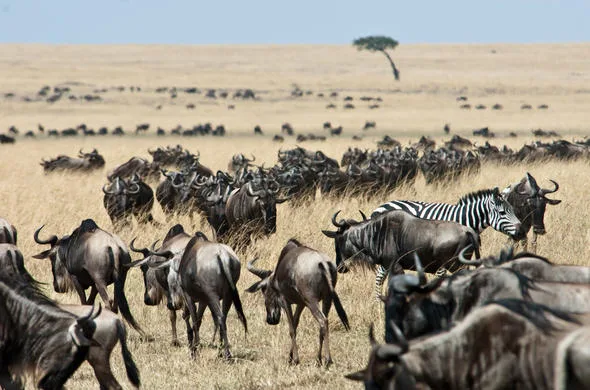
During the Great Migration period, gazelles may share grazing areas with wildebeest and zebras, and their presence adds to the diversity of herbivores on the plains.
Gazelles as Prey Animals
Gazelles are important prey for several predators.
Cheetahs
Cheetahs often hunt small and medium-sized antelopes. Their speed and acceleration make them highly effective hunters in open habitats.
Lions
Lions may prey on gazelles, although they often target larger herbivores.
Leopards
Leopards are opportunistic predators and may hunt gazelles in suitable habitats.
Spotted Hyenas
Hyenas are capable hunters and may capture gazelles.
African Wild Dogs
Where present, African wild dogs may hunt gazelles and other antelopes.
The relationship between predators and prey is one of the most important ecological processes in savannah ecosystems.
How Do Gazelles Detect Predators?
Gazelles rely on several senses. Their large eyes provide a wide field of vision and they can detect movement across open landscapes, while their hearing also helps identify potential threats.
Group living provides additional vigilance because several animals may scan the surroundings. When one gazelle becomes alarmed, others may respond, and this collective awareness improves survival opportunities.
Best Places to See Gazelles in Kenya
Masai Mara National Reserve

The Masai Mara is one of the strongest destinations for observing gazelles. Its open grasslands provide suitable habitat, and visitors may encounter Thomson’s and Grant’s gazelles during game drives. The Mara also offers opportunities to observe predator–prey interactions.
Amboseli National Park
Amboseli supports gazelles in suitable grassland and savannah habitats. The park is particularly attractive because wildlife can sometimes be photographed against Mount Kilimanjaro when weather conditions are clear.
Nairobi National Park
Nairobi National Park provides convenient wildlife viewing near the capital. Gazelles and other antelopes may occur in suitable open habitats.
Samburu National Reserve
The wider northern Kenya ecosystem supports antelopes adapted to drier environments. Visitors should distinguish gazelles from other species such as gerenuk and Beisa oryx.
Tsavo Ecosystem
Suitable parts of the Tsavo ecosystem support a variety of antelopes. Gazelle sightings depend on habitat and local distribution.
Best Time to See Gazelles in Kenya
Gazelles can be observed throughout the year and do not have a single tourist viewing season, although rainfall influences grazing conditions and animal distribution.
January to March
These months can provide rewarding wildlife viewing in suitable habitats.
April to May
Rainfall may produce fresh grass and greener landscapes.
June to October
Dry conditions can make some wildlife easier to observe in open habitats.
November to December
Short rains may influence feeding patterns and local movements.
The best time depends on the destination and wider safari interests.
Gazelle Photography Tips
Gazelles are attractive photographic subjects because of their elegant shape and alert behaviour.
- Photograph at eye level: A lower camera angle can create a more intimate perspective, although photographers should remain within the safari vehicle and follow guide instructions.
- Use a telephoto lens: A telephoto lens allows close-up photographs without approaching animals too closely.
- Watch for behaviour: Look for feeding, grooming, territorial displays and interactions between mothers and calves.
- Capture movement: Gazelles can move rapidly; a fast shutter speed is useful for photographing running or jumping animals.
- Include the landscape: Wide photographs can show gazelles within the larger savannah environment and help communicate their ecological setting.
Gazelles Versus Impalas
Gazelles and impalas are both antelopes, but they are not the same animals. Impalas are generally associated with woodland edges and mixed savannah habitats. Male impalas have distinctive lyre-shaped horns while female impalas lack horns.
Gazelles often have more pronounced facial markings, and Thomson’s gazelles also have a distinctive dark flank stripe. A guide can help visitors identify these species.
Gazelles Versus Dik-diks
Dik-diks are much smaller antelopes often associated with bushy habitats. Their size and facial appearance distinguish them from gazelles, and dik-diks are particularly interesting because they are among Africa’s smallest antelopes.
Gazelles Versus Springboks
Springboks are primarily associated with southern Africa and are not a typical wild safari species in Kenya. Although they resemble some gazelles, their natural distribution is different, and travellers should not confuse springboks with Thomson’s gazelles.
Conservation Challenges Facing Gazelles
Gazelles face pressures associated with habitat loss, land-use change and fragmentation. Expansion of agriculture and settlements can reduce available grazing areas, and fences and roads may interfere with wildlife movement. Illegal hunting can also affect populations, and climate variability may influence food and water availability.
Conservation requires maintaining suitable habitats and movement corridors.
Why Gazelles Matter to Kenya’s Ecosystems
Gazelles are important grazers and browsers that influence vegetation through feeding. They also provide prey for predators, and their movements contribute to ecological processes across the savannah. Protecting gazelles therefore supports a wider network of wildlife species.
Responsible Gazelle Viewing
- Do not chase gazelles or encourage guides to provoke running behaviour.
- Maintain appropriate vehicle distances.
- Do not approach young calves closely.
- Allow natural behaviour to unfold for photography.
Responsible viewing produces better wildlife experiences and reduces disturbance.
Suggested Three-Day Masai Mara Gazelle and Predator Safari
Day 1: Nairobi to Masai Mara
Depart Nairobi in the morning, travel to the Masai Mara and check in at your lodge. Enjoy an afternoon game drive and look for gazelles, zebras, giraffes and other wildlife.
Day 2: Full-Day Wildlife Safari
Begin early and explore the open grasslands. Observe gazelle feeding and social behaviour and look for predators such as lions and cheetahs. Your guide will select routes according to current wildlife movements.
Day 3: Return to Nairobi
Enjoy breakfast and a final activity if time permits, then travel back to Nairobi.
Frequently Asked Questions About Gazelles in Kenya
What gazelles are found in Kenya?
Thomson’s gazelles and Grant’s gazelles are among the best-known gazelles encountered on Kenya safaris.
Where can I see gazelles?
The Masai Mara, Amboseli and other suitable savannah habitats provide opportunities.
Are gazelles fast?
Yes. Gazelles are capable of rapid running and agile movements.
What do gazelles eat?
They feed on grasses, leaves and other vegetation, depending on species and habitat.
Do lions eat gazelles?
Yes. Lions may prey on gazelles, although they also hunt larger herbivores.
Are gazelles the same as impalas?
No. Gazelles and impalas are different antelope groups.
Can gazelles be seen year-round?
Yes, in suitable habitats.
Are gazelles endangered?
Conservation status varies by species and population. Habitat protection remains important.
See Gazelles on a Kenya Wildlife Safari
Gazelles in Kenya are more than graceful animals decorating the savannah. They are important herbivores, alert survivors and essential prey species within the country’s wildlife ecosystems.
At Safari Trips to Kenya, we arrange wildlife safaris that provide opportunities to observe gazelles alongside lions, cheetahs, elephants, giraffes and other animals. Contact our team to plan a personalised Kenya wildlife safari in the Masai Mara, Amboseli or other destinations.