
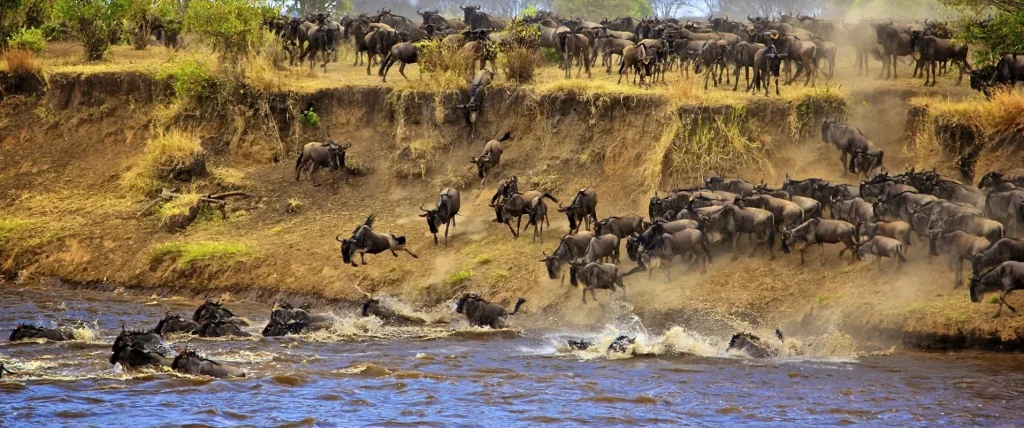
Masai Mara River Crossing
The Masai Mara River Crossing is one of the most dramatic wildlife spectacles associated with the Great Migration. During periods when migratory wildebeest and zebra herds move through the northern Serengeti–Masai Mara ecosystem, large numbers of animals may approach the Mara River and attempt to cross between grazing areas.
These crossings have become some of the most recognisable scenes from an African safari: thousands of wildebeest gathering along steep riverbanks, animals suddenly plunging into the water, zebras following behind, Nile crocodiles waiting in deeper channels and predators searching for vulnerable animals after the herds reach the opposite bank. Yet a Mara River crossing is also one of the most misunderstood safari experiences.
There is no fixed crossing time, no guaranteed crossing point and no date on which a crossing can be promised. Wildebeest may gather beside the river for hours before turning around. They may cross a few kilometres away from where vehicles are waiting. They may approach the water several times without entering it.
For travellers whose main ambition is to witness a crossing, the best strategy is to spend several days in the migration area, stay in a strategically located camp and remain flexible with game-drive plans. Individual species, river crossings and mountain views can never be guaranteed.
What Is a Masai Mara River Crossing?
A Masai Mara river crossing occurs when migratory herds move across the Mara River as part of their wider seasonal movement through the Serengeti–Mara ecosystem. The animals are primarily:
- Wildebeest
- Plains zebras
Other herbivores may also be present in the wider migration landscape. The river itself does not create the migration; instead, it becomes an obstacle that the animals sometimes need to cross as they move between areas of fresh grazing.
Where Do the River Crossings Take Place?
Most famous crossings occur along the Mara River, which flows through parts of Kenya's Masai Mara ecosystem and Tanzania's northern Serengeti. Within the Kenyan side, important crossing activity can occur in areas associated with:
- The Mara Triangle
- Sections of the main Masai Mara National Reserve
- Northern and southern stretches of the Mara River
- Traditional wildebeest crossing points
There is no single permanent crossing location. Different points may become active according to:
- Herd position
- Water levels
- Grazing conditions
- Riverbank accessibility
- Recent rainfall
This is why experienced guides monitor herd movements continuously.
When Do Masai Mara River Crossings Happen?
The broad period most closely associated with river crossings in the Masai Mara is usually July through October. However, this should not be treated as a guaranteed timetable. Wildlife movement depends on environmental conditions, so some years can produce earlier movements while other years may produce later herd arrivals. The exact timing is influenced by:
- Rainfall
- Fresh grass
- Water availability
- Herd movement
- Conditions in northern Serengeti
- Conditions inside the Masai Mara
Masai Mara River Crossing in July
July can mark the beginning of major northern migration activity, and some herds may approach or enter the Masai Mara during the month. Depending on conditions, travellers may encounter:
- Wildebeest concentrations
- Zebra herds
- Animals approaching the Mara River
- Early crossings
- Increased predator activity
July is therefore a potentially excellent migration month, but crossing activity is never guaranteed.
Masai Mara River Crossing in August
August is traditionally one of the most popular months for travellers hoping to witness a river crossing. Large migratory herds may be distributed across the northern Serengeti and Masai Mara ecosystem. Possible safari experiences include:
- Large wildebeest herds
- Zebra concentrations
- Multiple groups approaching the river
- Predator activity
- Nile crocodile sightings
- Riverbank gathering behaviour
August can also attract substantial visitor numbers.
Masai Mara River Crossing in September
September can be another excellent month for migration and river-crossing activity. Depending on rainfall and grazing, significant numbers of wildebeest may remain within the Mara ecosystem, and the herds may cross the river more than once as they move between different grazing areas. This is an important point: the migration is not necessarily one northbound crossing followed by one southbound crossing, as individual groups can cross back and forth.
Masai Mara River Crossing in October
Crossings can still occur during October. Some herds may remain inside the Masai Mara, while others gradually begin moving towards northern Serengeti as rainfall patterns change. October therefore remains relevant for migration safaris, although herd distribution can become increasingly variable.
Are Mara River Crossings Guaranteed?
No. No safari company, guide, camp or lodge can guarantee that you will see a Mara River crossing. A herd can arrive at the river and then:
- Stop
- Turn around
- Move upstream
- Move downstream
- Stay on the bank for hours
- Leave completely
- Suddenly cross without warning
Wildlife does not operate according to safari schedules. A responsible safari planner should therefore describe river crossings as a possibility rather than a guaranteed activity.
Why Do Wildebeest Cross the Mara River?
Wildebeest are following suitable grazing and water. If their seasonal movement takes them towards grazing areas on the opposite side of the river, the herd may need to cross, so the crossing is part of a broader ecological movement. Wildebeest are not specifically trying to reach the river. Their larger objective is access to:
- Fresh grass
- Water
- Suitable seasonal habitat
The river simply becomes a significant obstacle along the route.
How Does a River Crossing Start?
A crossing can develop slowly. Large numbers of wildebeest may approach the riverbank and gather close to the edge, and animals at the front may inspect the water but remain hesitant while the herd behind them continues increasing. At some point, one or several animals may enter the river, and once this happens, the movement of animals behind them can create momentum. Within seconds, a quiet riverbank can become extremely active, with hundreds or thousands of wildebeest following.
Why Do Wildebeest Hesitate Before Crossing?
The river represents genuine danger. Potential risks include:
- Deep water
- Strong current
- Steep banks
- Crocodiles
- Congestion
- Difficult exit points
- Injury
Individual wildebeest therefore often hesitate, and the herd may repeatedly approach and retreat before eventually crossing.
How Long Can Wildebeest Wait Before Crossing?
There is no fixed answer. They may wait:
- A few minutes
- An hour
- Several hours
- Most of the day
Sometimes a large herd gathers and never crosses while observers are present. This is why patience is essential on a migration safari.
How Long Does a River Crossing Last?
Crossings vary greatly. A small group may cross relatively quickly, while a major crossing involving thousands of animals may continue for a much longer period. The duration depends on:
- Number of animals
- Width of the crossing point
- River conditions
- Herd behaviour
- Entry and exit routes
Some crossings begin, stop and then restart.
How Many Wildebeest Cross at Once?
There is no fixed number. A crossing may involve:
- A few dozen animals
- Several hundred
- Several thousand
Large crossings are the most dramatic, but small crossings can provide equally interesting opportunities to observe behaviour.
Wildebeest and Zebra River Crossings
Zebras frequently migrate alongside wildebeest, so both species may appear at the same river crossing. The combination creates striking scenes as black-and-white zebra patterns mix with large wildebeest herds. The two species benefit from travelling together because their grazing strategies differ and their combined numbers improve predator detection.
Nile Crocodiles at the Mara River
The Mara River supports Nile crocodiles, including large individuals capable of attacking wildebeest. Crocodiles are ambush predators and may remain:
- Partly submerged
- Close to deeper channels
- Near crossing areas
When an opportunity develops, a crocodile may attack a swimming animal.
Do Crocodiles Attack at Every Crossing?
No. Some crossings happen with little visible crocodile activity, while other crossings can involve several attacks. The likelihood depends on:
- Crossing location
- Water depth
- Number of crocodiles
- Herd density
- River conditions
- Individual opportunity
Crocodile attacks are therefore possible but not guaranteed.
Other Dangers During a River Crossing
Crocodiles receive most of the attention, but they are not the only danger. Wildebeest may also be injured or killed because of:
- Steep riverbanks
- Falls
- Strong water currents
- Crowding
- Trampling
- Exhaustion
- Difficulty climbing out
Some crossing points have particularly challenging exit banks.
Predators After a River Crossing
The danger does not necessarily end when the herd reaches dry land. Predators may wait around migration routes, and possible predators include:
- Lions
- Spotted hyenas
- Cheetahs
These predators may target:
- Young animals
- Injured individuals
- Exhausted wildebeest
- Animals separated from the herd
Lions and Mara River Crossings
Lion prides living near migration areas can benefit from seasonal prey concentrations. They may wait:
- Near crossing exits
- On open plains
- Along migration routes
Lions do not need to enter the river to exploit migration activity. They may attack animals after a crossing or while herds move between grazing areas.
Hyenas and River Crossings
Spotted hyenas are also important migration predators. They may:
- Hunt weakened animals
- Pursue separated wildebeest
- Feed on carcasses
- Compete with lions
Their endurance makes them highly effective predators.
Cheetahs and River-Crossing Areas
Cheetahs generally avoid attacking large adult wildebeest. They are more likely to target:
- Gazelles
- Young wildebeest
- Smaller animals
Migration concentrations can nevertheless increase opportunities for cheetahs throughout the wider ecosystem.
River Crossings and Vultures
Vultures can gather where carcasses accumulate. They play an important ecological role by consuming dead animals and recycling nutrients, and birds commonly associated with carcasses may include several species of vultures and other scavenging birds.
Best Places to See a Mara River Crossing
There is no single guaranteed place. Your guide will normally consider:
- Current herd positions
- Recent crossing activity
- Road access
- River conditions
- Information from other guides
Certain sections of the Mara River repeatedly serve as crossing areas, but individual activity varies daily.
Mara Triangle River Crossings
The Mara Triangle is one of the important areas associated with migration activity. Its western position and access to stretches of the Mara River can make it particularly relevant during migration season. Visitors may encounter:
- Wildebeest
- Zebras
- Lions
- Hyenas
- Hippos
- Nile crocodiles
The Triangle can therefore provide much more than crossings alone.
River Crossings in Masai Mara National Reserve
Other stretches of the Mara River within the broader national reserve can also become important crossing areas. The best location depends on the movement of individual herds, so a safari should remain flexible rather than operating around one permanent crossing point.
Should You Stay Near the Mara River?
If river crossings are your main priority, staying reasonably close to important river areas can be advantageous. Benefits may include:
- Shorter morning transfers
- Faster response to herd movement
- More time near crossing areas
- Less daily driving
However, choosing accommodation purely because it contains "Mara River" in its description is not enough. The exact location matters.
Camps Near Mara River Crossings
A camp positioned strategically for migration season can significantly improve logistics. When choosing accommodation, consider:
- Distance to relevant river sections
- Access routes
- Which side of the river the camp occupies
- Reserve or conservancy rules
- Game-drive arrangements
- Seasonal herd patterns
Your operator should be able to explain why a particular camp fits your dates.
How Many Nights Should You Stay?
For a crossing-focused safari, more time is generally better.
2 Nights
Possible, but risky if seeing a crossing is your main goal.
3 Nights
Provides several game-drive opportunities.
4 Nights
A much stronger option.
5 Nights
Excellent for travellers specifically focused on migration.
6+ Nights
Ideal for photographers and serious migration enthusiasts. A 4- to 5-night stay is a strong starting point for travellers whose priority is the Mara River.
Why One Day Is Not Enough
A traveller may spend an entire day beside the river without seeing a crossing, and the following morning a crossing could happen shortly after sunrise. This unpredictability makes one-day crossing searches unreliable, whereas longer stays provide multiple opportunities.
Full-Day Game Drives During Migration Season
Full-day drives can be extremely useful. Instead of returning to camp for lunch, travellers carry a packed meal, which allows the guide to remain close to:
- Herd concentrations
- River areas
- Predator activity
It reduces the risk of losing significant wildlife time during long midday transfers.
Private Safari for Mara River Crossings
A private safari vehicle is especially valuable for migration travellers. Advantages include:
- Flexible departure times
- Ability to wait patiently
- No pressure from unrelated passengers
- More photography freedom
- Ability to change areas quickly
Shared game drives may require compromises.
Best Time of Day for River Crossings
There is no guaranteed best hour. Crossings can occur:
- Morning
- Midday
- Afternoon
Unlike traditional game-drive planning, crossing activity may justify staying in the field during warmer midday periods. If a large herd is gathering near the river, returning to camp simply because it is lunchtime may mean missing the event.
Morning River Crossing Safari
Early morning drives offer advantages including:
- Cooler weather
- Excellent photography light
- Active predators
- Access to herd locations early in the day
If herds are already close to the river, a morning crossing is possible.
Midday River Crossings
Wildebeest do not stop their migration because temperatures rise, and crossings can happen in the middle of the day. For this reason, migration-focused travellers often choose full-day game drives.
Afternoon River Crossings
Afternoon crossings are also possible. Later light may create dramatic photography conditions, particularly when dust rises from large herds.
Photographing a Mara River Crossing
River crossings are challenging but rewarding photographic events. Things happen quickly once animals start entering the water, so photographers should prepare equipment before the crossing begins. Useful equipment includes:
- Telephoto zoom lens
- Medium-range zoom
- Spare batteries
- Multiple memory cards
- Beanbag or camera support
Best Lens for River-Crossing Photography
There is no single perfect lens. A telephoto lens helps isolate:
- Individual wildebeest
- Crocodile interactions
- Animals climbing riverbanks
A wider lens can capture:
- Entire herds
- River landscape
- Scale of the crossing
A flexible zoom is particularly useful.
Photographing the Whole Crossing
Do not concentrate only on crocodile attacks. Some of the strongest images can include:
- Wildebeest gathering before the crossing
- Herds entering the water
- Dust on the riverbank
- Zebras mixed with wildebeest
- Animals climbing steep banks
- The scale of the landscape
The story is larger than individual predation events.
Migration Photography Etiquette
Vehicles should never interfere with the crossing. Drivers should avoid:
- Blocking animals
- Driving between herds and the river
- Pressuring animals towards the water
- Driving aggressively for position
- Obstructing exit routes
A photograph is never more important than natural wildlife behaviour.
Vehicle Crowding at River Crossings
Migration season attracts many visitors, so popular crossings can draw numerous safari vehicles. Vehicle density depends on:
- Crossing location
- Time
- Season
- Current wildlife activity
- Management regulations
Responsible guides should respect viewing rules.
Why Vehicle Position Matters
Poorly positioned vehicles can disturb wildebeest. If vehicles block an approach route, animals may:
- Stop
- Turn away
- Move elsewhere
This can alter natural behaviour, so proper vehicle management is essential.
Responsible River-Crossing Safaris
A responsible safari should:
- Maintain distance
- Keep designated routes open
- Avoid excessive noise
- Respect management rules
- Never encourage wildlife harassment
- Allow animals to approach the river naturally
Ethical viewing protects both wildlife and the quality of the safari.
Is the Mara River Crossing Too Graphic for Children?
Crossings are natural events, but some scenes can be intense. Children may witness:
- Crocodile attacks
- Injured wildebeest
- Animals struggling in water
- Predator kills
- Carcasses
Parents travelling with younger children should consider whether they are comfortable with these aspects of natural wildlife behaviour.
Hot-Air Balloon Safari During Migration Season
A balloon safari can provide spectacular aerial views of the broader Mara landscape, and large herds may sometimes be visible from the air. However, balloons:
- Follow wind direction
- Operate on fixed routes determined by conditions
- Cannot hover over a crossing
- Cannot guarantee migration sightings
A balloon safari should therefore complement rather than replace game drives.
River Crossing Safari by Road
A road safari from Nairobi is a practical option for migration travellers. Advantages include:
- Private vehicle availability
- Dedicated guide
- Flexible game drives
- Ability to carry photography equipment
- Good value for longer stays
The road journey takes significantly longer than flying.
Fly-In Mara River Crossing Safari
A fly-in safari reduces transfer time and gives travellers more time inside the Mara. It is especially suitable for:
- Luxury travellers
- Honeymooners
- Short holidays
- Photographers
- Senior travellers
Flights serve several Mara airstrips, so selecting the correct airstrip for your camp is important.
Budget Mara River Crossing Safari
Migration season is often one of the more expensive periods in the Mara because accommodation demand is high. Budget travellers can reduce costs by choosing:
- Road transport
- Simpler camps
- Shared departures
- Accommodation outside premium areas
However, location should not be sacrificed excessively. A cheaper camp requiring very long daily drives can reduce migration-viewing time.
Luxury Mara River Crossing Safari
Luxury migration safaris may include:
- Fly-in transfers
- Premium tented camps
- Private vehicles
- Bush meals
- Sundowners
- Balloon safaris
- Conservancy stays
For crossing-focused travellers, location should remain more important than luxury level.
What Else Will You See During a River Crossing Safari?
Even if no crossing happens, migration areas can offer outstanding wildlife viewing. Possible sightings include:
- Lions
- Leopards
- Cheetahs
- Hyenas
- Elephants
- Buffaloes
- Giraffes
- Hippos
- Crocodiles
- Wildebeest
- Zebras
- Topis
- Gazelles
- Vultures
A crossing should therefore be treated as one possible highlight of a much broader safari.
Hippos in the Mara River
The Mara River is also important habitat for hippos, and visitors may see pods resting in the water during daylight hours. Hippos and migration activity can occur in the same general river system, although the animals occupy the habitat differently.
Crocodiles Outside Migration Season
Nile crocodiles remain in the Mara River throughout the year and do not disappear when migratory wildebeest leave. Outside migration season, crocodiles continue feeding on aquatic and terrestrial prey when opportunities arise.
Are River Crossings Only Northbound?
No, and this is another common misconception. Wildebeest can cross the river several times while moving within the northern ecosystem. Individual herds may:
- Cross northward
- Cross southward
- Cross east or west depending on river orientation
- Cross back again
The movement is far more complicated than one single annual crossing.
Why Herds Cross Back and Forth
Animals follow grazing. If rainfall produces better grass on another side of the river, herd movement may change, and the same animals may therefore negotiate the Mara River several times during one northern migration season.
Mara River Crossing vs Great Migration
The terms are related but not identical.
Great Migration
The entire annual movement of wildebeest and other grazers through the Serengeti–Mara ecosystem.
Mara River Crossing
One particular behaviour that can occur during the northern phase of that migration. A visitor can therefore experience an excellent Great Migration safari without seeing a river crossing.
Is a Mara River Crossing the Best Part of the Migration?
That depends on the traveller. River crossings are dramatic, but other migration experiences can be equally impressive:
- Hundreds of thousands of animals across open plains
- Predator-prey interactions
- Herds moving at sunrise
- Zebras and wildebeest stretching to the horizon
- Lions surrounded by migratory prey
- Dust clouds created by moving herds
The entire migration is the spectacle.
Masai Mara vs Northern Serengeti River Crossings
The Mara River flows through both Kenya and Tanzania, so crossings may occur on either side of the international boundary. The best destination depends on:
- Herd location
- Travel dates
- Safari duration
- Accommodation
Travellers with sufficient time can combine Masai Mara and northern Serengeti.
Combining Masai Mara and Serengeti
A longer migration itinerary might include Nairobi → Masai Mara → Northern Serengeti → Central Serengeti → Ngorongoro → Arusha. This allows travellers to experience a larger part of the migration ecosystem, though border and safari vehicle logistics need to be planned correctly.
River Crossing Safari and Kenya Coast
Migration season can also be combined with a beach holiday. A typical itinerary may include 4–5 Nights Masai Mara + 4–6 Nights Kenya Coast. This works especially well for:
- Honeymooners
- Families
- Couples
- Longer Kenya vacations
What to Pack for a River Crossing Safari
Useful items include:
- Binoculars
- Camera
- Telephoto lens
- Spare batteries
- Extra memory cards
- Neutral safari clothing
- Light jacket
- Hat
- Sunglasses
- Sunscreen
- Insect repellent
- Personal medication
A light jacket is important because early mornings can be cool.
Binoculars at River Crossings
Binoculars are particularly useful because responsible vehicle positioning may mean observing parts of the action from some distance. They help you see:
- Crocodiles
- Animals gathering on the opposite bank
- Predator activity
- Wildebeest movement
Choosing a Mara River Crossing Safari
When comparing crossing-focused safaris, ask:
- Where exactly is the camp located?
- How far is it from the Mara River?
- Which river sections can the guide access?
- Is the vehicle private?
- Can we take full-day game drives?
- How many nights are included?
- Are park fees included?
- How experienced is the guide with migration safaris?
- Can the itinerary respond to current herd movements?
- Does anyone claim the crossing is guaranteed?
The last question is particularly important.
Common Mara River Crossing Safari Mistakes
Expecting a Guaranteed Crossing
The biggest mistake. Nothing can guarantee natural wildlife behaviour.
Staying Only One Night
This provides almost no flexibility.
Staying Too Far From the River
Long daily transfers can reduce opportunities.
Leaving the Herd Too Soon
Wildebeest can wait for hours before suddenly moving.
Watching Only the River
Migration activity across the plains can be equally impressive.
Choosing the Cheapest Package Without Checking Location
Price should be compared against actual safari access.
How to Increase Your Chances of Seeing a Crossing
Nothing can guarantee success, but you can improve your chances by:
- Travelling during the broad migration period
- Spending 4–5 nights or more
- Staying strategically
- Using an experienced guide
- Booking a private vehicle
- Taking full-day game drives
- Remaining patient
- Keeping the itinerary flexible
What If You Do Not See a River Crossing?
Your safari can still be exceptional. During migration season, you may experience:
- Huge wildebeest herds
- Zebras
- Lions
- Cheetahs
- Hyenas
- Elephants
- Hippos
- Crocodiles
- Exceptional photography
- Open Mara landscapes
A river crossing should be viewed as a bonus rather than the only measure of safari success.
Planning a Masai Mara River Crossing Safari
For travellers whose main objective is the Mara River crossing, a sensible approach is:
- Travel broadly between July and October.
- Allow at least four nights where possible.
- Choose a camp with good access to migration areas.
- Use an experienced guide.
- Consider a private vehicle.
- Be prepared for full-day game drives.
- Keep expectations realistic.
- Do not assume the animals will cross on schedule.
Patience is perhaps the most important ingredient. The wildebeest decide when the crossing happens.
Frequently Asked Questions About Masai Mara River Crossings
What is a Masai Mara River Crossing?
It is the movement of migratory wildebeest and zebras across the Mara River during parts of the Great Migration.
When do Mara River crossings happen?
They are broadly associated with July through October, although exact timing changes from year to year.
What is the best month to see a river crossing?
August and September are traditionally popular, but no month guarantees a crossing.
Can crossings happen in July?
Yes. Migration and crossing activity can occur in July depending on herd movement.
Can crossings happen in October?
Yes. Some herds may still cross while moving within or out of the Mara ecosystem.
Are river crossings guaranteed?
No. They are completely unpredictable.
What time do wildebeest cross the Mara River?
There is no fixed time. Crossings can occur in the morning, midday or afternoon.
How long do wildebeest wait before crossing?
They can wait anywhere from minutes to many hours and may ultimately decide not to cross.
How long does a crossing last?
It depends on herd size and river conditions. Some are brief while major crossings can continue considerably longer.
Where is the best place to see a crossing?
The best area changes according to current herd movements. Various sections of the Mara River can become active.
Is the Mara Triangle good for crossings?
Yes. The Mara Triangle is one of the important migration areas associated with sections of the Mara River.
Do crocodiles attack wildebeest during crossings?
Yes, Nile crocodiles sometimes attack wildebeest and other animals entering the river.
Does every crossing involve crocodile attacks?
No.
Do lions wait near crossings?
Lions may exploit migration routes and areas where herds concentrate, particularly after animals leave the river.
Can zebras cross with wildebeest?
Yes. Zebras commonly migrate alongside wildebeest and may use the same crossings.
How many nights should I stay?
Four to five nights is a strong starting point if crossings are a major priority.
Is a private safari vehicle worthwhile?
Yes. It provides much greater flexibility for waiting at migration areas and following herd movements.
Are full-day game drives recommended?
Yes. They can be particularly useful because crossings may happen at any time.
Is a balloon safari good for seeing crossings?
A balloon safari can provide excellent migration views but cannot guarantee or specifically follow a river crossing.
Can children watch Mara River crossings?
Yes, although parents should understand that crossings may involve injuries, predation and other graphic natural behaviour.
Can I combine Masai Mara with northern Serengeti?
Yes. A combined Kenya–Tanzania safari can provide a broader migration experience.
Is a river crossing necessary to enjoy the Great Migration?
No. Seeing vast herds moving across the plains is itself an extraordinary migration experience.