
Few animals capture the imagination quite like a giraffe. With its extraordinary height, patterned coat and graceful movements, the giraffe is one of Africa’s most recognisable mammals. For travellers planning a wildlife holiday, giraffes in Kenya are among the most rewarding animals to observe—they can be encountered in several national parks, reserves and conservancies, from the open plains of the Masai Mara to the dry landscapes of Samburu and the protected habitats around Lake Nakuru.
Kenya is especially important for giraffe diversity. The country supports three widely recognised giraffe forms: the Masai giraffe, reticulated giraffe and Rothschild’s giraffe, which is commonly treated as part of the northern giraffe group in modern taxonomic discussions. These giraffes differ in coat patterns, geographic distribution and conservation history. Understanding the differences adds an entirely new dimension to a safari—instead of simply photographing a tall animal, visitors can learn how giraffes feed, communicate, move through their habitats and survive in landscapes shared with lions and other predators. This guide explains the giraffes found in Kenya, the best places to see them, their behaviour, conservation challenges and practical advice for wildlife photography.
Why Is Kenya an Important Destination for Giraffes?
Kenya contains a remarkable variety of habitats, from open savannah and woodland to semi-arid northern ecosystems, and different giraffe populations occupy different parts of the country. This diversity makes Kenya particularly attractive for travellers interested in identifying giraffe forms. A visitor exploring the Masai Mara may encounter Masai giraffes; in Samburu, reticulated giraffes are among the region’s most distinctive animals; and at Lake Nakuru and certain other protected areas, visitors may observe giraffes associated with Rothschild’s conservation populations. A carefully designed itinerary can therefore introduce travellers to several giraffe forms within one country.
How Many Types of Giraffes Are Found in Kenya?
Kenya is associated with three major giraffe forms:
- Masai giraffe
- Reticulated giraffe
- Rothschild’s giraffe
Giraffe taxonomy has been debated and revised as genetic research has developed. Some scientific treatments recognise several giraffe species, while others classify giraffes differently at species and subspecies levels. For safari travellers, the most practical approach is to understand the three recognisable forms and their main Kenyan distributions.
1. Masai Giraffe
The Masai giraffe is associated with southern Kenya and northern Tanzania and is particularly well known from the Masai Mara ecosystem.
What Does a Masai Giraffe Look Like?
Masai giraffes have irregular, jagged-edged coat patches that can appear leaf-like or star-shaped, with dark patches contrasting against lighter spaces between them. Their markings are often less geometrically regular than those of reticulated giraffes.
Where Can You See Masai Giraffes?
The Masai Mara National Reserve is one of the most popular destinations, and Masai giraffes also occur in other suitable southern Kenya habitats.
Behaviour
Masai giraffes feed on leaves and shoots from trees and shrubs, often browsing at heights inaccessible to many other herbivores. They may be seen alone or in loose groups.
Why Are They Important?
Masai giraffes are part of the ecological balance of East African savannahs. Their feeding behaviour influences vegetation, while their presence supports wildlife tourism and conservation awareness.
2. Reticulated Giraffe
The reticulated giraffe is one of the most visually distinctive giraffe forms and is particularly associated with northern Kenya.
Appearance
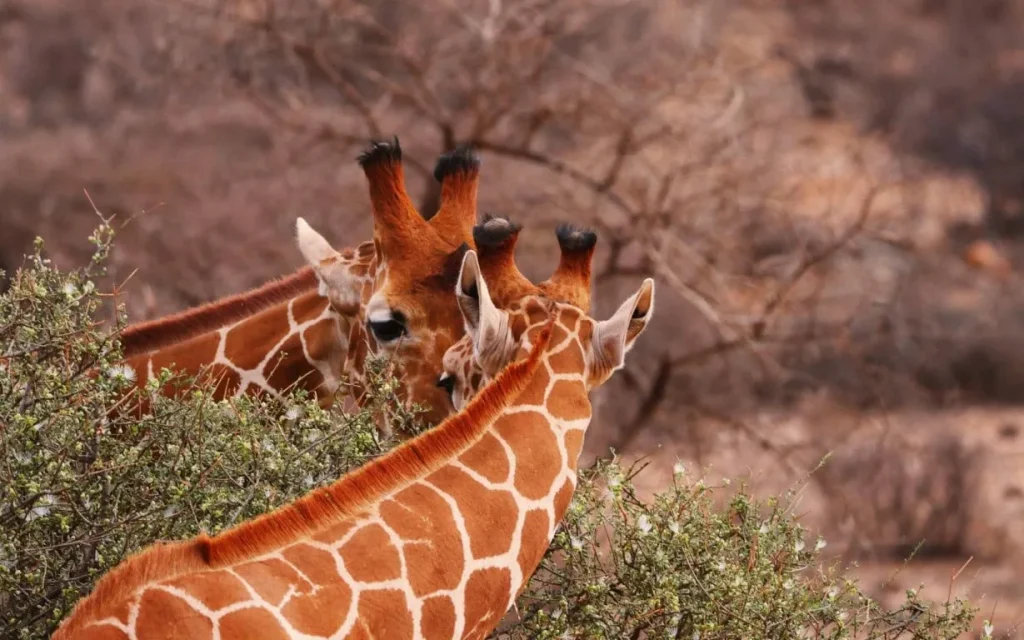
Reticulated giraffes have large, relatively regular reddish-brown patches separated by narrow pale lines, resembling a network of geometric shapes. This makes them comparatively easy to distinguish from Masai giraffes.
Where to See Reticulated Giraffes
Samburu National Reserve is one of the best-known destinations, and they also occur in other suitable northern Kenya landscapes and conservancies.
Why Visit Samburu?
Samburu offers opportunities to observe reticulated giraffes alongside Grevy’s zebras, gerenuks, Beisa oryx and Somali ostriches—animals collectively associated with the Samburu Special Five.
Conservation
Reticulated giraffes face pressures associated with habitat loss, fragmentation and other human-related threats. Conservation programmes in northern Kenya work to protect populations and their habitats.
3. Rothschild’s Giraffe
Rothschild’s giraffe is another distinctive giraffe form associated with conservation efforts in Kenya and is often discussed within the broader northern giraffe group.
Appearance
Rothschild’s giraffes have large coat patches separated by pale lines. One commonly noted identification feature is the relatively pale lower legs, although coat patterns vary among individuals and identification should consider multiple characteristics.
Where to See Rothschild’s Giraffes
Lake Nakuru National Park is one of the most recognised destinations, and the Giraffe Centre in Nairobi is also closely associated with conservation education involving Rothschild’s giraffes.
Conservation History
Rothschild’s giraffes have been the focus of important conservation initiatives. Translocations and habitat protection have contributed to efforts to establish and maintain populations. Visitors should understand that these programmes involve carefully managed conservation work rather than simply moving animals for tourism.
Masai, Reticulated and Rothschild’s Giraffes: How to Tell Them Apart
- Masai giraffe: Distinctive appearance: Irregular, jagged-edged patches. Important Kenya destinations: Masai Mara and southern Kenya.
- Reticulated giraffe: Distinctive appearance: Regular geometric patches with narrow pale lines. Important Kenya destinations: Samburu and northern Kenya.
- Rothschild’s giraffe: Distinctive appearance: Large patches and relatively pale lower legs. Important Kenya destinations: Lake Nakuru and conservation sites.
Coat patterns are useful, but they are not the only identifying feature. A knowledgeable guide can help visitors recognise differences.
Best Places to See Giraffes in Kenya
Masai Mara National Reserve
The Masai Mara is one of Kenya’s most rewarding wildlife destinations. Masai giraffes may be encountered browsing among scattered trees or moving across open grasslands. The reserve also supports lions, elephants, buffaloes, zebras and numerous antelopes, and giraffes can be especially attractive photographic subjects against the Mara’s expansive landscape.
Samburu National Reserve
Samburu National Reserve is one of the best destinations for observing reticulated giraffes. The dry northern landscape provides a distinctive backdrop, giraffes may browse along riverine woodland and other suitable habitats, and Samburu is particularly rewarding for travellers interested in northern Kenya wildlife.
Lake Nakuru National Park
Lake Nakuru National Park is an important destination for giraffe viewing. The park’s conservation history includes Rothschild’s giraffe populations, and visitors can combine giraffe observation with opportunities to see rhinos, buffaloes and other wildlife.
Nairobi Giraffe Centre
The Giraffe Centre in Nairobi is an educational and conservation attraction that provides opportunities to learn about giraffes and conservation. The experience differs from observing wild giraffes in a national park—visitors should approach it as a conservation education visit rather than a substitute for a wilderness safari.
Nairobi National Park
Nairobi National Park provides wildlife viewing close to Kenya’s capital. Giraffes may be encountered in suitable habitats, and the park offers an unusual opportunity to observe wildlife with Nairobi’s urban skyline in the distance.
Amboseli National Park
Amboseli National Park supports giraffes in suitable woodland and savannah habitats. However, elephants and views of Mount Kilimanjaro are the park’s most famous attractions, and giraffe sightings depend on habitat and local movements.
Tsavo Ecosystem
The wider Tsavo ecosystem supports giraffes in suitable habitats, and visitors may encounter them during game drives. The region’s red soils and varied landscapes create distinctive photographic settings.
Ol Pejeta Conservancy
Ol Pejeta Conservancy in Laikipia supports giraffes alongside rhinos, elephants and other wildlife and is particularly attractive for travellers interested in conservation-focused safaris.
How Tall Are Giraffes?
Giraffes are the tallest living land animals. Adult males may reach approximately 5–6 metres in height, while females are generally shorter. Their exceptional height allows them to browse leaves beyond the reach of many other herbivores, although height also creates challenges—giraffes must adopt an awkward posture to drink water from the ground.
Why Do Giraffes Have Long Necks?
The giraffe’s long neck is one of its most distinctive adaptations, allowing access to high vegetation and playing a role in interactions between males. Adult males sometimes engage in a behaviour known as necking, in which they swing their necks and strike one another to help establish dominance. Scientists have studied multiple evolutionary explanations for the giraffe’s long neck; feeding advantages and sexual selection are among the important factors discussed.
What Do Giraffes Eat?

Giraffes are browsers. They feed primarily on leaves, shoots and other plant material, and acacia and related trees are important food sources in many habitats. Their long tongues and specialised mouths help them select vegetation, and giraffes can feed among thorny branches with remarkable precision. Their diet varies according to habitat and season.
How Do Giraffes Drink Water?
Because of their height, giraffes must spread or bend their front legs and lower their heads to drink—a posture that can make them vulnerable to predators. Giraffes may obtain substantial moisture from the vegetation they consume, and their drinking frequency varies according to diet and environmental conditions. Visitors may occasionally observe giraffes drinking at waterholes.
How Fast Can Giraffes Run?
Despite their long legs and unusual proportions, giraffes can run surprisingly quickly, reaching speeds of around 50–60 kilometres per hour in short bursts. Their running motion is distinctive, with the front and hind legs on each side moving in coordinated patterns. Watching a giraffe run across open savannah is an impressive wildlife experience.
Do Giraffes Live in Herds?
Giraffes have flexible social systems. They may form loose groups whose membership changes over time—adult females and young animals may associate with one another, while adult males may travel alone or join different groups. Unlike some herd animals, giraffe groups do not always maintain fixed membership, and this flexible social organisation is an important aspect of giraffe behaviour.
How Do Giraffes Communicate?
Giraffes communicate through body posture, movement and other signals, and their interactions can be subtle. Researchers have also documented low-frequency vocalisations and other sounds, although giraffes are generally quieter than many familiar mammals. A safari guide may help visitors recognise social interactions that are easy to overlook.
Giraffe Breeding and Calves
Giraffes have a relatively long gestation period of approximately 15 months, and females generally give birth to a single calf. Newborn calves are already tall compared with many other mammals and must learn to stand and walk quickly. Young giraffes remain vulnerable to predators, and mothers may defend calves aggressively when threatened.
What Predators Hunt Giraffes?
Adult giraffes are large and powerful animals, and their kicks can be dangerous. However, lions may hunt giraffes, particularly when conditions favour an attack, and young calves are more vulnerable to predators such as lions and hyenas. Predation is part of the natural ecological relationship between giraffes and carnivores, and visitors should never interfere with these interactions.
Why Are Giraffes Important to the Ecosystem?
Giraffes influence vegetation through browsing at heights inaccessible to many other herbivores. Their movements can contribute to seed dispersal, and they also form part of the food web. Protecting giraffes therefore helps maintain wider ecological processes.
Best Time to See Giraffes in Kenya
Giraffes can be observed throughout the year—they do not have a single migration season comparable to wildebeest, although rainfall affects vegetation and wildlife distribution.
January to March
These months are often warm and relatively dry, and giraffe viewing can be rewarding.
April to May
Rainfall may produce fresh vegetation, though road conditions can become muddy.
June to October
These months are popular for Kenya safaris, and wildlife viewing is often productive.
November to December
Short rains may influence feeding patterns; giraffes remain present in suitable habitats.
Giraffe Photography Tips
Use the Landscape
Giraffes are particularly attractive when photographed within their natural surroundings. A wide composition can show their height against trees or open plains.
Photograph at Eye Level Where Possible
A lower camera angle can emphasise the animal’s height, but photographers should remain within authorised viewing areas and follow guide instructions.
Watch for Behaviour
Look for browsing, social interactions and movement. A giraffe feeding among acacia branches can make a more interesting photograph than a stationary portrait.
Use a Telephoto Lens
A telephoto lens helps capture facial details and coat patterns without approaching too closely.
Avoid Cutting Off the Head or Legs
Giraffes are unusually tall—check the framing carefully, as a vertical composition is often effective.
Giraffe Conservation in Kenya
Giraffes face several conservation challenges, including habitat loss and fragmentation, agricultural expansion and fencing that may interfere with movement, illegal hunting and other human pressures, and climate variability that may influence vegetation and water availability. Conservation programmes work with protected-area managers, researchers and local communities.
Community Conservation and Giraffes
Many giraffe populations occur outside national parks, so community conservancies play an important role. Protecting wildlife corridors and maintaining suitable habitat can support giraffe movement, and tourism can provide economic incentives for conservation when benefits reach local communities. Responsible safari operators should respect conservation regulations and local land-use arrangements.
Responsible Giraffe Viewing
Responsible viewing allows animals to behave naturally. In practice:
- Do not approach giraffes too closely.
- Avoid blocking their movement.
- Do not feed wild giraffes.
- Remain inside the vehicle unless your guide confirms that leaving is permitted.
- Avoid loud noises and sudden movements.
- Never encourage a giraffe to run for photographs.
Giraffe Safaris for Families
Giraffes are particularly popular with children because of their unusual appearance. A family safari can combine giraffe viewing with opportunities to see elephants, zebras and other wildlife; shorter game drives may be more comfortable for young children, and a private safari vehicle provides flexibility. The Giraffe Centre in Nairobi may also offer an educational experience, subject to current visitor arrangements.
Suggested Five-Day Kenya Giraffe Safari
Day 1: Nairobi Arrival
Arrive in Nairobi, transfer to your hotel, and depending on arrival time, visit the Giraffe Centre or relax.
Day 2: Nairobi to Lake Nakuru
Travel through the Rift Valley to Lake Nakuru, enjoy an afternoon game drive, and look for giraffes, rhinos and other wildlife.
Day 3: Lake Nakuru to Masai Mara
Travel towards the Masai Mara, enjoy an afternoon game drive if time permits, and look for Masai giraffes and other savannah animals.
Day 4: Full-Day Masai Mara Safari
Explore the reserve, observe giraffes browsing and moving through the landscape, and look for lions, elephants, buffaloes and other wildlife.
Day 5: Return to Nairobi
Enjoy breakfast and a final activity if time permits, travel back to Nairobi, and note that travellers particularly interested in reticulated giraffes should consider adding Samburu.
Suggested Northern Kenya Giraffe Safari
A northern Kenya itinerary can focus on reticulated giraffes. Begin in Nairobi and travel to Ol Pejeta, continue to Samburu for two or three nights, and explore suitable habitats in search of reticulated giraffes and other northern species. Return to Nairobi or continue to another destination. This itinerary is especially attractive to wildlife photographers and travellers interested in species identification.
Frequently Asked Questions About Giraffes in Kenya
What types of giraffes are found in Kenya?
Kenya is associated with Masai, reticulated and Rothschild’s giraffes.
Where is the best place to see giraffes?
The Masai Mara, Samburu and Lake Nakuru are among the important destinations.
Where can I see reticulated giraffes?
Samburu and other northern Kenya habitats are particularly suitable.
Where can I see Rothschild’s giraffes?
Lake Nakuru and certain conservation sites are well-known locations.
How tall are giraffes?
Adult males may reach approximately 5–6 metres.
What do giraffes eat?
They primarily browse leaves, shoots and other vegetation.
Are giraffes dangerous?
Giraffes are wild animals and can defend themselves with powerful kicks. Visitors should maintain appropriate distances.
Can I see giraffes throughout the year?
Yes. Giraffes can be observed year-round in suitable habitats.
Book a Giraffe Safari in Kenya
Giraffes in Kenya are among the country’s most fascinating wildlife attractions. From Masai giraffes in the Mara to reticulated giraffes in Samburu and Rothschild’s conservation populations around Lake Nakuru, Kenya offers exceptional opportunities to observe these remarkable animals. At Safari Trips to Kenya, we arrange private and group wildlife safaris designed around your interests—contact our team with your preferred travel dates, number of guests and destinations to plan a personalised Kenya giraffe and wildlife safari.