
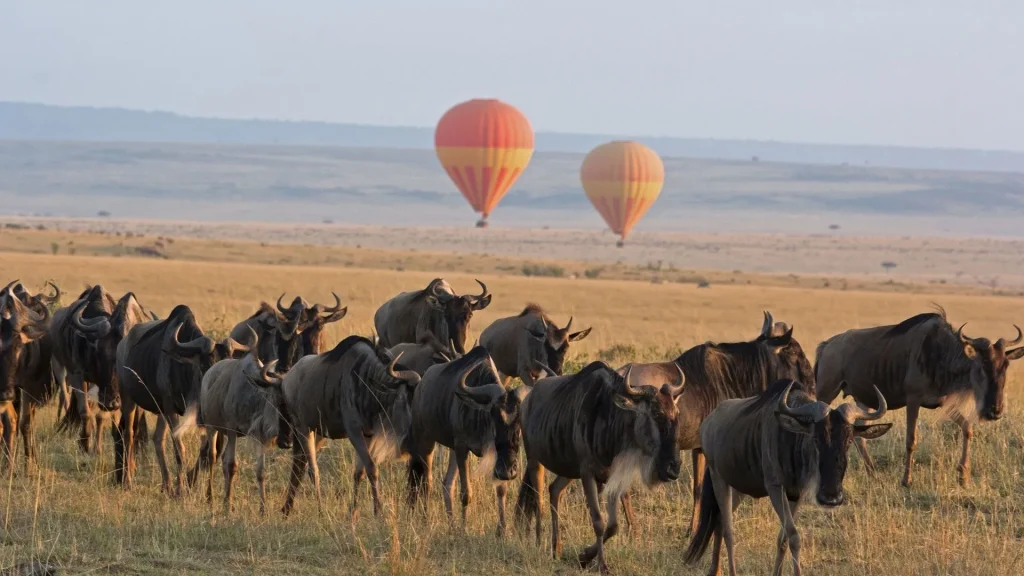
Masai Mara Hot Air Balloon Safari
A Masai Mara Hot Air Balloon Safari offers one of the most memorable ways to experience Kenya's famous savannah landscape. Instead of viewing the ecosystem only from a 4×4 vehicle, travelers rise above the plains in the early morning and watch the Masai Mara unfold below from the air. From this elevated perspective, the landscape looks completely different.
You may see:
- Long lines of wildebeest moving across the grasslands.
- Zebra herds spreading across open plains.
- Elephants walking between feeding areas.
- Giraffes moving through scattered acacia trees.
- Hippo pools and winding rivers.
- Safari vehicles appearing tiny below.
- Sunrise light spreading across the Mara.
- Predator territories stretching over vast distances.
- Seasonal migration herds when they are in the area.
The experience is not primarily about flying directly over large animals at low level. A balloon safari is about appreciating the scale, shape and rhythm of the greater Masai Mara ecosystem. It is also one of the most popular premium safari activities in Kenya, especially for:
- Honeymooners.
- Couples.
- Families with older children.
- Photographers.
- First-time safari travelers.
- Great Migration visitors.
- Travelers celebrating special occasions.
A balloon safari normally begins before sunrise, involves a road transfer to the launch site, a safety briefing, inflation of the balloon, an early morning flight, landing and often a celebratory breakfast afterward. Because the activity depends on weather, location, flight rules and available operators, it should be planned carefully.
This detailed guide explains what to expect from a Masai Mara Hot Air Balloon Safari, how the experience works, what wildlife you may see, best seasons, safety, costs, what to wear, photography tips, migration viewing and how to decide whether a balloon safari is worth adding to your Kenya itinerary. Individual species, river crossings and mountain views can never be guaranteed.
What Is a Masai Mara Hot Air Balloon Safari?
A hot air balloon safari is an early-morning aerial wildlife and landscape experience conducted over an authorized section of the greater Masai Mara ecosystem. Passengers travel in a large basket beneath a hot air balloon. The pilot controls altitude using heat inside the balloon, while the wind largely determines horizontal movement, which makes every flight slightly different.
Unlike a helicopter or airplane, a balloon moves relatively quietly and smoothly, and the experience can feel surprisingly peaceful once airborne. Most travelers describe three particularly striking elements:
- The silence.
- The enormous scale of the landscape.
- The quality of sunrise light.
Why Take a Hot Air Balloon Safari in the Masai Mara?
Game drives are the foundation of a Masai Mara safari, but a balloon flight provides a perspective that a vehicle cannot. From the ground, wildlife encounters feel close and detailed. From the air, you understand the larger ecological picture. You can see:
- How herds spread across the plains.
- How rivers cut through the landscape.
- How different habitats connect.
- How roads and camps sit within the ecosystem.
- How enormous the Masai Mara really is.
This contrast is what makes ballooning valuable. It should be seen as a complement to game drives rather than a replacement for them.
What Happens on a Typical Balloon Safari?
Although schedules vary by operator, the experience commonly follows a similar pattern.
Very Early Morning Pickup
Guests are collected from their camp or lodge before dawn, often while it is still completely dark. The exact time depends on:
- Distance from the launch site.
- Sunrise time.
- Road conditions.
- Camp location.
Travelers should expect a shorter night's sleep than usual.
Transfer to the Launch Site
The drive to the balloon launch area can itself be interesting, and nighttime or pre-dawn wildlife may occasionally be encountered. Guests should remain inside the safari vehicle unless directed otherwise.
Safety Briefing
At the launch site, the pilot or crew explains:
- Boarding procedures.
- Landing position.
- Safety rules.
- What to do during takeoff.
- What to do during landing.
Passengers should listen carefully.
Balloon Inflation
The balloon envelope is laid out on the ground and large fans begin filling it with air. The burners then heat the air inside, and as the balloon rises upright, the basket moves into position. This inflation process can be visually impressive. Photographers may want their cameras ready, but safety instructions take priority.
Boarding
Guests climb into the basket according to crew instructions. Some baskets are divided into compartments to distribute weight and improve passenger stability.
Takeoff
The balloon gradually becomes buoyant and lifts away from the ground. Takeoff is often smoother than first-time passengers expect, and within moments the launch vehicles and crew begin shrinking below.
Sunrise Flight
The flight usually takes place around sunrise. The balloon may travel at different altitudes during the journey, sometimes rising higher for broad panoramic views and at other moments flying lower when conditions permit. The pilot continuously assesses:
- Wind.
- Terrain.
- Wildlife.
- Obstacles.
- Landing options.
- Aviation requirements.
Landing
The landing location depends on wind direction. Balloon crews track the flight from the ground and travel toward the expected landing area, while guests follow the pilot's instructions for landing position. Landings can range from very gentle to slightly bumpy depending on conditions.
Post-Flight Breakfast
Many Masai Mara balloon experiences include a breakfast after landing. Depending on the operator, this may be arranged in a scenic bush location. The meal can become part of the experience and may include:
- Coffee.
- Tea.
- Juice.
- Fruit.
- Bread or pastries.
- Eggs.
- Other breakfast dishes.
Some operators also include a celebratory drink. After breakfast, guests usually continue by vehicle back to camp or proceed directly into a game drive.
How Long Does a Masai Mara Balloon Safari Last?
The actual flight is commonly around one hour, though exact duration depends on wind and landing conditions. The entire activity takes much longer because it includes:
- Camp pickup.
- Road transfer.
- Safety briefing.
- Balloon preparation.
- Flight.
- Landing.
- Breakfast.
- Return transfer.
Travelers should generally treat it as a half-morning experience. Your safari itinerary should not schedule another rigid activity immediately afterward.
What Time Does the Balloon Safari Start?
Balloon flights normally take place early in the morning because dawn often provides the most suitable atmospheric conditions, and guests may be collected well before sunrise. Morning air is often:
- Cooler.
- More stable.
- Less turbulent.
These conditions can be better for balloon operations than hotter parts of the day. The sunrise also provides exceptional scenery and photography.
Why Balloon Flights Are Usually at Sunrise
There are practical and visual reasons.
More Stable Air
Balloon pilots prefer stable wind conditions. As the ground heats later in the day, rising warm air can create stronger thermal activity.
Better Wildlife Activity
Early morning is often one of the best periods for observing wildlife movement. Predators may still be active, and herbivores are often feeding.
Better Photography Light
Sunrise produces:
- Golden light.
- Long shadows.
- Soft contrast.
- Beautiful landscape colors.
This is one reason balloon flights are particularly attractive to photographers.
What Wildlife Can You See From a Balloon?
The wildlife varies according to:
- Flight route.
- Season.
- Herd movements.
- Altitude.
- Habitat.
- Wind direction.
Potential sightings include:
- Wildebeest.
- Zebras.
- Elephants.
- Giraffes.
- Buffaloes.
- Antelopes.
- Hippos.
- Hyenas.
- Lions.
- Other predators.
- Numerous birds.
However, passengers should keep expectations realistic. A balloon is not a precision wildlife vehicle. The pilot cannot simply steer directly toward a lion or elephant herd the way a safari driver might, because wind determines much of the route.
Can You See Lions From a Balloon?
Sometimes. Lions may be visible if the flight passes over or near suitable areas, but spotting them from the air can be more difficult than expected, as large animals can appear surprisingly small against the enormous landscape. Experienced pilots may point out wildlife where practical, but this is not guaranteed. Ballooning is more about landscape and herd scale than close predator portraits.
Can You See Elephants?
Elephants can sometimes be particularly easy to identify from above because of their size and group structure, and seeing a family herd moving across the savannah can be spectacular. From the air, travelers may also appreciate how elephants use:
- Grasslands.
- Woodland.
- River corridors.
- Seasonal water areas.
Can You See the Great Migration From a Balloon?
Yes, if the flight route passes over areas where large migration herds are concentrated. This can be one of the most impressive ways to understand the scale of the Great Wildebeest Migration. From ground level, large herds are already extraordinary, and from the air the numbers can become even more striking. You may see:
- Wildebeest lines stretching across plains.
- Zebra groups mixed among the herds.
- Trails formed by repeated animal movement.
- Dust rising behind moving animals.
- Predator territories surrounding herd concentrations.
However, migration sightings are never guaranteed. The herds move naturally according to:
- Rain.
- Grass.
- Water.
- Seasonal conditions.
The balloon itself also follows wind direction.
Is the Balloon Safari Good for Mara River Crossings?
Travelers should not book a balloon safari specifically expecting to fly over a river crossing. River crossings are unpredictable, and the balloon route is also controlled by wind. It is theoretically possible to see animals near rivers during a migration flight, but no operator can guarantee a crossing from the air. If river crossings are your primary goal, traditional vehicle-based game drives remain essential.
Best Time for a Masai Mara Hot Air Balloon Safari
Balloon safaris can operate during much of the year when weather and operational conditions permit. The best season depends on your priorities.
July to October
This is the most famous period because of the Great Migration. Potential advantages include:
- Large wildebeest herds.
- Zebra concentrations.
- Dry-season landscapes.
- Excellent wildlife density.
- Strong visibility.
Disadvantages include:
- Higher demand.
- Higher overall safari costs.
- Limited balloon availability.
- More visitors.
Advance booking is strongly recommended.
January to February
These months can offer excellent resident wildlife and generally drier conditions. The main migratory herds are usually farther south in the Serengeti ecosystem, but the Masai Mara remains excellent for resident wildlife.
March to May
The wetter season creates:
- Green landscapes.
- Dramatic clouds.
- Strong photographic scenery.
- Lower visitor numbers.
However, weather can affect flight operations.
June
June can be beautiful because landscapes may remain relatively green while conditions begin drying.
November to December
Short rains can refresh the ecosystem, and green scenery can make aerial photography particularly attractive.
Which Month Is Best?
There is no single best month. Choose:
- July–October for migration potential.
- January–February for excellent resident wildlife and drier conditions.
- Green season for lush landscapes and fewer visitors.
Is Ballooning Available Every Day?
Not necessarily. Balloon operations depend on:
- Wind.
- Weather.
- Visibility.
- Safety conditions.
- Aviation requirements.
Flights may be canceled if conditions are unsuitable. Safety should always come before the itinerary.
What Happens if the Balloon Flight Is Canceled?
Policies vary by operator. Possible arrangements may include:
- Rebooking for another morning.
- Refund according to operator policy.
- Alternative arrangement.
Travelers should confirm cancellation terms before booking. If ballooning is important to you, consider scheduling it before your final morning in the Mara. This creates at least some possibility of rescheduling if weather causes cancellation.
How Safe Is a Masai Mara Balloon Safari?
Balloon safaris operated by professional companies use trained pilots and established safety procedures. Safety depends on:
- Pilot experience.
- Weather assessment.
- Equipment maintenance.
- Passenger compliance.
- Aviation regulations.
Guests should always follow crew instructions.
Who Should Not Take a Balloon Safari?
Ballooning may not be suitable for everyone. Travelers should discuss concerns with the operator if they have:
- Significant mobility limitations.
- Recent surgery.
- Severe back problems.
- Certain medical conditions.
- Pregnancy.
- Difficulty climbing into a basket.
Landing can sometimes be bumpy, and passengers must usually be able to follow the landing position correctly.
Is a Balloon Safari Suitable for Children?
Minimum age requirements vary by operator. Very young children are usually not suitable because:
- Basket walls can be relatively high.
- Children must follow safety instructions.
- Landings can be physical.
- The pre-dawn schedule is demanding.
Families should confirm minimum age and height rules before booking.
Is a Balloon Safari Suitable for Older Travelers?
Many older travelers participate successfully. The main physical considerations are:
- Climbing into the basket.
- Standing during the flight.
- Assuming landing position.
- Handling a potentially bumpy landing.
Travelers with mobility issues should ask detailed questions before paying.
What Is the Balloon Basket Like?
Balloon baskets are generally made from strong woven materials designed to absorb landing energy. Larger safari balloons may have baskets divided into separate passenger compartments, which helps distribute weight. Passengers generally stand for the flight, and there may not be conventional seats.
How High Does the Balloon Fly?
Altitude changes during the flight. At some points the balloon may travel relatively low, subject to safe operating procedures. At others, it may climb higher to take advantage of different wind directions or provide broader views. Pilots use altitude strategically because wind can move differently at different levels.
Can a Hot Air Balloon Be Steered?
Not in the same way as an airplane. The pilot controls vertical movement by heating or allowing the balloon to cool, and by moving between different altitudes can sometimes take advantage of winds traveling in different directions. But horizontal control remains limited compared with powered aircraft, which is why the landing point cannot be fixed in advance.
What Happens During Landing?
The pilot will explain landing procedures before takeoff. Passengers may be instructed to:
- Face a particular direction.
- Hold internal handles.
- Bend knees.
- Remain inside the basket until told to leave.
In some conditions, the basket may touch down and stop gently. In others, it may tip or drag slightly before stopping. This is normal balloon operation.
What Should You Wear?
Wear practical safari clothing. Early morning can be cold before takeoff, so useful clothing includes:
- Long trousers.
- Closed shoes.
- Shirt.
- Fleece.
- Light jacket.
- Hat.
Once the burners begin operating and the sun rises, conditions may feel warmer, so layering works best.
What Shoes Should You Wear?
Wear sturdy, closed shoes. Avoid:
- High heels.
- Loose sandals.
- Flip-flops.
The launch and landing areas can be:
- Grassy.
- Uneven.
- Dusty.
- Damp.
Comfortable walking shoes are ideal.
Should You Wear a Hat?
A hat can be useful because of the heat from balloon burners, and a securely fitting safari hat may also protect from sun after landing. Avoid loose hats that could blow away.
What Should You Bring?
Keep belongings minimal. Useful items include:
- Camera.
- Phone.
- Sunglasses.
- Small binoculars.
- Light jacket.
- Personal medication.
Large backpacks can be inconvenient, so ask the operator about baggage restrictions.
Photography on a Masai Mara Balloon Safari
Balloon flights provide excellent opportunities for landscape photography. Potential subjects include:
- Sunrise.
- Herd patterns.
- Mara rivers.
- Acacia-dotted plains.
- Balloon shadow.
- Wildlife groups.
- Distant escarpments.
- Other balloons.
Best Camera Lens for Balloon Photography
A combination of focal lengths is useful.
Wide-Angle Lens
Excellent for:
- Landscapes.
- Sunrise.
- Balloon basket context.
- Large herds.
Mid-Range Zoom
Useful for:
- Wildlife.
- Herd patterns.
- Rivers.
- Isolated trees.
Very large telephoto lenses can be cumbersome inside the basket, so a versatile zoom is often more practical.
Phone Photography
Modern smartphones can produce excellent aerial images. Advantages include:
- Lightweight.
- Easy handling.
- Wide field of view.
- Video capability.
Secure the phone carefully and avoid leaning over the basket dangerously.
Camera Safety
Use:
- Wrist strap.
- Neck strap.
- Secure camera grip.
Do not place loose equipment on basket edges, as objects dropped from the balloon can be dangerous.
Video From the Balloon
Video can be very effective because balloon flight is generally smooth. Try recording:
- Takeoff.
- Sunrise.
- Wide herd movement.
- Balloon shadow.
- Landing preparation from a safe position.
Always follow pilot instructions.
Drones and Balloon Safaris
Do not assume you can fly a drone from or near a balloon. Drone use in wildlife areas is heavily controlled and may be prohibited. Unauthorized drones can:
- Disturb wildlife.
- Interfere with aircraft.
- Create safety risks.
Follow all current aviation and protected-area regulations.
Masai Mara Balloon Safari Cost
A Masai Mara Hot Air Balloon Safari is a premium optional activity and usually costs substantially more than a standard game drive. The price can reflect:
- Specialized aircraft.
- Pilot.
- Ground crew.
- Fuel.
- Tracking vehicles.
- Permits.
- Insurance.
- Breakfast.
- Transfers.
Exact prices change over time and differ by operator, so travelers should request current pricing when booking.
Is the Balloon Safari Included in a Masai Mara Package?
Usually not. Most general safari packages include:
- Accommodation.
- Game drives.
- Meals.
- Park fees where stated.
Ballooning is normally treated as an optional extra because of its high cost. Luxury packages occasionally include it, but this should be confirmed.
Is the Balloon Safari Worth the Cost?
For many travelers, yes—especially if it is their first visit to the Masai Mara or they are celebrating a special occasion. It can be particularly worthwhile for:
- Honeymooners.
- Photographers.
- Migration travelers.
- Couples.
- Families with older children.
- Travelers who enjoy unique experiences.
However, it should not replace essential game drives. If your budget forces you to choose between one balloon flight and enough days of proper wildlife game drives, the game drives should usually take priority.
Balloon Safari vs Game Drive
The two experiences are fundamentally different.
Balloon Safari
Best for:
- Landscape scale.
- Sunrise.
- Aerial herd patterns.
- Special occasion.
- Unique perspective.
Game Drive
Best for:
- Close wildlife viewing.
- Detailed animal behavior.
- Predator tracking.
- Photography flexibility.
- River-crossing searches.
A well-designed Masai Mara itinerary includes both if the budget allows.
Balloon Safari vs Fly-In Safari
These are also different. A domestic safari flight is primarily transportation, while a balloon safari is an experience. Even travelers who fly into the Mara may still enjoy a balloon flight because the altitude, pace and route are completely different.
Balloon Safari During the Great Migration
Migration season can be exceptionally rewarding. From the air you may appreciate how migration changes the entire ecosystem, with large herds appearing as:
- Dark moving masses.
- Long animal lines.
- Scattered grazing groups.
- Tracks carved across the grassland.
Predators may also be present, although they are much harder to spot from altitude.
Balloon Safari Outside Migration Season
It is still highly worthwhile. Resident wildlife remains abundant, and the lack of enormous migration herds can allow travelers to appreciate:
- Landscapes.
- Elephant groups.
- Giraffes.
- Rivers.
- Smaller resident herds.
Green-season scenery can be particularly attractive.
Balloon Safari for Honeymooners
A balloon flight is one of the most popular honeymoon upgrades in the Masai Mara. It combines:
- Early morning adventure.
- Sunrise.
- Scenic flight.
- Breakfast.
- Shared memorable experience.
Couples may combine it with:
- Private game drive.
- Sundowner.
- Bush dinner.
- Luxury tented camp.
Balloon Safari for Families
Older children may find ballooning extremely exciting. Families should check:
- Minimum age.
- Minimum height.
- Safety requirements.
- Pickup time.
Parents should also consider whether children are comfortable standing for an extended period.
Balloon Safari for Photographers
Photographers should strongly consider the activity because it provides imagery that cannot be captured from a vehicle. Useful subjects include:
- Geometric herd patterns.
- River bends.
- Layered landscapes.
- Sunrise silhouettes.
- Animal trails.
However, serious photographers should avoid carrying too much equipment inside the basket.
Balloon Safari for Solo Travelers
Solo travelers can join scheduled flights, and there is generally no need to charter an entire balloon. This makes ballooning one of the easier premium activities for solo safari guests to add.
Balloon Safari for Groups
Groups can also book together, subject to basket capacity. Larger private groups should book early, particularly during:
- August.
- September.
- Christmas.
- New Year.
Best Camps for a Balloon Safari
The best accommodation depends partly on proximity to the balloon operator's pickup zone. Before booking, ask:
- Does this camp offer balloon transfers?
- Which balloon operator serves the area?
- What is the pickup time?
- How long is the transfer?
- Is return transfer included?
- Can the balloon safari be combined with a game drive afterward?
A camp very far from the launch area may require an extremely early pickup.
Where Do Balloons Fly in the Masai Mara?
Flight zones depend on licensed operators, launch sites, wind and current operational conditions. Not every balloon flies over the exact same part of the Masai Mara, and the route can change daily. This should be understood as an advantage rather than a disadvantage because every flight becomes unique.
Can You Choose the Flight Route?
No, passengers do not choose the exact route. The pilot works with:
- Wind direction.
- Wind speed.
- Airspace.
- Terrain.
- Safety.
You can choose a balloon operator and launch area, but not an exact wildlife target.
How Far in Advance Should You Book?
During peak season, book well in advance. This is especially important for:
- July.
- August.
- September.
- October.
- Christmas.
- New Year.
Balloon capacity is limited, and waiting until arrival can lead to disappointment.
Should You Book the Balloon for Your First Morning?
Not always. If you arrive late the previous evening after a long road journey, the extremely early wake-up may be tiring. A better strategy can be:
- Day 1: Arrive.
- Day 2: Normal game drives.
- Day 3: Balloon safari.
- Day 4: Continue wildlife viewing.
However, weather risk should also be considered. Do not automatically leave ballooning until your final morning if no rescheduling opportunity would remain.
What Happens After Breakfast?
Depending on your itinerary, you may:
- Return to camp.
- Join your guide for a game drive.
- Continue a full-day safari.
- Rest during midday.
One efficient strategy is to combine the balloon experience with a morning or full-day game drive afterward.
Can You Combine Ballooning With a Full-Day Game Drive?
Yes, depending on logistics. This can be an excellent use of time for wildlife enthusiasts. A possible schedule is:
- Pre-dawn: Camp pickup.
- Sunrise: Balloon flight.
- Morning: Bush breakfast.
- Late morning onward: Meet safari guide and continue wildlife viewing.
- Afternoon: Picnic lunch and continued game drive.
- Evening: Return to camp.
This creates a long but memorable safari day.
Can You Combine Ballooning With a Sundowner?
Yes. However, remember that the day begins extremely early, and a full balloon, game-drive and sundowner schedule can be tiring. Travelers should balance experiences with rest.
Balloon Safari During the Rainy Season
Rain itself does not necessarily mean every flight is canceled. However, certain weather conditions can make flying unsuitable, and operations depend on pilot judgment. The green season can provide extraordinary aerial scenery when flights operate. Advantages include:
- Bright green plains.
- Dramatic clouds.
- Fewer tourists.
- Beautiful light.
What If You Are Afraid of Heights?
Ballooning can feel different from standing on a high building. Because the basket moves with the air and there is no fixed structure beside you, some people find the experience surprisingly comfortable. However, reactions vary, and travelers with severe height anxiety should consider whether they will enjoy the experience before booking a non-refundable activity.
Is Ballooning Scary?
Most of the flight is calm and takeoff is generally smooth. The most physical part can be landing. First-time passengers often feel nervous before takeoff and relaxed once airborne.
Is There Much Motion Sickness?
Balloon flight typically involves less of the rapid movement associated with small aircraft. Because the balloon travels with the wind, there may be relatively little sensation of speed. Travelers prone to motion sickness should still seek appropriate personal medical advice.
Is the Balloon Noisy?
The landscape can be very quiet during periods when the burner is not operating, while the burner itself produces a loud burst of sound when used. This contrast between the burner and the silence afterward is part of the experience.
Can Balloons Disturb Wildlife?
Responsible operators maintain appropriate altitude and follow wildlife and aviation regulations. Pilots should avoid deliberately harassing animals, and wildlife welfare should remain a priority.
Responsible Balloon Tourism
Choose operators that demonstrate:
- Professional safety standards.
- Trained pilots.
- Responsible wildlife conduct.
- Proper waste management.
- Respect for local communities.
- Legal operating permissions.
Balloon tourism should add value without creating unnecessary ecological disturbance.
What About Community Land?
Some balloon routes may cross broader community or conservancy landscapes depending on operating areas and wind. Tourism in the greater Mara exists alongside local communities and landowners, and responsible safari development should ensure local benefits and appropriate land-use agreements.
How Ballooning Changes Your View of the Mara
One of the greatest benefits is conceptual. On game drives, travelers often think in terms of individual sightings. From the balloon, you begin seeing:
- Ecosystem scale.
- Habitat connectivity.
- Wildlife movement.
- River systems.
- Human infrastructure.
This can deepen appreciation for conservation. The Masai Mara is not simply a collection of lions, elephants and wildebeest; it is a landscape.
Best Time of Year for Balloon Photography
Dry Season
The dry season provides:
- Golden grass.
- Dust.
- Strong contrast.
- Migration possibilities.
Green Season
The green season provides:
- Rich color.
- Dramatic clouds.
- Fresh vegetation.
- Softer landscapes.
Both can be excellent.
Sunrise Balloon Photography Tips
To improve images:
- Prepare camera settings before takeoff.
- Use a fast enough shutter speed.
- Avoid excessive zoom.
- Include landscape context.
- Watch the changing direction of light.
- Photograph shadows and patterns.
- Take both wide and close compositions.
Most importantly, do not spend the entire flight staring through a screen. Look around.
Common Balloon Safari Mistakes
- Booking too late: Peak-season flights may sell out.
- Bringing too much equipment: Large camera bags become inconvenient.
- Wearing inappropriate shoes: Landing areas can be rough.
- Ignoring safety instructions: Always follow the pilot.
- Expecting a river crossing: No wildlife event can be guaranteed.
- Treating the flight as a substitute for game drives: It complements them.
- Booking an impossible schedule: Allow enough time after the activity.
Sample Balloon Safari Morning
A sample itinerary might look like the following, although exact times vary considerably.
- 4:30–5:00 a.m.: Wake up and prepare.
- Before dawn: Vehicle pickup from camp.
- Pre-sunrise: Reach launch site and attend safety briefing.
- Around sunrise: Take off.
- Next hour: Fly over the Mara landscape.
- Morning: Land and transfer to breakfast.
- Later morning: Continue on a game drive or return to camp.
How Many Nights Should You Stay if Ballooning?
A minimum 3-night Masai Mara stay is ideal if you want to include ballooning without making the itinerary feel rushed. Four nights is even better because you can combine:
- Multiple game drives.
- Balloon safari.
- Relaxation.
- Migration exploration where relevant.
2-Night Masai Mara With Balloon Safari
Possible, but quite compressed. For example:
- Day 1: Arrive and afternoon drive.
- Day 2: Balloon safari + game drive.
- Day 3: Morning game drive and departure.
This works, but leaves little room for weather disruption.
3-Night Masai Mara With Balloon Safari
More comfortable. For example:
- Day 1: Arrival and afternoon game drive.
- Day 2: Morning and afternoon game drives.
- Day 3: Balloon safari and continued wildlife viewing.
- Day 4: Final drive and departure.
This gives better balance.
4-Night Masai Mara With Balloon Safari
Excellent for serious wildlife travelers. You gain:
- More game drives.
- More flexibility.
- Better migration opportunities.
- Less pressure if weather affects ballooning.
Balloon Safari Combined With Siana
Travelers staying around Siana may be able to include a balloon safari depending on the operating zone and transfer logistics. Ask specifically:
- What is the pickup time from Siana?
- Which launch site is used?
- How long is the road transfer?
- Is transport included?
- Where will you meet your safari guide afterward?
The answer depends on your exact camp.
Balloon Safari Combined With Mara Conservancies
Many broader Mara itineraries combine the national reserve with nearby conservancies. Balloon availability and launch arrangements vary by area, so your safari operator should coordinate the activity with the correct camp and operator.
Balloon Safari and Lake Naivasha
A longer Kenya itinerary might combine Lake Naivasha + Masai Mara + balloon safari. This creates a contrast between:
- Freshwater scenery.
- Boat experiences.
- Mara wildlife.
- Aerial safari.
Balloon Safari and Amboseli
A strong Kenya itinerary could include Amboseli + Masai Mara + balloon safari. This combines:
- Kilimanjaro landscapes.
- Elephant viewing.
- Mara predators.
- Great Migration opportunities.
- Aerial scenery.
Balloon Safari and Lake Nakuru
Combining the Mara with Lake Nakuru can add:
- Rhinos.
- Different habitats.
- Birdlife.
- Lake scenery.
A balloon safari then provides another distinct style of wildlife experience.
Balloon Safari and the Kenya Coast
A classic honeymoon or luxury itinerary might combine Masai Mara + hot air balloon + Diani Beach. This provides:
- Wildlife.
- Sunrise adventure.
- Romantic safari atmosphere.
- Indian Ocean relaxation.
Who Gets the Most Value From Ballooning?
The activity is particularly valuable for travelers who:
- Have never ballooned before.
- Want an iconic Masai Mara experience.
- Enjoy photography.
- Appreciate landscapes.
- Are visiting during migration season.
- Are celebrating a special event.
Travelers with very limited budgets may reasonably prioritize extra safari nights instead.
Should You Balloon on Your First Kenya Safari?
If your budget allows, yes. The experience is unique and complements ground-level safari exceptionally well. However, make sure the core safari already includes enough:
- Game drives.
- Nights in the Mara.
- Good guiding.
Ballooning should be an enhancement rather than the foundation.
Frequently Asked Questions About Masai Mara Hot Air Balloon Safaris
What is a Masai Mara Hot Air Balloon Safari?
It is an early-morning scenic flight over part of the Masai Mara ecosystem in a hot air balloon, often followed by breakfast.
How long is the flight?
The actual flight is commonly around an hour, although duration varies according to conditions.
What time does it start?
Very early, usually before sunrise.
Why are flights at sunrise?
Morning conditions are often more suitable for ballooning, and sunrise provides excellent wildlife activity and photography light.
Can I see wildlife from the balloon?
Yes. Potential sightings include wildebeest, zebras, elephants, giraffes, buffaloes, antelopes and sometimes predators.
Can I see the Great Migration?
Potentially, if migration herds are in the flight area. This cannot be guaranteed.
Can I see a Mara River crossing?
It is possible to see wildlife near rivers, but a crossing cannot be predicted or guaranteed from a balloon.
Is ballooning safe?
Professional operators follow aviation and safety procedures. Passengers must follow pilot instructions.
Can children participate?
Minimum age and height policies vary by operator. Check before booking.
Can pregnant travelers participate?
Operators may restrict participation during pregnancy because landings can be bumpy. Confirm directly before booking.
Is there seating?
Passengers usually stand in divided basket compartments during the flight.
Is the landing rough?
It can occasionally be bumpy. The pilot will explain the correct landing position.
What should I wear?
Wear layered safari clothing and closed shoes.
Can I bring a camera?
Yes. Secure it carefully with a strap.
Is breakfast included?
Many balloon safari packages include a post-flight breakfast, but exact inclusions vary.
Is the activity included in standard safari prices?
Usually not. Ballooning is generally an optional premium activity.
Is it worth the cost?
For many travelers, yes, particularly for a first safari, honeymoon, special occasion or migration journey.
What if the weather is bad?
The operator may cancel the flight for safety reasons. Rebooking or refund policies vary.
When should I book?
Book early during peak migration months and festive periods.
Is July good for ballooning?
Yes. July can offer excellent dry-season landscapes and possible migration activity.
Is August good?
Yes. August is particularly popular because large migration herds are often in the wider Mara ecosystem.
Is September good?
Yes. September commonly offers strong wildlife concentrations and dry conditions.
Is ballooning worthwhile outside migration season?
Absolutely. The resident wildlife and Mara landscapes remain impressive throughout the year.
How to Decide Whether to Add a Balloon Safari
Ask yourself:
- Is this my first Masai Mara safari?
- Do I enjoy scenic experiences?
- Is aerial photography important?
- Am I celebrating something special?
- Can my safari budget accommodate the activity without reducing essential wildlife days?
If the answer to most of these is yes, ballooning is likely worth adding. If your budget is limited, prioritize enough safari nights + experienced guide + good vehicle + suitable accommodation before paying for premium extras.
Planning a Masai Mara Hot Air Balloon Safari
A well-planned Masai Mara Hot Air Balloon Safari provides an unforgettable aerial perspective on one of Africa's greatest wildlife landscapes. The strongest itinerary allows enough time in the Mara for both ground-level wildlife experiences and aerial exploration. Ballooning gives you the scale, while game drives provide the detail, and together they create a much richer understanding of the ecosystem.
Safari Trips to Kenya can add a Masai Mara balloon experience to private, honeymoon, family, luxury, photography and Great Migration safaris, coordinating camp pickup, flight scheduling, post-flight breakfast and onward game drives. The balloon safari can also be incorporated into itineraries combining the Masai Mara National Reserve, Siana, Mara conservancies, Lake Naivasha, Lake Nakuru, Amboseli, Ol Pejeta, Samburu and the Kenya coast.
For travelers who can include it without shortening their essential safari time, a sunrise balloon flight can become one of the defining memories of a Kenya journey—not because it replaces wildlife viewing from the ground, but because it reveals just how vast and interconnected the Masai Mara really is.