
A hippopotamus resting in a Kenyan river can look almost motionless—only its ears, eyes and nostrils may break the surface. Minutes later, the same animal might rise from the water, open its enormous mouth or move towards another hippo with surprising speed. These encounters are among the reasons hippos in Kenya fascinate safari travellers.
The common hippopotamus (Hippopotamus amphibius) is one of Africa’s largest land mammals. Despite its bulky appearance and strong association with water, it is not a slow or harmless animal. Hippos are powerful, territorial in water and capable of moving quickly when disturbed. Kenya offers excellent opportunities to observe them in rivers, lakes and suitable wetland habitats, with some of the most accessible viewing experiences around Lake Naivasha and the Masai Mara, while other national parks and protected landscapes also support hippo populations.
For visitors interested in wildlife behaviour, hippos are especially rewarding because they lead a life divided between water and land. They spend much of the day submerged or resting in water, then commonly emerge to graze during the evening and night. Understanding this behaviour helps travellers appreciate why hippos are found in particular places and how to watch them safely.

What Is a Hippopotamus?
The common hippopotamus is a large, semi-aquatic mammal native to sub-Saharan Africa. Its scientific name is Hippopotamus amphibius. Adult hippos have heavy bodies, short legs, broad heads and large mouths, with eyes, ears and nostrils positioned high on the head so they can remain mostly submerged while monitoring their surroundings.
Although they spend extensive periods in water, hippos do not breathe underwater and must surface regularly. Their skin is sensitive to prolonged exposure to direct sunlight, which is one reason they spend so much time in water or mud. Hippos also produce skin secretions that help protect their skin—secretions sometimes described inaccurately as blood or sweat.
How Big Are Hippos?
Adult common hippos are among the heaviest land mammals. Large males can weigh well over a tonne, with individual weights varying according to age, sex and condition. Their impressive size is especially noticeable when they leave the water—because much of the body is submerged during daytime sightings, travellers may underestimate how large a hippo actually is.
Where to See Hippos in Kenya
Hippos occur in several Kenyan freshwater habitats. The best destination depends on whether travellers prefer viewing from a safari vehicle, a boat or a safe observation point.
1. Lake Naivasha
Lake Naivasha is one of Kenya’s best-known destinations for hippo viewing. The freshwater lake lies in the Great Rift Valley and supports a variety of birds and aquatic wildlife, with hippos among its most recognisable residents. A professionally operated Lake Naivasha boat safari may provide opportunities to observe hippos from a safe distance, though boat excursions must be conducted responsibly because hippos can be dangerous when approached too closely. The lake is also popular with birdwatchers, making it a useful destination for travellers interested in combining wildlife observation with a relaxed Rift Valley experience.
Lake Naivasha is relatively accessible from Nairobi and can be included in a short excursion or as part of a longer safari travelling towards Lake Nakuru and the Masai Mara. The surrounding accommodation ranges from practical lodges to higher-end properties. Travellers should not assume that hippos can be approached safely from hotel lawns or lakeshores—hippos may leave the water after dark, and guests must follow property safety instructions.
2. Masai Mara National Reserve
The Masai Mara National Reserve is another important destination for observing hippos. The Mara River and associated water habitats support hippos, alongside crocodiles and other wildlife. Hippos may be seen resting in pools or gathering in suitable sections of the river, and a guided game drive can include observation stops at authorised viewing areas. The Mara is particularly rewarding because hippo viewing can be combined with sightings of elephants, lions, giraffes, buffaloes and other wildlife.
The Mara River is famous for wildebeest migration crossings. Hippos may inhabit parts of the same river system, but their presence is not dependent on the migration—they are resident animals rather than participants in the annual wildebeest migration. Travellers should not confuse a river-crossing excursion with a guaranteed hippo encounter; both depend on natural conditions and access arrangements.
3. Tsavo National Parks
Hippos occur in suitable freshwater habitats within the wider Tsavo ecosystem. Mzima Springs in Tsavo West is particularly associated with aquatic wildlife—the springs create a freshwater environment within an otherwise relatively dry landscape. Hippos may be present, although sightings depend on their movements and conditions. Visitors should follow designated access routes and observation arrangements.
4. Other Kenyan Wetlands and Rivers
Hippos also occur in other suitable freshwater habitats across Kenya. However, not every lake or river provides reliable or safe tourist viewing opportunities, and the presence of hippos does not mean that visitors should approach the water independently. For a planned safari, it is generally better to select established destinations with experienced guides and appropriate viewing arrangements.
Why Do Hippos Spend So Much Time in Water?
Hippos spend much of the day in water because it helps regulate their body temperature and protect their skin. Their large bodies can become hot under direct sunlight, and water provides relief. Hippos may rest in groups in suitable pools, rivers and lakes. Although they appear to float, hippos often move along the bottom in shallower water—their bodies are dense, and their movement underwater differs from conventional swimming. They can close their nostrils and ears when submerged but must return to the surface to breathe.
What Do Hippos Eat?
Hippos are primarily grazers and generally feed on grasses, often leaving the water during the evening or at night. An adult hippo may travel away from its daytime resting area to find suitable grazing, which creates important safety considerations around lakeside accommodation—a hippo that appears absent during the day may move through nearby grounds after dark. Visitors should never walk unescorted through areas where hippos may be feeding.
Do Hippos Eat Fish?
Common hippos are primarily herbivorous, and their normal diet consists largely of terrestrial grasses. They are not specialised fish predators. Although unusual feeding behaviours have occasionally been documented, these do not change the basic description of hippos as grazing mammals.
Hippo Social Behaviour
Hippos often gather in groups in suitable water habitats. A group may include females, young animals and adult males; dominant males may defend territories associated with sections of water. Their behaviour can include vocalisations, displays and physical confrontations. Hippos communicate through distinctive grunts, wheezes and other sounds that can be heard during boat excursions or from safe observation points.
Why Do Hippos Open Their Mouths?
A hippo opening its mouth widely is one of the most recognisable wildlife scenes. This behaviour may be associated with displays, communication or aggression and should not automatically be interpreted as a harmless yawn. The enormous mouth and large canine teeth are important features in hippo confrontations.
Are Hippos Dangerous?
Yes. Hippos are dangerous wild animals and should always be treated with caution. Their size, speed and defensive behaviour make close encounters hazardous, and they may react aggressively when disturbed, especially in water or when they perceive a threat. A hippo moving between water and grazing areas should never be blocked; visitors should not approach hippos on foot, and boat operators must maintain appropriate distances.
Hippo Safety on Lake Naivasha
- Choose an experienced, authorised boat operator and follow the guide’s instructions
- Remain seated when instructed
- Do not encourage the boat operator to approach hippos closely for photographs
- Avoid sudden movements that may compromise boat safety
Hippo Safety at Safari Lodges
- Follow staff instructions after dark
- Do not walk towards hippos grazing near accommodation
- Use escorted pathways where required
- Never attempt to feed or photograph a hippo at close range
Best Time of Day to See Hippos
Hippos can be observed during daylight hours in suitable water habitats, though their activity changes throughout the day.
Morning
Morning conditions may provide pleasant light for photography, and hippos may be visible resting in the water.
Afternoon
Hippos often remain in water during hotter periods, with heads appearing above the surface periodically.
Evening and Night
Hippos commonly become more active on land after dark, but this is not a reason to approach them. Nighttime hippo observation should take place only through safe, authorised arrangements.
Best Time of Year to See Hippos in Kenya
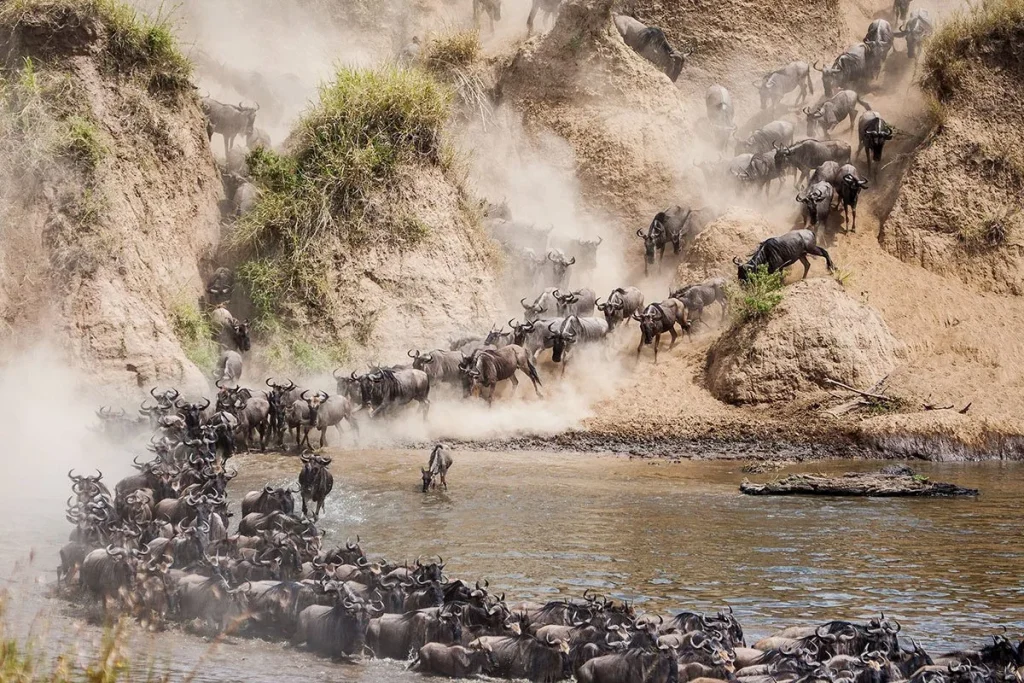
Hippos are resident animals in suitable habitats and are not seasonal migrants like wildebeest, so they can be observed throughout the year. Water levels, rainfall and habitat conditions influence where animals gather—during dry periods, hippos may concentrate in available water; during wetter periods, their distribution may change. The best time to visit therefore depends on the destination and wider safari itinerary. For Lake Naivasha, boat safety and weather conditions should also be considered.
Hippo Photography Tips
Photographing hippos requires patience because much of their body is often underwater and interesting images may depend on behaviour, light and composition.
- Use a telephoto lens to capture details from a safe distance
- Watch for mouth displays, interactions and surfacing groups
- Include the river, lake or surrounding landscape in wider compositions
- Never pressure guides to move too close—animal welfare and visitor safety come first
Hippos and Crocodiles
Hippos and Nile crocodiles may occupy the same rivers and water habitats. Their relationship is complex—adult hippos are powerful animals, while crocodiles are formidable predators, and interactions vary according to circumstances. Travellers may observe both species during a Mara River safari or at other suitable locations, but dramatic confrontations are not guaranteed.
Hippos and Their Ecological Role
Hippos influence freshwater ecosystems through their movement and feeding. They graze on land and spend substantial time in water, transferring nutrients between terrestrial and aquatic environments; their pathways may also influence vegetation and access routes around water bodies. The ecological effects depend on population density, water conditions and habitat characteristics, but they remain an important component of many African freshwater ecosystems.
Hippo Conservation in Kenya
Hippos face threats associated with habitat change, human-wildlife conflict and pressure on freshwater ecosystems. Expanding settlement and agricultural activity can reduce access to suitable grazing and water habitats, and conflicts may occur where people and hippos use the same areas. Conservation requires protecting habitats while addressing the safety and livelihood needs of surrounding communities, and responsible tourism can support appreciation of these animals and their ecological importance.
Combining Hippo Viewing with a Kenya Safari
Hippo viewing can be incorporated into several safari routes.
Nairobi, Lake Naivasha and Masai Mara
A popular itinerary may include Nairobi, Lake Naivasha and the Masai Mara. Lake Naivasha offers boat-based wildlife viewing; the Masai Mara provides conventional game drives and opportunities to observe hippos in river habitats.
Tsavo West and Kenya’s Coast
Travellers visiting Tsavo West may include suitable freshwater attractions before continuing to the coast.
Rift Valley Wildlife Safari
A Rift Valley itinerary may combine Lake Naivasha with Lake Nakuru and other destinations. The route should be designed according to available time and wildlife interests.
Suggested Four-Day Hippo and Wildlife Safari
Day 1: Nairobi to Lake Naivasha
Depart Nairobi and travel towards Lake Naivasha. Arrive at the selected accommodation, enjoy a professionally guided boat excursion where weather and conditions permit, and look for hippos and waterbirds from a safe distance before overnighting near the lake.
Day 2: Lake Naivasha to Masai Mara
Travel towards the Masai Mara, arrive at the selected camp or lodge, and enjoy an afternoon game drive if time permits before overnighting in the Mara region.
Day 3: Masai Mara Wildlife Safari
Spend the day exploring the reserve. Look for elephants, lions, giraffes, buffaloes and other wildlife, and visit suitable river-viewing areas where permitted. Hippo sightings are possible but not guaranteed.
Day 4: Return to Nairobi
Enjoy breakfast and begin the return journey. A morning activity may be included depending on the itinerary.

Frequently Asked Questions About Hippos in Kenya
Where is the best place to see hippos in Kenya?
Lake Naivasha and the Masai Mara are among the best-known destinations for hippo viewing.
Can I see hippos on a Lake Naivasha boat safari?
Yes, hippo sightings are possible, although wildlife cannot be guaranteed.
Are hippos dangerous?
Yes. Hippos are powerful wild animals and should never be approached closely.
Do hippos live in the Masai Mara?
Yes. Hippos inhabit suitable river habitats in the Masai Mara ecosystem.
Do hippos come out of the water at night?
They commonly leave the water to graze during the evening and night.
Can hippos swim?
Hippos move through water using their powerful bodies and often propel themselves along the bottom.
What do hippos eat?
They primarily graze on grasses.
Can I photograph hippos safely?
Yes, from suitable viewing locations and with responsible guides who maintain appropriate distances.
Plan a Hippo Safari in Kenya
Hippos in Kenya offer some of the country’s most memorable freshwater wildlife encounters. Whether you watch them surfacing in Lake Naivasha or resting in the Mara River, their behaviour provides a fascinating contrast to the animals of the open savannah. At Safari Trips to Kenya, we can incorporate hippo-viewing opportunities into personalised wildlife itineraries that also include Kenya’s national parks, lakes and other attractions. Contact our team to plan a safari that combines responsible wildlife observation with comfortable accommodation and carefully organised transport.