
A crocodile can remain almost motionless in shallow water for so long that an inexperienced observer may mistake it for a floating log. Only the eyes, nostrils and rough outline of its back may be visible. When it moves, however, the apparent stillness disappears. A powerful tail propels the animal through the water, revealing the remarkable adaptations of one of Africa’s oldest surviving reptile lineages.
Crocodiles in Kenya inhabit rivers, lakes and suitable wetland environments. They are important aquatic predators and scavengers, feeding on fish, birds, mammals and other animals according to their size and the opportunities available. For safari visitors, the best-known encounters occur along the Mara River during the Great Wildebeest Migration. Yet crocodiles are not limited to the Masai Mara. They also occur in other Kenyan waterways, including parts of the Lake Baringo system, the Tana River and suitable coastal river habitats.
Understanding crocodile ecology makes these sightings more interesting. Their ability to remain submerged, regulate body temperature and survive long periods between substantial meals reflects millions of years of evolutionary adaptation. This guide explains the crocodile species associated with Kenya, where travellers may see them, how they hunt, why they are important to ecosystems and how to observe them safely.

What Types of Crocodiles Are Found in Kenya?
The best-known crocodile in Kenya is the Nile crocodile, scientifically named Crocodylus niloticus. This large species occurs across parts of sub-Saharan Africa and is strongly associated with freshwater habitats. Nile crocodiles are responsible for the famous predator encounters seen during some Mara River crossings, and they are also found in suitable lakes, rivers and wetlands elsewhere in Kenya.
African crocodile taxonomy and distribution are more complex than many popular wildlife guides suggest. Other crocodilian species occur in parts of Africa, but the Nile crocodile is the principal species that most travellers should expect to encounter on a conventional Kenyan safari. Identification should be based on reliable local records rather than assuming every crocodile-like animal belongs to a different species.
What Does a Nile Crocodile Look Like?
Nile crocodiles have elongated bodies, powerful tails, short limbs and heavily armoured skin. Their colour varies, often appearing olive, brownish or grey, with darker markings. The eyes and nostrils sit high on the head, allowing the animal to see and breathe while much of its body remains underwater, and the jaws contain numerous conical teeth adapted for gripping prey. Unlike mammals, crocodiles do not chew food thoroughly; smaller prey may be swallowed whole, while larger carcasses may be torn into pieces. Young crocodiles look broadly similar to adults but are much smaller and often display more distinct markings.
How Big Do Nile Crocodiles Grow?
Nile crocodiles are among Africa’s largest reptiles. Large adults can exceed four metres in length, and exceptional individuals may grow considerably larger. Males generally reach greater sizes than females. However, estimating a crocodile’s length from a safari vehicle or boat can be difficult, because only part of the animal may be visible above water and distance can distort apparent size. Claims about unusually large crocodiles should be treated cautiously unless supported by reliable measurements.
Where to See Crocodiles in Kenya
Crocodile sightings depend on habitat, water conditions and wildlife movements. Some locations are better known for crocodiles than others.
Mara River – Masai Mara Ecosystem
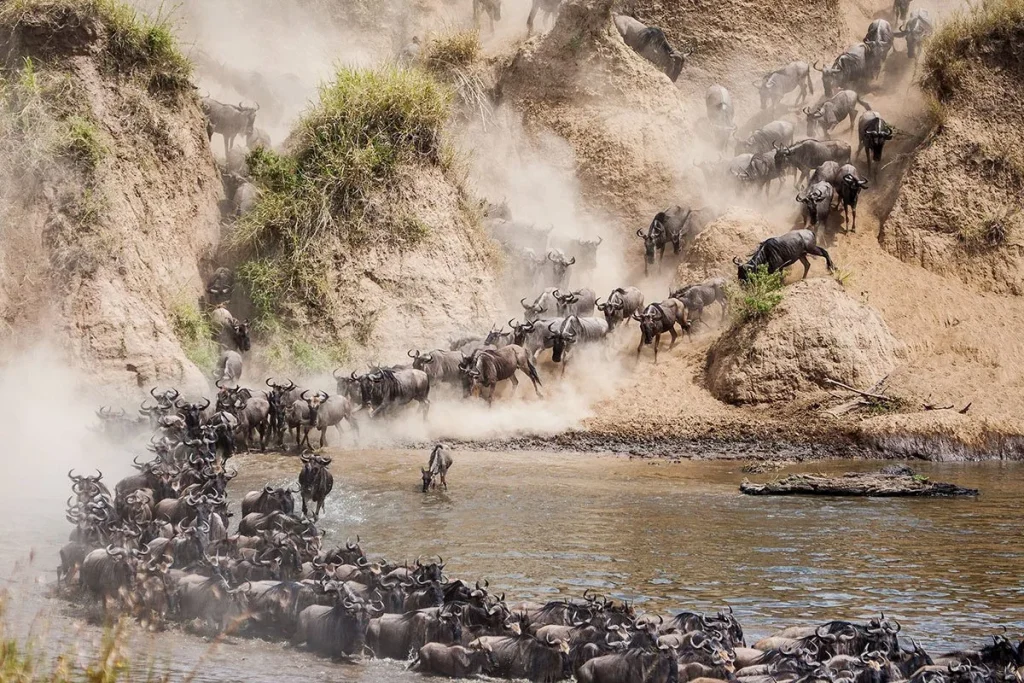
The Mara River is Kenya’s most famous crocodile-viewing destination. Large Nile crocodiles inhabit suitable sections of the river, and during parts of the Great Wildebeest Migration, crocodiles may encounter wildebeest and zebras attempting to cross. However, crocodiles can be observed outside the main migration period, their presence does not guarantee a river crossing or attack, and the Mara River is best visited as part of a broader Masai Mara wildlife safari.
Lake Baringo
Lake Baringo, in Kenya’s Rift Valley, is known for its aquatic wildlife and birdlife. Nile crocodiles inhabit suitable areas around the lake, and boat-based wildlife excursions may provide opportunities to observe crocodiles, hippos and waterbirds. Visitors must use experienced, authorised operators and follow local safety procedures, and crocodiles may be difficult to detect when submerged.
Tana River
The Tana River is Kenya’s longest river and supports important aquatic habitats. Nile crocodiles occur in suitable sections of the river system, although the river extends through varied landscapes and crocodile-viewing opportunities differ substantially by location. It should not be treated as one continuous tourist crocodile-viewing site, and any visit requires local knowledge, appropriate access and suitable safety arrangements.
Coastal Rivers and Wetlands
Suitable river and estuarine habitats near Kenya’s coast can support crocodiles, although their distribution depends on water conditions and habitat suitability. Travellers should not assume that every beach, mangrove forest or coastal lagoon contains crocodiles, and crocodiles should never be approached simply because they appear inactive.
Other Inland Waterways
Nile crocodiles may occur in additional Kenyan rivers and wetland systems. However, local populations vary, and some waterways are more suitable for crocodile viewing than others. Travellers specifically interested in crocodiles should select a destination with established observation opportunities rather than relying on chance sightings.
Crocodiles in the Masai Mara
The Masai Mara is the best-known Kenyan safari destination for observing crocodiles in the context of large-mammal migration. The Mara River creates a natural obstacle for migrating wildebeest and zebras, and during some crossings, crocodiles may attack animals swimming through the water. These encounters can be dramatic, but they are unpredictable. A safari focused on river crossings should allow several days and use experienced guiding. Visitors should also appreciate the broader ecosystem, including lions, cheetahs, hyenas, elephants, giraffes and numerous bird species.
Crocodiles and the Great Wildebeest Migration
The Great Wildebeest Migration is a seasonal movement of grazing animals through the Serengeti–Mara ecosystem. Its timing is influenced by rainfall and vegetation conditions. During parts of the year, large herds may approach the Mara River, and some crossings take place in Kenya while others occur in northern Tanzania. Crocodiles may exploit these events as feeding opportunities. However, not every crossing results in a crocodile attack, river currents, steep banks and crowding also present hazards, and travellers should avoid expecting a particular crossing or predator encounter on a fixed date.
What Do Crocodiles Eat in Kenya?
Nile crocodiles are opportunistic predators, and their diet changes with age and size.
Young Crocodiles
Hatchlings and small juveniles may feed on insects, small fish, amphibians and other small aquatic animals. They are themselves vulnerable to predators.
Medium-Sized Crocodiles
As crocodiles grow, they can take larger fish, birds and other prey. Their feeding behaviour depends on habitat and prey availability.
Large Adults
Large crocodiles may capture substantial mammals when suitable opportunities arise, and they also consume fish and other aquatic prey. Crocodiles may scavenge carcasses rather than always killing animals themselves, so their feeding ecology is more varied than dramatic migration footage sometimes suggests.
How Crocodiles Hunt
Crocodiles are highly adapted to ambush hunting. They may remain submerged with only their eyes and nostrils visible, and their muscular tails provide rapid acceleration over short distances. When prey comes within reach, a crocodile may seize it with its jaws. In water, a crocodile can use its strength and body position to subdue prey. Some crocodiles perform a rotating movement known as a death roll, which can help tear food or overcome resistance, although not every attack involves a death roll.
Can Crocodiles Run on Land?
Crocodiles are primarily adapted to aquatic movement, but they can move on land. They may walk, crawl or make short bursts of rapid movement, and their speed varies with size, terrain and circumstances. Visitors should never assume that a crocodile on a riverbank is too slow to be dangerous, and maintaining distance is essential.
How Long Can Crocodiles Stay Underwater?
Crocodiles can remain submerged for extended periods. Their ability to hold their breath depends on activity, temperature and physiological conditions, and a resting crocodile may remain underwater much longer than one actively struggling or hunting. This adaptation makes crocodiles difficult to detect, and an apparently empty stretch of water should never be assumed safe for swimming.
Are Crocodiles Cold-Blooded?
Crocodiles are ectothermic reptiles. They rely heavily on environmental heat sources to regulate body temperature, which is why crocodiles may be observed basking on riverbanks. Sun exposure helps warm the body, and they may return to water to avoid overheating. Basking is not a sign that the animal is harmless or unable to move.
Crocodile Reproduction and Nesting

Female Nile crocodiles generally lay eggs in nests excavated in suitable ground. The nesting location must provide conditions that allow the eggs to develop, and females may guard nesting areas and defend their offspring. After hatching, young crocodiles face numerous threats; predators, environmental conditions and limited food availability can affect survival, and only a proportion of hatchlings reach adulthood. Visitors should never approach suspected crocodile nests.
How Long Do Nile Crocodiles Live?
Nile crocodiles can live for several decades. Their lifespan depends on environmental conditions, food availability, disease, injury and human pressures. Large adults may survive for many years, although precise ages of wild crocodiles are difficult to establish without long-term records, and size alone is not a reliable indicator of exact age.
Crocodiles Versus Hippos
Crocodiles and hippos may share the same rivers and lakes, although they occupy different ecological roles. Hippos are large semiaquatic mammals that primarily graze on vegetation, while crocodiles are carnivorous reptiles. Both animals can be dangerous to people, their interactions vary, and neither species should be approached closely. Boat excursions in crocodile and hippo habitats require experienced operators.
Are Crocodiles Dangerous to Tourists?
Yes. Nile crocodiles are dangerous wild animals and can attack people who enter or approach occupied waters. Visitors should never swim in rivers or lakes where crocodiles may be present unless a location has been explicitly assessed and designated safe by responsible local authorities.
- Do not approach crocodiles on riverbanks.
- Never attempt to feed or touch them.
- Remain within permitted viewing areas and follow guide instructions.
A crocodile that appears motionless can still react rapidly.
Is It Safe to Photograph Crocodiles?
Crocodiles can be photographed safely from appropriate locations. A telephoto lens allows photographers to capture details without approaching the animal, and boat-based photography should be undertaken only with suitable authorised operators. Visitors should remain seated or follow the boat guide’s instructions, and should never lean dangerously over the water or attempt to attract crocodiles with food.
Best Time to See Crocodiles in Kenya
Crocodiles inhabit suitable Kenyan waterways throughout the year. The best time to observe them depends on the destination and the type of behaviour the traveller wants to see. For crocodile interactions with migrating wildebeest, July to October is the commonly targeted Mara River period, although migration timing varies. For general crocodile viewing, suitable river and lake habitats may provide opportunities in different seasons, and water levels and weather can influence visibility.
Crocodile Photography Tips
- Focus on the eyes: The eyes are among the most expressive features in a crocodile portrait; sharp focus on the visible eye can make a strong image.
- Use a telephoto lens: A telephoto lens allows photography from a safe distance and can isolate the animal against water or vegetation.
- Watch for reflections: Still water may create interesting reflections, although glare can obscure details. A polarising filter may help in some circumstances, although it also reduces available light.
- Capture behaviour: Basking, swimming and interactions with other animals can produce more informative images than static portraits alone.
- Respect wildlife: Do not approach nests, disturb resting animals or encourage guides to move dangerously close.
Ecological Importance of Crocodiles
Crocodiles are important components of aquatic ecosystems. They feed on a variety of prey and may scavenge carcasses, and their presence influences food-web relationships. As large predators, they form part of the ecological processes that shape river and wetland communities, so conservation of crocodiles involves protecting suitable aquatic habitats and maintaining healthy ecosystems.
Threats Facing Crocodiles in Kenya
Habitat Modification
Changes to rivers, wetlands and shorelines can affect nesting and feeding habitats. Water extraction, infrastructure and land-use changes may alter suitable environments.
Human–Crocodile Conflict
Crocodiles may come into conflict with people using rivers and lakes for fishing, water collection or other activities. These conflicts can be serious, and effective management requires protecting human safety while considering wildlife conservation.
Pollution
Pollution can affect aquatic ecosystems and the prey species crocodiles depend upon.
Illegal Killing
Crocodiles may be killed because of fear, conflict or illegal exploitation, and conservation efforts must consider both ecological and community needs.
Responsible Crocodile Tourism
Responsible tourism should never involve provoking crocodiles. Feeding wild crocodiles can alter their behaviour and create risks, and tourists should not encourage operators to attract crocodiles towards boats or people. Viewing should take place from safe, permitted locations, and visitors should follow local rules and respect surrounding communities.
Combining Crocodile Viewing with Other Kenya Wildlife
A Kenya crocodile safari can be part of a broader wildlife itinerary. The Masai Mara offers opportunities to observe predators and large herbivores. Lake Baringo is particularly interesting for aquatic wildlife and birds, and other national parks and conservancies provide different habitats and species. Combining destinations can create a more varied safari, but travel distances should be considered carefully.
Frequently Asked Questions About Crocodiles in Kenya
Are there crocodiles in Kenya?
Yes. Nile crocodiles inhabit suitable rivers, lakes and wetlands.
Where is the best place to see crocodiles?
The Mara River is particularly famous, especially during the Great Migration. Lake Baringo is another established crocodile habitat.
What species of crocodile lives in the Mara River?
The Nile crocodile, Crocodylus niloticus.
Do crocodiles eat wildebeest?
Yes. Large Nile crocodiles may attack wildebeest during river crossings.
Are crocodiles active all year?
Yes. Crocodiles remain present in suitable habitats throughout the year, although their behaviour varies with environmental conditions.
Can crocodiles attack humans?
Yes. Nile crocodiles are dangerous and must be observed from a safe distance.
Can crocodiles be seen from a safari vehicle?
Yes, at suitable river viewpoints.
Are there crocodiles in Lake Baringo?
Yes. Nile crocodiles occur in the lake.
Can I swim in rivers where crocodiles live?
No. Swimming in crocodile-occupied waters is dangerous.
Are crocodiles important to the ecosystem?
Yes. They are predators and scavengers that contribute to aquatic food webs.
Plan a Kenya Wildlife Safari
Observing crocodiles in Kenya provides an opportunity to understand one of Africa’s most remarkable aquatic predators. From the Mara River to suitable lakes and wetlands, Nile crocodiles reveal how wildlife adapts to different environments and feeding opportunities. Safari Trips to Kenya can help organise a wildlife itinerary that includes crocodile-viewing opportunities alongside elephants, lions, giraffes, birds and other animals. Contact Safari Trips to Kenya with your preferred travel dates and wildlife interests to request a personalised Kenya safari proposal.