
1 Day Kenya Safari
Plan a 1 Day Kenya Safari with private transport, expert guiding and wildlife viewing. Explore the best one-day…
View SafariHandpicked Kenya Safari Tours for Every Traveler
The best Kenya safaris combine exceptional wildlife viewing, carefully selected national parks and conservancies, experienced guides, well-located accommodation and enough time in each destination to experience Kenya rather than simply drive through it.
| Safari Interest | Recommended Kenya Safari Focus |
|---|---|
| Best Overall Safari Experience | Masai Mara combined with complementary parks |
| Best for Big Cats | Masai Mara |
| Best for Great Migration | Greater Masai Mara ecosystem |
| Best for Elephants | Amboseli |
| Best for Kilimanjaro Views | Amboseli |
| Best for Northern Wildlife | Samburu |
| Best for Wilderness | Tsavo |
| Best for Rhinos | Dedicated rhino conservation areas |
| Best for Private Conservancies | Greater Mara and Laikipia |
| Best for Photography | Masai Mara, Amboseli and private conservancies |
| Best for Families | Private multi-destination Kenya safari |
| Best for Honeymooners | Masai Mara plus Kenya Coast |
| Best for Luxury | Fly-in conservancy safari |
| Best for Budget Travelers | Road safari |
| Best for First-Time Visitors | 7–10 day multi-park safari |
| Best for Repeat Visitors | Conservancies and specialist destinations |
| Best Safari + Beach | Wildlife circuit plus Kenya Coast |
| Best Multi-Country Combination | Kenya with Tanzania, Uganda or Rwanda |
Showing 1–12 of 215 safaris
Plan a 1 Day Kenya Safari with private transport, expert guiding and wildlife viewing. Explore the best one-day…
View SafariExplore the 10 Days Family Kenya Safari with a day-by-day safari plan, key wildlife experiences, destinations, accommodation ideas,…
View SafariExplore the 10 Days Fly-in Kenya Safari with a day-by-day safari plan, key wildlife experiences, destinations, accommodation ideas,…
View SafariExplore the 10 Days Honeymoon Kenya Safari with a day-by-day safari plan, key wildlife experiences, destinations, accommodation ideas,…
View SafariPlan a 10 Days Kenya Big Five Safari with expert guides, game drives and carefully chosen camps. Request…
View SafariA 10 day Kenya journey connecting Nairobi, Ol Pejeta, Samburu or Buffalo Springs, Solio, Lake Nakuru, Maasai Mara…
Lake Naivasha, Lake Nakuru, Masai Mara
View SafariPlan a 10 Days Kenya Safari with expert guides, game drives and carefully chosen camps. Request a quote.
View SafariPlan a 10 Days Kenya Safari & Diani Beach with expert guides, game drives and carefully chosen camps.…
Diani Beach
View SafariPlan a 10 Days Kenya Wildlife Safari with expert guides, game drives and carefully chosen camps. Request a…
View SafariPlan a 10 Days Luxury Kenya Safari with expert guides, game drives and carefully chosen camps. Request a…
View SafariA 10 day Kenya journey connecting Nairobi, Maasai Mara, Lake Naivasha, Amboseli and Diani Beach.
Amboseli, Diani Beach, Lake Naivasha
View SafariPlan a 10 Days Masai Mara & Amboseli with expert guides, game drives and carefully chosen camps. Request…
Masai Mara, Amboseli
View SafariThe quality of a safari depends on much more than the number of parks visited.
Several elements make the difference between an average itinerary and an exceptional one.
The most important element is access to strong wildlife areas.
Kenya supports an extraordinary range of mammals.
Depending on the itinerary, you may see:
The best itineraries choose destinations according to wildlife strengths rather than simply according to fame.
One of the biggest mistakes when planning a Kenya safari is attempting to cover too much ground.
Wildlife does not operate according to an itinerary.
A leopard may remain hidden all morning.
A lion pride may sleep for six hours before becoming active.
A cheetah may spend much of the day resting before suddenly beginning a hunt.
Wildebeest may gather beside the Mara River without crossing.
More time creates more opportunities.
For important wildlife destinations, three nights is often much better than one or two nights.
A professional guide can transform the safari.
Good guides understand:
The best guides do more than find animals.
They interpret what you are seeing.
A beautiful lodge does not automatically provide a better safari.
Location matters.
A well-positioned camp can mean:
Travelers should therefore compare accommodation according to both comfort and wildlife access.
A safari vehicle should provide:
Private vehicles are particularly useful for photographers and families.
Kenya is a large country.
A safari that looks excellent on a map can involve excessive driving.
Good routing should balance:
Flying can be introduced where long road transfers would consume too much safari time.
For someone visiting Kenya for the first time, the strongest itinerary normally combines Kenya's classic wildlife experiences.
A first safari should provide:
The Masai Mara will usually be one of the central destinations.
It can then be combined with a contrasting area such as Amboseli or another ecosystem.
The Masai Mara offers one of the most complete classic safari experiences in Kenya.
Possible wildlife includes:
The open landscapes also make animals relatively easy to observe.
For travelers whose priority is predators, the Masai Mara is one of the strongest choices.
The ecosystem supports:
The combination of abundant prey and open habitat creates excellent predator viewing.
The Masai Mara is especially famous for lions.
Visitors may encounter:
Several nights improve the opportunity to follow particular prides and understand their behavior.
Leopards are more elusive.
They often use:
An experienced guide may search using tracks, alarm calls and knowledge of established territories.
For leopard-focused travelers, patience is essential.
Open plains provide good cheetah habitat.
Visitors may see cheetahs:
Photographers often appreciate areas where open landscapes provide unobstructed views.
The traditional Big Five are:
Kenya supports all five.
However, the best Big Five safari does not necessarily attempt to see them all in one destination.
A better strategy is to combine complementary ecosystems.
A well-designed Big Five itinerary may include:
For:
For:
For:
This approach substantially improves overall wildlife diversity.
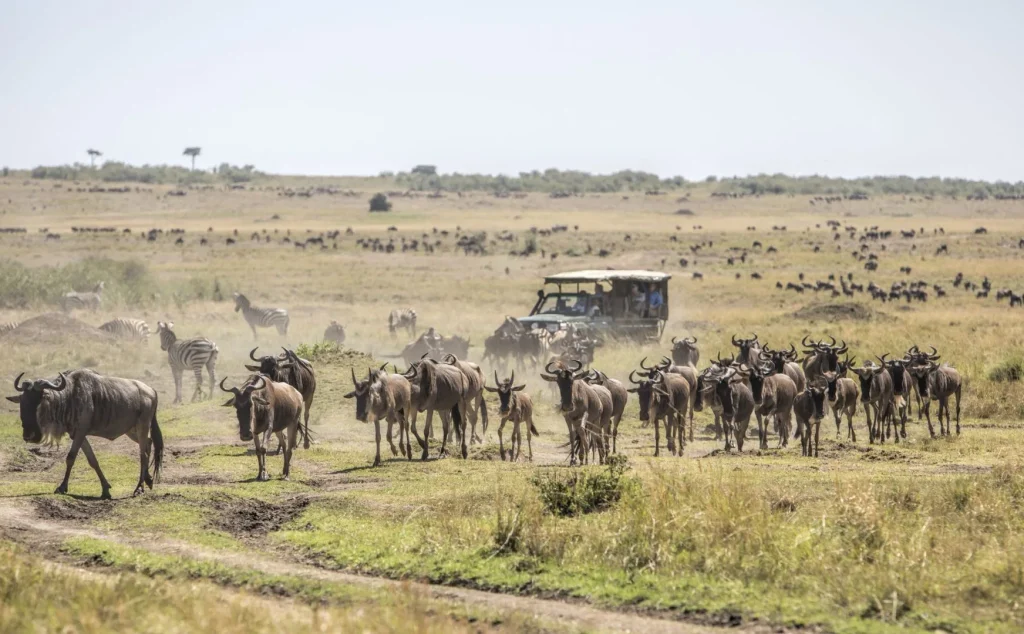
The Greater Masai Mara ecosystem is Kenya's principal destination for Great Migration safaris.
Large numbers of wildebeest and zebras move through the Serengeti-Mara ecosystem in response to:
When large herds are in Kenya, the ecosystem becomes particularly dramatic.
The migration is not simply about wildebeest.
It affects predators and scavengers throughout the ecosystem.
Travelers may encounter:
Large concentrations of prey create extraordinary wildlife interactions.
Travelers interested in river crossings should stay in an appropriate part of the greater Mara ecosystem during the migration period.
However, crossings cannot be scheduled.
Wildebeest may:
The best strategy is to allow several days.
No.
No safari operator can guarantee a river crossing.
Even when thousands of wildebeest are near the river, the animals decide when and where to cross.
Patience is essential.
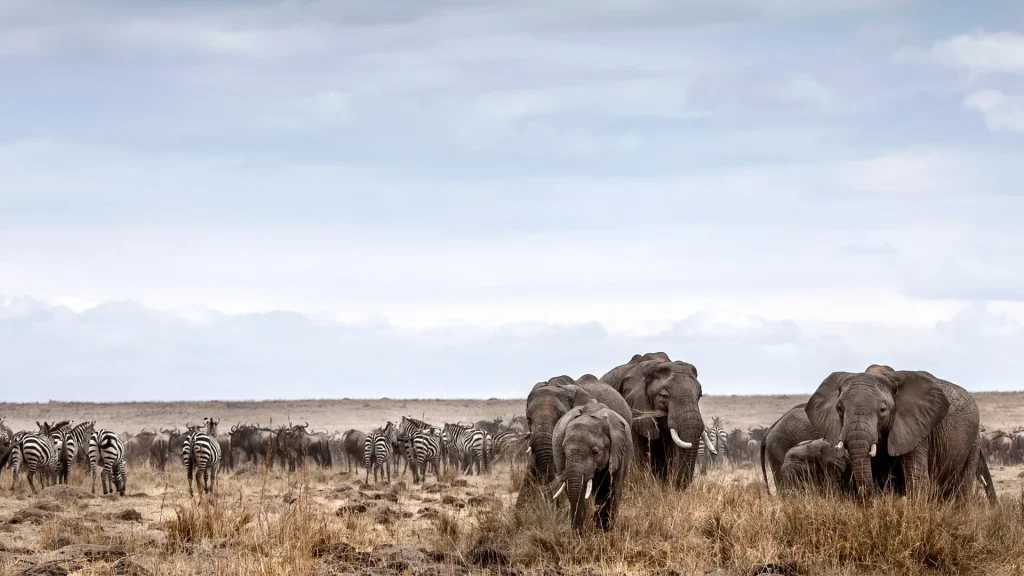
Amboseli National Park is one of Africa's most famous elephant destinations.
Large elephant families may move across open plains and wetlands.
Travelers can observe:
One of Amboseli's great attractions is the possibility of photographing elephants with Mount Kilimanjaro in the background.
Visibility depends on weather.
Early morning can provide particularly good mountain views.
Travelers who specifically want to see rhinoceroses should deliberately include a recognized rhino conservation area.
Kenya protects both:
A targeted rhino destination can provide much stronger opportunities than hoping for a chance sighting.
A rhino-focused stop may also introduce visitors to:
This adds an educational dimension to the safari.
Travelers interested in unusual species should consider Samburu.
Northern Kenya supports animals adapted to dry environments.
Specialized wildlife may include:
These species make Samburu particularly valuable on longer safaris.
For travelers seeking a greater sense of scale and remoteness, Tsavo deserves serious consideration.
The Tsavo ecosystem is enormous.
Wildlife may include:
The landscape differs significantly from the Masai Mara.
Tsavo works particularly well for travelers who want:
Private and community conservancies provide some of Kenya's most rewarding safari experiences.
Potential benefits include:
Conservancies are particularly valuable for repeat visitors and photographers.
Kenya is one of Africa's premier wildlife photography destinations.
A serious photography safari should emphasize:
Different destinations offer different subjects.
Excellent for:
Excellent for:
Excellent for:
Excellent for:
Early morning provides:
Late afternoon provides:
Midday should not automatically be dismissed.
Interesting wildlife behavior can occur at any time.
Kenya offers exceptional bird diversity.
Habitats include:
Birdwatchers may encounter:
A dedicated birding safari should use a specialist guide.
Kenya is an excellent family safari destination.
The best family itineraries prioritize:
A private vehicle allows families to:
This can significantly improve the experience.
Teenagers may appreciate additional activities such as:
where available.
This creates variety beyond conventional game drives.
Couples often benefit from a private safari.
Popular options include:
A private vehicle provides flexibility and privacy.
Kenya is one of Africa's strongest honeymoon destinations because wildlife can easily be combined with romantic accommodation and the coast.
Honeymoon experiences may include:
A classic Kenya holiday combines wildlife with the Indian Ocean coast.
A typical structure is:
Enjoy:
Finish with:
This is particularly effective for trips lasting around 10–14 days or longer.
Luxury safaris can include:
However, the best safari luxury is not necessarily a large room.
The most valuable luxury may be:
Mid-range safaris can provide outstanding wildlife experiences.
Accommodation commonly includes:
For many travelers, mid-range provides the strongest balance between price and comfort.
Budget travelers can still enjoy Kenya's major wildlife destinations.
Savings may come from:
The safari should not save money by reducing wildlife time excessively.
Private safaris are ideal for:
The vehicle and guide are dedicated to your party.
You can decide:
This flexibility can dramatically improve a wildlife-focused trip.
Group safaris work particularly well for:
They reduce transport costs but provide less flexibility.
Travelers should confirm:
Road safaris offer:
They are particularly effective when parks are logically connected.
Fly-in safaris are ideal when:
Light aircraft connect Nairobi with several major safari areas.
| Road Safari | Fly-In Safari |
|---|---|
| Lower cost | Faster |
| More luggage flexibility | Baggage restrictions |
| See countryside | Scenic aerial views |
| Same guide possible | Camp guides commonly used |
| Longer transfers | More wildlife time |
| Good for families | Excellent for luxury travel |
Kenya can be very suitable for older travelers because most wildlife viewing takes place from vehicles.
Senior-friendly itineraries can include:
Solo travelers have several options.
Best for reducing cost.
Best for flexibility.
Useful for travelers who prefer to fly between destinations and join camp activities.
Travelers returning to Kenya may prefer to move beyond the standard circuit.
Options include:
Repeat safaris often become less about seeing more species and more about understanding wildlife behavior.
Kenya is a year-round safari destination.
Different seasons suit different priorities.
Generally one of the most popular periods.
Advantages may include:
This is also a high-demand period.
Another excellent period for resident wildlife.
Advantages may include:
The short rains can produce:
These are traditionally wetter months.
Advantages may include:
Some roads can become challenging after heavy rain.
| Interest | Useful Period |
|---|---|
| General Wildlife | Year-round |
| Dry-Season Viewing | June–October |
| Migration | Seasonal; depends on herd movement |
| Green Landscapes | Rainy/green seasons |
| Birding | Excellent across several seasons |
| Photography | Year-round depending on desired style |
| Lower Visitor Numbers | Parts of green season |
Not necessarily.
Migration is spectacular, but Kenya's resident wildlife remains excellent throughout the year.
Travelers focused on:
can have outstanding safaris outside peak migration months.
Trip length should match the number of destinations.
Three days should usually focus on one wildlife area.
Trying to combine distant parks creates excessive driving.
Five days can combine two complementary destinations.
This is suitable for travelers with limited time.
A week is one of the strongest choices for first-time travelers.
It allows:
Ten days allow a more comprehensive journey.
Travelers can combine:
Two weeks allows a relaxed safari and beach combination.
Alternatively, the entire trip can focus on wildlife.
| Safari Length | Recommended Style |
|---|---|
| 3 Days | One destination |
| 4–5 Days | Short two-area safari |
| 6–7 Days | Classic Kenya safari |
| 8–10 Days | Comprehensive wildlife safari |
| 11–14 Days | Extended Kenya circuit |
| 14+ Days | Safari + beach or multi-country |
A well-balanced week might include:
Focus on elephants and contrasting scenery.
Add rhinos, specialized wildlife or a conservancy.
Finish with several days in Kenya's premier big-cat ecosystem.
The actual route should minimize driving.
A 10-day itinerary might include:
This gives the most important wildlife areas enough time.
A two-week holiday might include:
This provides an excellent balance between adventure and relaxation.
Kenya offers:
Lodges may include:
They are particularly useful for families and travelers who prefer hotel-style accommodation.
Permanent tents can provide:
Tented camps often provide a stronger wilderness atmosphere.
These tend to be smaller.
Potential advantages include:
Consider:
Do not choose accommodation solely from photographs of bedrooms.
The best safari is not necessarily the most expensive.
Prices are influenced by:
A safari package may include:
Conservancy fees and domestic flights should be clearly specified.
Common exclusions include:
Useful items include:
Kenya and Tanzania can create an exceptional longer safari.
A combined trip can include:
Enough time should be allowed to prevent excessive transfers.
Kenya can be combined with Uganda or Rwanda.
This allows travelers to experience:
The contrast makes this one of East Africa's most diverse wildlife journeys.
The best safari should also be responsible.
Travelers should choose operations that:
Visitors should:
Natural behavior is more valuable than an artificially close encounter.
Conservancies can protect wildlife habitat outside national parks and reserves.
They may support:
Responsible tourism helps provide economic value for keeping land available to wildlife.
There is no single best itinerary. The Masai Mara is Kenya's most famous all-round wildlife destination, but the strongest safaris often combine it with complementary ecosystems.
The Masai Mara is an excellent starting point because of its wildlife diversity and predator populations.
The Masai Mara is one of Kenya's strongest lion destinations.
Amboseli is particularly famous for elephant herds.
The Masai Mara provides excellent cheetah opportunities.
Include a recognized rhino conservation area in your itinerary.
The greater Masai Mara ecosystem is Kenya's primary migration destination.
No. Wildebeest crossings are completely natural and unpredictable.
A private safari combining strong wildlife destinations and low-density conservancies is an excellent choice.
A private 7–10 day itinerary with limited long transfers and family-friendly accommodation works particularly well.
A private Masai Mara or conservancy safari followed by the Kenya Coast is a classic honeymoon combination.
Road safaris using comfortable but simpler accommodation generally provide the best value.
Luxury is most valuable when it provides better location, privacy, guiding and wildlife access rather than simply a more elaborate room.
Seven to ten days is ideal for many first-time visitors.
Yes, if the itinerary concentrates on one or two complementary areas.
No. Two weeks allow a relaxed wildlife circuit or safari-and-beach holiday.
Road travel offers value and flexibility. Flying saves time. The best choice depends on distance, budget and trip length.
Kenya offers year-round wildlife viewing. June–October and January–March are especially popular, while green-season months can offer beautiful scenery and fewer visitors.
Yes. Resident wildlife remains excellent throughout the year.
Yes. Kenya and Tanzania are an excellent combination for longer East African safaris.
Yes. Uganda or Rwanda can be added by regional flight.
Yes. Combining safari with the Kenya Coast is one of the country's strongest travel experiences.
No. Animals move freely, so sightings cannot be guaranteed.
Instead of asking only, “What is the best safari in Kenya?”, begin by asking what you most want from the journey.
If your priority is lions, leopards and cheetahs, devote several nights to the Masai Mara.
If you dream of photographing large elephant herds beneath Mount Kilimanjaro, include Amboseli.
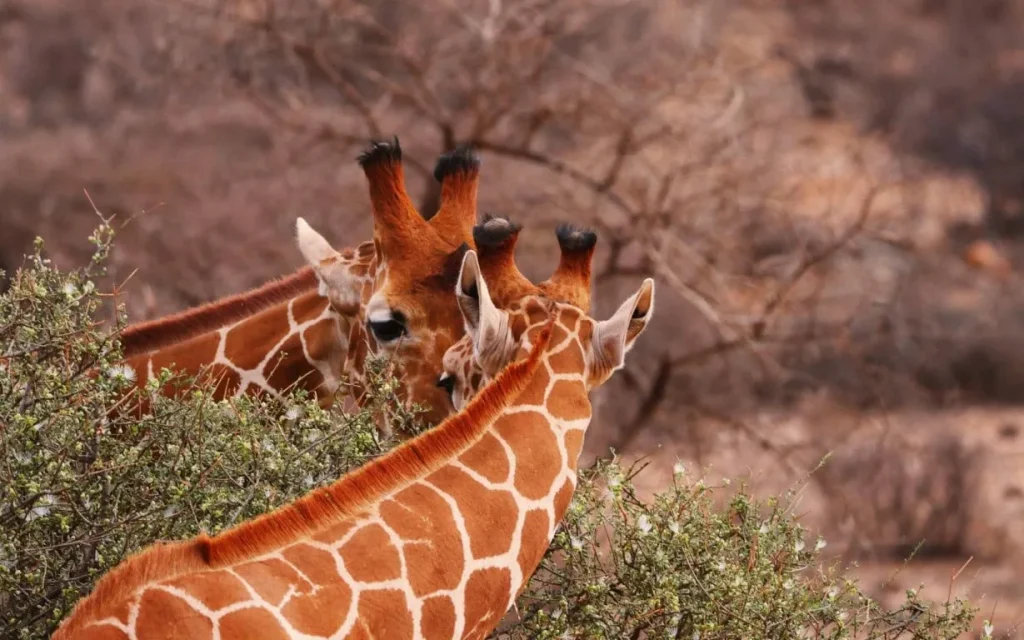
If you want unusual northern wildlife such as Grevy's zebra, gerenuk and reticulated giraffe, include Samburu.
If you want expansive wilderness and a natural connection toward the coast, consider Tsavo.
If rhinoceroses are essential, deliberately add a rhino conservation area rather than leaving the sighting to chance.
If you are a photographer, choose a private vehicle and spend longer in fewer wildlife areas.
If you are traveling with children, prioritize comfortable routing and longer stays.
If you are honeymooning, consider combining a private wildlife safari with several days on the Kenya Coast.
If the Great Migration is your priority, build the itinerary around the greater Mara ecosystem while remembering that herd movements and river crossings remain unpredictable.
Above all, allow enough time.
The difference between a good safari and an exceptional safari is often not another destination. It is another morning in the same wildlife area.
It is having time to return to the territory where a leopard was seen the previous evening.
It is waiting beside an elephant herd instead of immediately driving onward.
It is spending an hour watching lion cubs interact.
It is remaining near a cheetah long enough to see it rise, scan the plains and begin hunting.
It is allowing a professional guide to interpret the landscape rather than simply racing from one animal sighting to another.
That is what the best Kenya safaris ultimately provide: not simply more animals, but enough time, space and expert guiding to experience Kenya's wildlife as part of a living ecosystem.