

Best Camera for Migration Safari
Choosing the best camera for a migration safari is not simply a matter of buying the most expensive camera body. The Great Wildebeest Migration presents a wide range of photographic situations, from enormous herds crossing open grasslands to fast-moving animals entering rivers, distant predators and atmospheric landscapes at sunrise. A successful safari photography setup must handle these different situations without becoming unnecessarily complicated; reliable autofocus, suitable lenses, manageable weight and enough storage are often more important than having the newest camera model.
The Masai Mara National Reserve in Kenya is one of the world’s best-known destinations for migration photography. During the months when migratory herds are present, photographers may encounter wildebeest moving across plains, zebras gathering near water, crocodiles resting along riverbanks and predators following grazing animals. However, the migration is a natural event: river crossings cannot be scheduled, and wildlife may remain in one location for hours before suddenly moving. Photographers therefore need equipment that is ready for unexpected action but also comfortable to use during long periods of waiting.
This guide explains how to choose a camera for a Great Migration safari, which lenses are most useful, what settings work for different wildlife situations and how to protect equipment in Kenya’s safari environment.
What Makes Migration Photography Different?
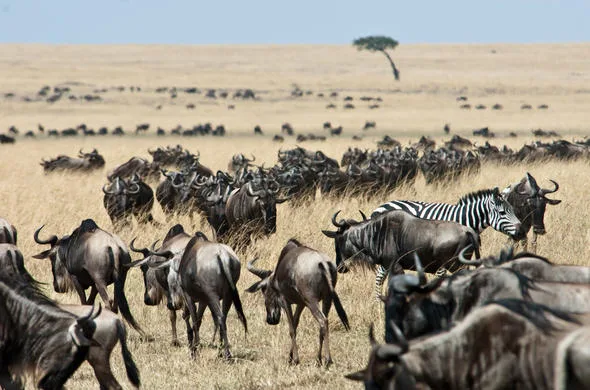
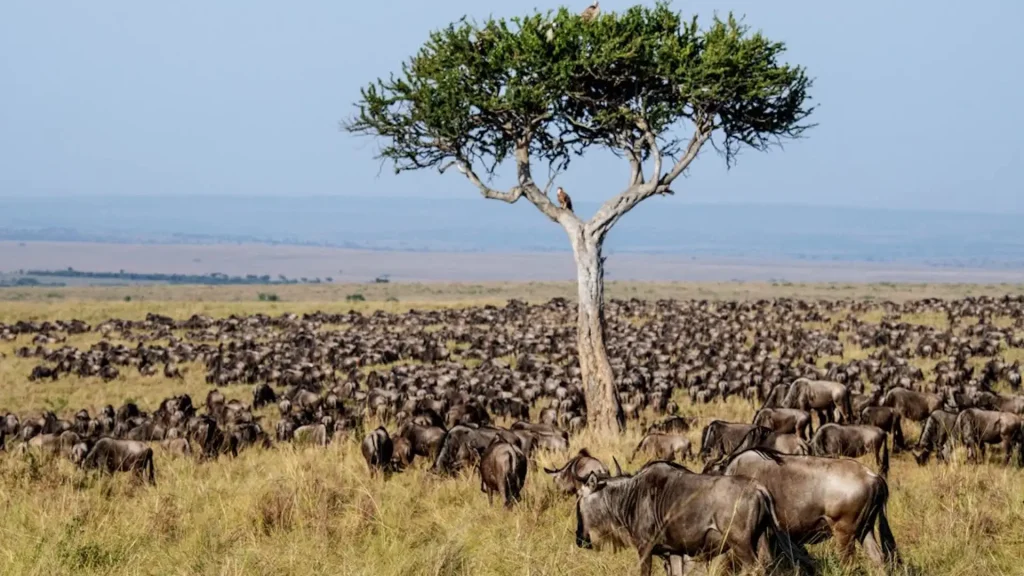
A migration safari combines several types of wildlife photography. At one moment, a photographer may be observing a distant herd across an enormous grassland; a few minutes later, animals may begin running towards a river, creating fast-moving action. Some of the most memorable photographs show a single wildebeest or zebra in sharp detail, while others capture hundreds of animals moving together, with the surrounding landscape providing scale.
These situations require different focal lengths and camera settings. A long telephoto lens is useful for distant animals and close-up portraits; a shorter zoom lens is better for large herds, environmental compositions and animals that approach the safari vehicle. The best safari camera is therefore one that works reliably with a suitable range of lenses. Camera handling also matters: a photographer who can quickly adjust shutter speed, autofocus mode and exposure compensation may obtain better results than someone using a more expensive camera without understanding its controls.
Mirrorless Cameras Versus DSLR Cameras
Both mirrorless and DSLR cameras can produce excellent migration photographs. Modern mirrorless wildlife cameras offer several advantages, particularly sophisticated autofocus systems and electronic viewfinders. Many mirrorless models can recognise animals and track moving subjects across the frame, which can be particularly useful when photographing wildebeest running through dust or birds flying above the Mara River.
DSLR cameras remain capable wildlife photography tools, especially when paired with quality telephoto lenses, and photographers who already own a reliable DSLR system do not necessarily need to replace it before travelling. The most sensible choice depends on existing equipment, budget and familiarity. A camera that the photographer knows well is often preferable to an unfamiliar model purchased immediately before departure.
Important Camera Features for Migration Photography
Reliable Animal Autofocus
Autofocus performance is one of the most important considerations. Moving wildebeest, running zebras and birds in flight can be difficult to photograph with a camera that struggles to maintain focus. Modern cameras with animal-detection autofocus can help track moving subjects, although performance varies between species and situations.
Dust, vegetation, overlapping animals and low contrast can confuse even advanced systems. Photographers should practise selecting focus areas manually when automatic detection becomes unreliable.
Continuous Shooting Speed
A camera with a reasonably fast continuous shooting mode is useful for action photography. During a river crossing, several important moments may occur within a fraction of a second, and continuous shooting increases the chance of capturing a useful body position or interaction.
However, extremely high frame rates create large numbers of files, so photographers should balance shooting speed against storage capacity and review time. For many safari situations, approximately 8–15 frames per second is sufficient, although faster cameras can provide additional flexibility.
Buffer Capacity
The camera’s buffer determines how many photographs can be captured before the shooting rate slows, which matters during prolonged action sequences. A camera may advertise a very high frame rate but sustain it only briefly when recording large RAW files. Photographers should examine buffer performance with the file format and memory cards they intend to use; fast memory cards can help the camera clear its buffer more efficiently.
Low-Light Performance
Early morning and late afternoon are important periods for wildlife photography. The light can be beautiful, but it may also be relatively weak, so a camera that produces usable images at higher ISO settings provides greater flexibility. Full-frame cameras often perform well in low light, although modern APS-C cameras can also produce excellent results. The lens’s maximum aperture and the photographer’s technique are equally important.
Weather and Dust Resistance
The Masai Mara can be dusty during dry periods. Fine dust may enter camera bags, collect around controls and become particularly troublesome during lens changes. Weather-resistant camera bodies and lenses provide useful protection, although no ordinary camera should be considered completely dustproof or waterproof. A protective bag, careful handling and regular cleaning remain essential.
Battery Life
Safari days can begin before sunrise and continue until late afternoon. Cold mornings, electronic viewfinders, image review and continuous autofocus can increase battery consumption. Carry at least one spare battery, preferably more for intensive photography, and check charging facilities at the safari camp before travelling.
Best Camera Systems for a Migration Safari
There is no single camera that is best for every photographer.
The following systems illustrate the types of equipment worth considering.
Sony Alpha Cameras
Sony’s Alpha mirrorless system includes cameras designed for wildlife and action photography.
Models such as the Sony A7 IV, Sony A7R V and Sony A9 III offer different combinations of resolution, speed and autofocus capability.
The A7 IV provides a versatile full-frame option for general wildlife and travel photography.
The A7R V offers high resolution, which can be useful when cropping distant wildlife images.
The A9 III is designed for demanding action photography and offers advanced high-speed shooting capabilities.
However, its cost and specialised features may be unnecessary for many travellers.
Sony’s broad lens selection is another advantage.
Canon EOS R Cameras
Canon’s mirrorless system includes several strong wildlife photography options.
The Canon EOS R6 Mark II offers a useful combination of autofocus performance, continuous shooting and manageable file sizes.
The Canon EOS R5 Mark II provides higher resolution and advanced features for photographers who want greater flexibility.
Canon’s RF telephoto lenses include options suitable for different budgets and photographic styles.
Travellers already familiar with Canon controls may prefer to remain within the system.
Nikon Z Cameras
Nikon offers a range of mirrorless cameras suitable for safari photography.
The Nikon Z6 III provides a versatile option for wildlife, travel and action photography.
The Nikon Z8 offers high-resolution imaging and advanced autofocus capabilities.
The Nikon Z9 is a professional camera designed for demanding photography environments.
Nikon’s telephoto lens range includes options particularly attractive for wildlife photographers.
The best choice depends on budget, weight tolerance and the need for specialised features.
Fujifilm APS-C Cameras
Fujifilm offers capable APS-C cameras that can be attractive for travellers seeking a lighter system.
The Fujifilm X-H2S is designed with action photography in mind and offers fast shooting capabilities.
APS-C sensors provide a narrower field of view than full-frame sensors when using lenses of the same focal length.
This can be useful for distant wildlife, although it does not physically increase the lens’s focal length.
Fujifilm’s telephoto zoom options make the system worth considering for safari photography.
Full-Frame Versus APS-C Cameras
One of the most common questions is whether a full-frame camera is necessary for wildlife photography. The answer is no. Full-frame cameras generally offer advantages in high-ISO performance and can provide greater flexibility with depth of field, which appeals to photographers who want excellent image quality in changing light.
APS-C cameras can be lighter and more affordable, depending on the model and lens combination. Their narrower field of view can make distant wildlife occupy more of the frame when using the same focal length, although the result also depends on sensor resolution and lens quality. A good APS-C camera with a suitable telephoto lens may outperform an expensive full-frame camera paired with an unsuitable lens. For most travellers, lens selection and practical handling deserve as much attention as sensor size.
Best Lenses for a Migration Safari
100–400mm Telephoto Zoom
A 100–400mm safari lens is one of the most versatile options for wildlife photography. At the shorter end, it can capture medium-distance animals and environmental scenes; at 400mm, it provides useful reach for wildlife that remains farther from the vehicle. This flexibility is particularly valuable in the Masai Mara, where animal distances can change quickly, and it is an excellent choice for photographers who want a relatively simple setup.
100–500mm Telephoto Zoom
A 100–500mm lens provides additional reach while retaining a flexible zoom range. It is particularly useful for distant animals, birds and situations where the safari vehicle cannot approach more closely, and the ability to zoom out matters when wildlife moves towards the vehicle. Photographers should consider the lens’s weight and maximum aperture.
150–600mm Telephoto Zoom
A 150–600mm wildlife lens offers substantial reach and can be attractive for photographers working with distant subjects, including birds and animals that remain far from the road. However, such lenses can be relatively heavy and may have narrower maximum apertures, making fast shutter speeds more challenging in low light. A beanbag or other stable support can improve handling.
70–200mm Telephoto Zoom
A 70–200mm lens is particularly useful for wildlife close to the vehicle and for attractive portraits and environmental photographs. A version with a wide maximum aperture is valuable during early morning or late afternoon, although 200mm may be insufficient for distant animals. For a migration safari, this lens works especially well as part of a two-camera setup.
24–70mm Standard Zoom
A 24–70mm lens is useful for landscapes, safari camps, people and large herds close to the vehicle. It provides a broader perspective than a long telephoto lens, and photographers who want to tell the complete story of their safari should not overlook shorter focal lengths—a vast herd against the Mara landscape can be more powerful than a tightly cropped image of a single animal.
Should You Carry Two Camera Bodies?
A two-camera setup can be very useful during a Masai Mara photography safari.
One camera can carry a long telephoto lens, while the other has a shorter zoom.
This reduces the need to change lenses when wildlife approaches unexpectedly.
It also provides backup equipment if one camera develops a problem.
However, two bodies increase weight, cost and the number of batteries and memory cards required.
For casual photographers, one reliable camera with a versatile zoom may be sufficient.
For serious wildlife enthusiasts, a second body can be a worthwhile investment.
Camera Settings for Wildebeest River Crossings
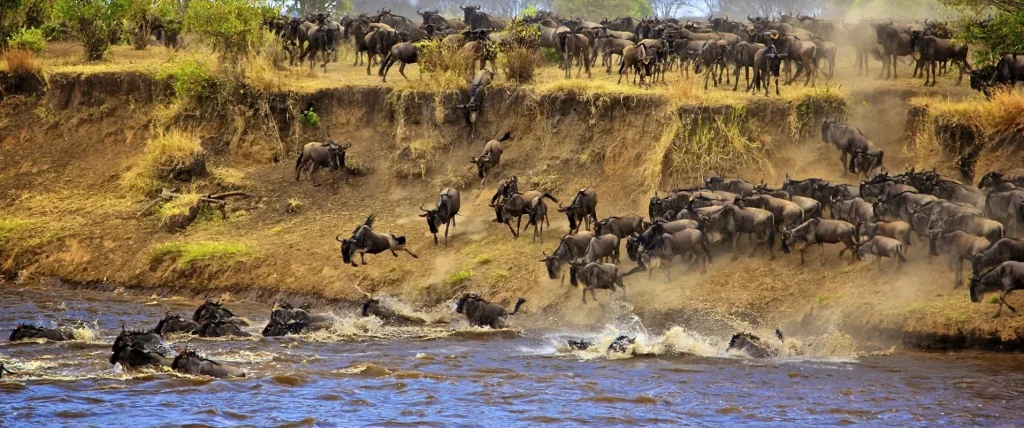
Wildebeest river crossing photography is among the most demanding situations on a migration safari. Animals may suddenly begin running, jumping or entering water, and the scene can contain dust, splashing water and overlapping subjects. A useful starting point is to use a fast shutter speed, continuous autofocus and continuous shooting.
For running wildebeest, approximately 1/1600 to 1/2500 second can be a practical starting range; faster speeds may be needed to freeze splashing water or very rapid movement. An aperture around f/5.6 to f/8 may provide a useful balance between light and depth of field, depending on the lens, and auto ISO can help maintain the selected shutter speed as light conditions change. These are starting points, not universal settings—the correct exposure depends on the actual light, camera and desired result.
Camera Settings for Elephants and Large Mammals
Elephants and other large mammals often move more slowly than animals involved in a river crossing.
For relatively calm subjects, a shutter speed around 1/500 to 1/1000 second may be sufficient, depending on movement and focal length.
A slower speed may work when the camera is well supported and the subject is stationary.
Aperture selection depends on the composition.
For a single elephant portrait, a wider aperture may help separate the animal from the background.
For a group of elephants at different distances, a smaller aperture may be preferable.
Camera Settings for Lions and Leopards
Big cats present different challenges.
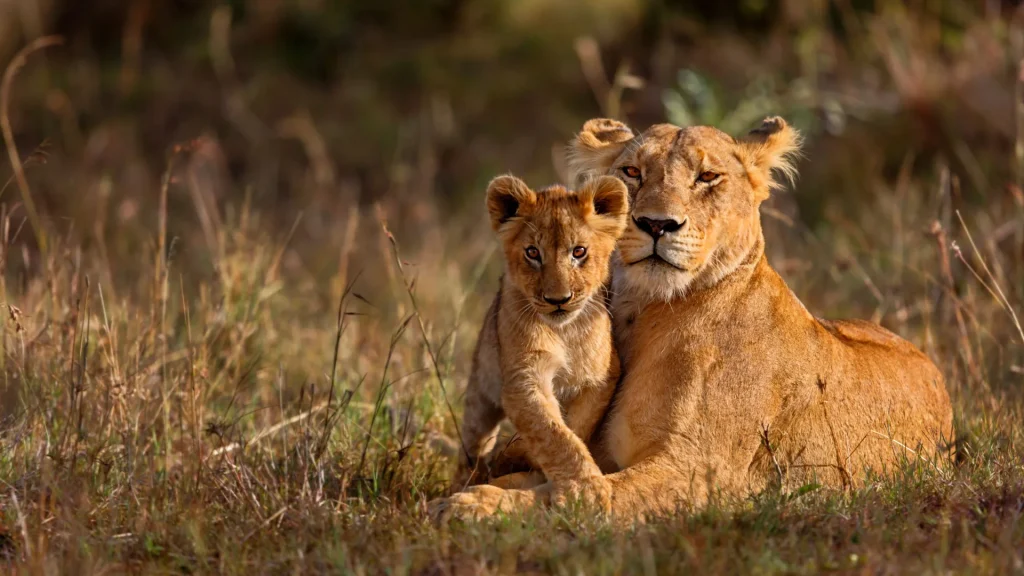
A resting lion may remain almost motionless, allowing relatively moderate shutter speeds.
However, a sudden head movement or change in posture can produce motion blur.
For resting animals, approximately 1/500 second can be a reasonable starting point with a stable setup.
For walking or running predators, increase the shutter speed.
Focus should generally be placed on the animal’s eye when practical.
Leopards in shaded woodland may require higher ISO settings because light levels are lower.
Camera Settings for Birds in Flight
Bird photography often requires particularly fast shutter speeds.
A starting point around 1/2000 to 1/3200 second can be useful for birds in flight.
Continuous autofocus and an appropriate tracking mode are important.
Larger birds may be easier to track than small, rapidly moving species.
Practise following birds smoothly before the safari.
The ability to keep a moving subject within the viewfinder is a skill that improves with experience.
Understanding Exposure Compensation
Wildlife photography often involves challenging backgrounds.
A dark animal against pale grass may cause the camera to produce an exposure that is not ideal.
Similarly, a white bird against dark vegetation can be overexposed.
Exposure compensation allows the photographer to adjust the brightness selected by the camera’s automatic metering system.
Learning to use it quickly can improve results in changing light.
The camera’s histogram and highlight warnings are useful tools for checking exposure.
Avoid relying exclusively on how bright an image appears on the rear screen.
RAW Versus JPEG for Safari Photography
RAW files preserve more image information and provide greater flexibility during editing.
This is particularly useful when photographing animals against bright skies or in challenging early morning light.
However, RAW files occupy more storage space.
JPEG files are smaller and easier to share immediately.
Many photographers choose to record RAW and JPEG simultaneously.
This provides editing flexibility while retaining convenient files for quick viewing.
The best approach depends on storage capacity and the intended use of the photographs.
Memory Cards and Storage
A migration safari can generate thousands of images, and continuous shooting during river crossings produces particularly large numbers of files. Carry several reliable memory cards rather than depending on one card for the entire trip, and use cards compatible with the camera’s required write speeds.
If possible, back up photographs each evening using a portable SSD or laptop. For particularly important photographs, keeping files on both the memory card and a separate backup device provides greater protection. Avoid formatting memory cards until the images have been safely copied and verified.
Batteries and Charging
Safari photography often begins before sunrise.
Long game drives, continuous autofocus and frequent image review can consume substantial battery power.
Carry spare batteries and charge them whenever facilities are available.
Check the electrical socket arrangements at your accommodation.
Some remote safari camps use solar power or generators and may have restrictions on high-power equipment.
A suitable charging adapter is essential.
Travellers should also check airline rules concerning spare lithium-ion batteries, which generally need to be carried in hand luggage rather than checked baggage.
Protecting Cameras from Dust
Dust is one of the most common practical challenges during a Kenya wildlife photography safari. Fine particles can settle on lenses, camera bodies and exposed equipment. Avoid changing lenses while the safari vehicle is moving through dusty conditions; when a lens change is necessary, protect the camera opening and work as quickly as practical.
- Carry a blower and suitable lens-cleaning materials.
- Use a simple protective cover when travelling on dusty roads.
- Do not use rough clothing to wipe dust from optical surfaces, because particles may scratch the lens coating.
Rain Protection
The Masai Mara can experience rain during different periods of the year.
Sudden showers may occur even outside the main rainy seasons.
A lightweight rain cover is useful for protecting camera equipment.
Weather-sealed equipment provides additional protection but should not be treated as waterproof.
After exposure to moisture, allow equipment to dry appropriately before storing it for an extended period.
Avoid placing wet cameras inside sealed bags without ventilation.
Beanbags and Camera Supports
A safari photography beanbag is one of the most useful accessories for long-lens photography.
It can provide support when shooting from an open vehicle window or suitable roof opening.
A beanbag is often more practical than a tripod inside a safari vehicle.
Tripods can be difficult to position when several guests share the vehicle.
They may also interfere with movement during sudden wildlife encounters.
The best support depends on the vehicle design.
Travellers should discuss camera equipment with the safari operator before departure.
Choosing a Photography-Friendly Safari Vehicle
The quality of the safari vehicle can have a major influence on photography.
A vehicle with a pop-up roof or suitable open viewing arrangement provides opportunities to photograph wildlife from different angles.
Window seats are particularly valuable for photographers.
A private safari vehicle allows greater flexibility because the guide can respond to individual photographic interests.
In a shared vehicle, guests must balance their preferences with those of other travellers.
Photographers carrying long lenses should ask about vehicle space and the number of passengers.
A well-organised photography safari should prioritise comfortable positioning and safe equipment handling.
Why a Private Safari Can Be Better for Photographers
A private Masai Mara photography safari offers several advantages.
The guide can spend longer at a productive sighting without needing to accommodate different preferences.
Photographers can choose to wait for animal behaviour rather than moving quickly to another location.
A private vehicle also provides more space for camera bags and equipment.
This is particularly useful during migration season, when patience may be required near potential river crossing locations.
However, private guiding increases the cost per traveller.
For photographers on a limited budget, a small shared group with similar interests can be a practical alternative.
Photographing the Great Migration Responsibly
Wildlife photography must never take priority over animal welfare. Safari vehicles should remain on authorised roads and follow the rules of the relevant protected area. Guides must not block animals approaching river crossings or position vehicles in ways that interfere with their movements.
Crowding around wildlife can create stress and reduce the quality of the experience for everyone. Photographers should never ask a guide to chase animals or approach dangerously close for a better image. Respectful distance often produces more natural photographs and protects the long-term sustainability of wildlife tourism.
Best Time for Migration Photography
The Great Wildebeest Migration moves through the Serengeti–Mara ecosystem throughout the year. The herds generally enter the Kenyan Masai Mara during part of the July-to-October period, but the exact timing varies with rainfall and grazing conditions. River crossings are particularly unpredictable.
Travellers should avoid selecting dates solely on the assumption that a crossing will occur during a specific week. The best approach is to allow several days in the Mara, remain flexible, and rely on a knowledgeable guide to monitor current wildlife activity and select suitable viewing areas.
Morning and Afternoon Photography
Early morning provides soft light and cooler temperatures.
It is particularly attractive for animal portraits and landscape compositions.
Morning mist may also create atmospheric scenes in suitable conditions.
Late afternoon produces warm light that can emphasise the colours of the grassland.
Backlighting can create dramatic outlines around animals, especially when dust is present.
Midday light is often harsher, but it can still be useful for action photography because strong light allows faster shutter speeds.
Photographers should adapt their approach rather than assuming that useful images are possible only at sunrise and sunset.
Best Locations for Migration Photography
Mara Triangle
The Mara Triangle provides access to western Mara habitats and sections of the Mara River.
It is particularly attractive for photographers interested in migration landscapes and resident wildlife.
Central Masai Mara
The central reserve supports a variety of wildlife habitats and provides opportunities for predator and herbivore photography.
Actual wildlife distribution varies.
Mara River
The Mara River is associated with the famous migration crossings.
However, access to specific viewing points is controlled by reserve regulations.
Photographers should rely on authorised guides and avoid obstructing wildlife.
Surrounding Conservancies
Private conservancies around the Mara can provide excellent resident wildlife photography.
However, they do not all offer direct access to the main river crossing areas.
Travellers should choose accommodation according to their specific photographic priorities.
How Many Days Do You Need for Migration Photography?
A two-night safari provides limited opportunities for serious migration photography.
Three nights offer a more practical introduction.
Four or five nights allow greater flexibility for changing weather, wildlife movements and different photographic locations.
A week may be worthwhile for dedicated wildlife photographers.
However, a longer stay does not guarantee a river crossing.
The main advantage is the opportunity to respond to natural events without rushing.
Should You Rent Camera Equipment?
Renting a telephoto lens can be a sensible alternative to purchasing expensive equipment for a single safari.
A quality lens may make a greater difference than upgrading to a new camera body.
However, rental equipment should be tested before departure.
Travellers should understand the lens’s weight, handling and autofocus behaviour.
Check insurance coverage and responsibility for accidental damage.
International travellers should also consider transport arrangements and airline baggage limits.
Camera Equipment Checklist for a Migration Safari
A practical safari camera gear checklist includes:
- A reliable camera body.
- A suitable telephoto zoom lens.
- A shorter zoom lens for landscapes and close wildlife.
- Spare batteries and chargers.
- Several high-quality memory cards.
- A portable backup device.
- A blower and lens-cleaning materials.
- Dust and rain protection.
- A comfortable camera strap.
- A beanbag or other suitable support.
- Binoculars.
- A universal travel adapter.
Not every photographer needs every item.
The aim is to carry equipment that can be used confidently rather than transporting unnecessary weight.
Common Migration Photography Mistakes
- Using a shutter speed that is too slow for moving wildlife.
- Relying on a long telephoto lens for every situation, making it difficult to capture large herds or nearby animals.
- Spending too much time reviewing images while important behaviour continues.
- Carrying insufficient memory cards and batteries for long game drives.
- Changing lenses in dusty conditions, which increases the risk of contamination.
- Concentrating entirely on river crossings while overlooking the many other photographic opportunities in the Mara.
The migration is a broader ecological event, and its story includes grazing, movement, predator interactions and the surrounding landscape.
Frequently Asked Questions About Migration Safari Cameras
What is the best camera for a migration safari?
A modern mirrorless or DSLR camera with reliable autofocus, good continuous shooting performance and a suitable telephoto lens is an excellent choice. The best model depends on budget and experience.
Is a 400mm lens enough for the Masai Mara?
A 400mm lens is useful for many safari situations. Additional reach can help with distant wildlife and birds, but flexibility is often more important than maximum focal length.
Do I need a full-frame camera?
No. APS-C cameras can produce excellent wildlife photographs when paired with suitable lenses.
What shutter speed should I use for wildebeest crossings?
Approximately 1/1600 to 1/2500 second is a useful starting range for fast action, although the correct setting depends on movement and available light.
Should I shoot RAW or JPEG?
RAW provides greater editing flexibility. Many photographers record both RAW and JPEG.
Is a tripod necessary?
Usually not. A beanbag or suitable vehicle support is often more practical.
Can I photograph river crossings every day?
No. River crossings are unpredictable and cannot be guaranteed on any particular day.
Is a private safari vehicle worth it?
For serious photographers, a private vehicle provides flexibility, space and the opportunity to spend longer at productive sightings.
Plan a Masai Mara Photography Safari with Safari Trips to Kenya
The best camera for a migration safari is the one that allows you to respond confidently to changing wildlife situations. A reliable camera, versatile telephoto lens and good understanding of autofocus and exposure will often produce better results than an expensive but unfamiliar setup.
At Safari Trips to Kenya, we arrange Masai Mara photography safaris with private or small-group vehicle options, professional guides and accommodation selected according to travel dates and photographic priorities.
We can help plan longer stays during the migration season, choose suitable areas of the Mara and organise itineraries that allow time for patient wildlife observation.
Contact our team with your preferred dates, number of travellers and photography interests to plan a personalised Great Migration photography safari in Kenya.