
How Many Wildebeest Migrate
The Great Wildebeest Migration involves an estimated 1.3 to 1.5 million wildebeest, making it one of the world’s most remarkable large-mammal movements. The frequently quoted figure of 1.5 million is a useful approximation, but it should not be treated as an exact count that remains unchanged throughout the year.
The population changes as calves are born, animals die and environmental conditions influence survival. Scientific estimates also vary according to survey methods and the period studied. The migrating wildebeest are joined by large numbers of zebras and other grazing animals moving through the Serengeti–Mara ecosystem of Tanzania and Kenya.
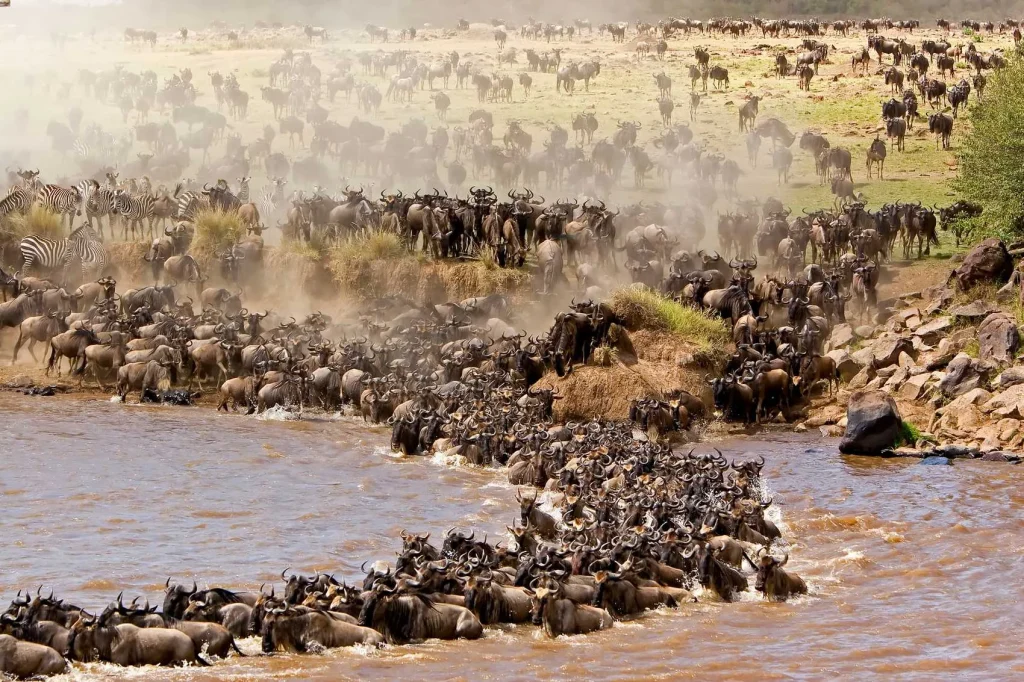
For visitors, the scale is difficult to imagine until they see the herds spread across the plains. Thousands of wildebeest may be visible in one direction, with more animals appearing beyond the horizon. Yet the entire migratory population is rarely concentrated in one place. The herds can spread across enormous areas, sometimes forming large concentrations and at other times breaking into smaller groups.
Understanding how many wildebeest migrate each year also helps explain the ecological importance of this movement, the spectacular calving season and the uncertainty involved in planning a migration safari.
How Many Wildebeest Take Part in the Great Migration?
The commonly cited estimate is approximately 1.5 million migratory wildebeest. Some references use a range of roughly 1.3 to 1.5 million. These are estimates rather than permanent fixed totals.
Wildlife populations are dynamic. Numbers change through births, deaths and environmental pressures. Researchers use aerial surveys and other scientific methods to estimate large herbivore populations across the ecosystem. Counting every animal individually would be impractical.
Does Exactly 1.5 Million Wildebeest Migrate?
No. The figure is a rounded estimate and should not be interpreted as a precise number of animals travelling together. Nor does it mean that 1.5 million wildebeest enter the Masai Mara simultaneously. The population is distributed across the wider Serengeti–Mara ecosystem.
Why Do Estimates Differ?
Population estimates depend on when surveys take place and how they are conducted. Animals may be spread over large areas, and some groups can be difficult to observe. Births and deaths also change the population. For these reasons, different sources may report somewhat different figures.
Are All the Wildebeest in One Herd?
No. The Great Migration does not consist of one enormous, tightly packed herd moving along a single route. Instead, wildebeest form groups of different sizes. Some concentrations may include thousands of animals, while other groups may be much smaller.
The animals respond to grazing conditions, rainfall and the movements of surrounding herds. This means the migration can look very different from one month to another. A visitor may encounter an immense concentration of wildebeest on one day and relatively few animals in the same area several weeks later.
Where Do the Migrating Wildebeest Live?
The migratory population moves through the Serengeti–Mara ecosystem, which extends across northern Tanzania and southwestern Kenya. Important regions include the southern Serengeti, central Serengeti, western corridor, northern Serengeti and Masai Mara.
The animals move between these landscapes according to seasonal conditions. Their route is not a perfectly circular path followed by every individual. Some herds may take different routes or remain in particular areas for longer periods.
How Many Wildebeest Enter the Masai Mara?
There is no fixed number that enters the Masai Mara every year. The number depends on rainfall, grazing conditions and herd movements. Some migratory groups cross into Kenya, while others may remain in northern Tanzania. Animals may move back and forth across the international border.
Consequently, the full migratory population should not be described as spending the entire migration season inside the Masai Mara. The Mara is one important part of a much larger ecosystem.
How Many Zebras Join the Migration?
The Great Migration also involves substantial numbers of zebras. Estimates often describe several hundred thousand zebras participating in movements across the ecosystem. However, exact numbers vary.
Zebras and wildebeest may graze in the same broad areas, but their feeding preferences differ. Zebras can consume taller, coarser grasses, while wildebeest generally favour shorter, nutritious grazing. These differences can help explain why the species are frequently found together.
Do Gazelles Migrate with Wildebeest?
Several antelope species occur in the Serengeti–Mara ecosystem. Some may show seasonal movements associated with environmental conditions. However, their movements should not automatically be described as identical to those of wildebeest.
The widely quoted migration spectacle primarily concerns wildebeest, accompanied by zebras and other grazing animals. Each species has its own ecological requirements and movement patterns.
How Many Wildebeest Calves Are Born Each Year?
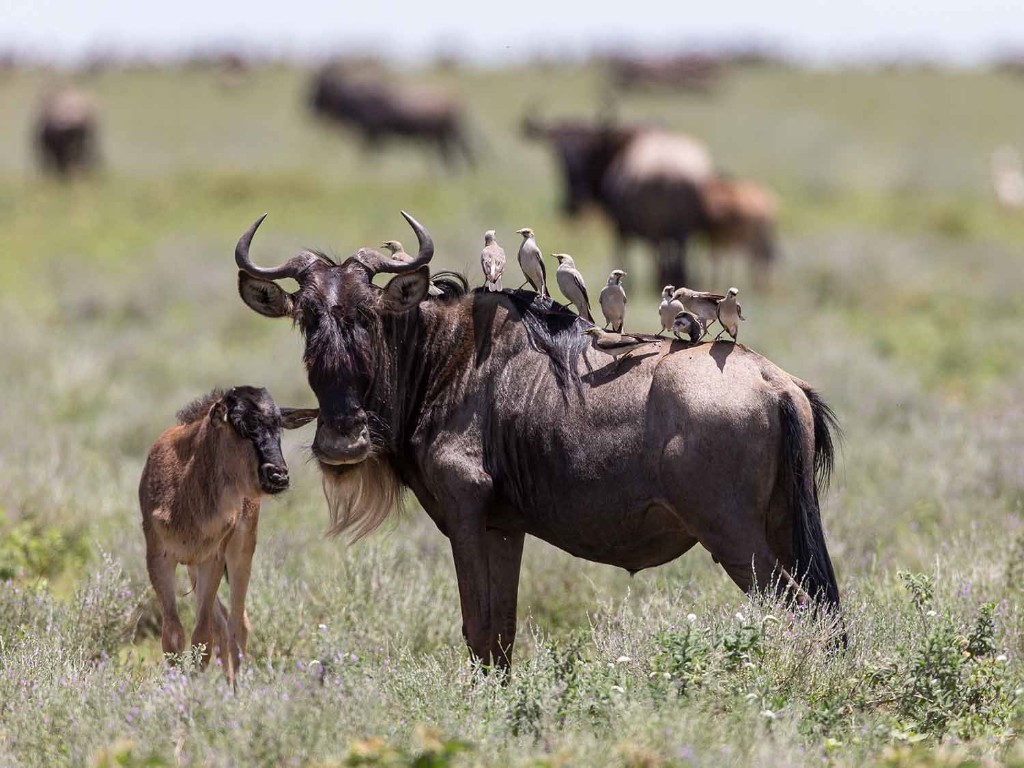
The wildebeest calving season is one of the most extraordinary stages of the migration. During a relatively concentrated period, hundreds of thousands of calves may be born across the southern Serengeti and nearby Ndutu plains. A commonly quoted estimate is around 400,000 to 500,000 calves in a season, although actual numbers vary.
Why Are So Many Calves Born Together?
Wildebeest have a strongly seasonal breeding cycle. Many females give birth during a relatively short period when grazing conditions are favourable. This synchronised calving produces large numbers of vulnerable young animals within a limited time and also attracts predators and scavengers.
Where Does Calving Take Place?
The calving season is particularly associated with the southern Serengeti and Ndutu region. It generally occurs during the early part of the year, especially around January to March, with February often highlighted. However, timing depends on seasonal conditions.
Can Tourists See Wildebeest Calving?
Yes, during suitable periods in the appropriate areas. However, births cannot be guaranteed on a particular game drive. Travellers should plan according to the broader seasonal window.
How Many Wildebeest Die During Migration?
There is no single reliable annual figure that applies to every year. Wildebeest face mortality from predation, disease, injury, starvation and environmental conditions. River crossings can also be dangerous.
However, it would be misleading to suggest that all migration deaths occur during dramatic river crossings. Many animals die in less visible circumstances across the wider ecosystem.
Are Crocodiles Responsible for Most Deaths?
No such general conclusion should be assumed. Crocodiles are important predators at certain river crossings, but mortality occurs through many different causes.
Do Lions Follow the Migration?
Lions and other predators may take advantage of concentrations of grazing animals. However, predators also occupy territories and use resident prey populations. Their movements are not necessarily identical to those of the wildebeest.
Why Do So Many Wildebeest Migrate?
Wildebeest depend on suitable grazing and water. The Serengeti–Mara ecosystem experiences seasonal changes in rainfall. These changes influence grass growth and the distribution of resources. Large numbers of animals move across the landscape to take advantage of changing conditions.
The migration is therefore an ecological response to the environment rather than a journey towards one permanent destination.
How Far Do 1.5 Million Wildebeest Travel?
The annual migration circuit is often described as approximately 800 kilometres. However, this is a general estimate. Individual animals may travel different distances. Some herds move farther than others, and the route changes according to grazing conditions and rainfall.
Wildebeest may also move back and forth within particular regions. The migration should not be imagined as every animal walking exactly 800 kilometres in a straight line.
When Are the Largest Herds in the Southern Serengeti?
The southern Serengeti is particularly important during the calving period. Large concentrations of wildebeest may gather where nutritious grasses are available. This commonly occurs during the early part of the year. However, herd distribution changes with rainfall.
Visitors interested in the calving season should plan a southern Serengeti itinerary rather than assuming the main herds will be in Kenya.
When Are Large Herds in the Western Serengeti?
The western corridor is commonly associated with migration activity around May and June. Some herds may move through areas associated with the Grumeti River. However, not every wildebeest follows the same route, and crossings cannot be guaranteed.
When Are Large Herds in the Masai Mara?
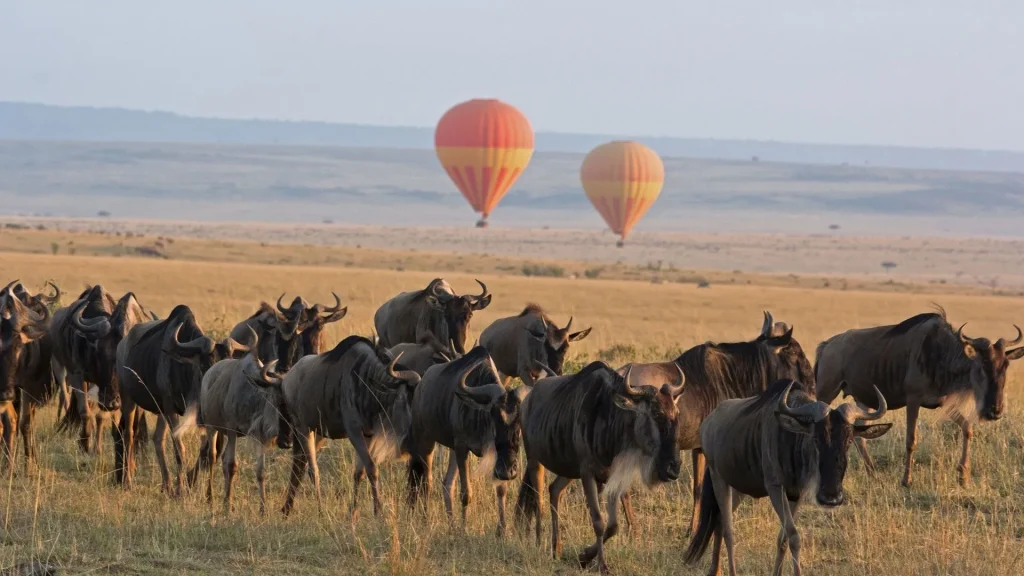
The Masai Mara is commonly associated with migration activity from July through October. August and September are popular planning months. However, the exact timing of herd movements varies. Some years may see earlier arrivals or later departures. Large numbers of wildebeest may remain in Tanzania even when other herds are present in Kenya.
How Do Researchers Count Migrating Wildebeest?
Estimating the population of a migratory species spread across a vast ecosystem is challenging. Researchers may use aerial surveys, statistical sampling and other methods. Aerial observations allow teams to examine extensive landscapes. However, survey accuracy depends on visibility, animal distribution and methodology.
Population estimates therefore carry uncertainty. Scientific monitoring is important for understanding long-term trends.
Has the Wildebeest Population Always Been This Large?
No. Wildebeest populations have changed over time. Disease, environmental conditions, conservation measures and habitat changes have influenced population levels. The history of the Serengeti ecosystem includes major changes associated with livestock disease and wildlife recovery.
The present-day migration is therefore part of a changing ecological history. Population monitoring remains important.
Why Is the Great Migration Important?
The movement of large herbivore populations has profound ecological effects. Wildebeest consume grass across extensive areas. Their grazing influences vegetation, their movement also redistributes nutrients, and predators and scavengers depend partly on the availability of large herbivores.
The migration also connects different habitats within the ecosystem. Protecting these connections is essential for maintaining the natural process.
What Would Happen If Migration Routes Were Blocked?
Wildlife movement depends on access to suitable habitats. Barriers, habitat fragmentation and incompatible land uses can interfere with migration. If animals cannot reach seasonal grazing or water, their survival may be affected.
Conservation therefore requires attention to landscapes beyond individual park boundaries. The Serengeti–Mara ecosystem includes protected areas and community lands that are important to wildlife movement.
How Many Wildebeest Can You See on One Safari?
There is no predictable number. A visitor may encounter thousands of wildebeest during a game drive when large herds are present. At other times, animals may be dispersed or absent from the selected area. The number visible depends on season, location, weather and natural movements. A safari operator cannot guarantee that a particular number of wildebeest will be seen.
How Many Days Should You Spend Watching the Migration?
Three or four nights is a useful choice for many migration-focused visitors. Longer stays provide more opportunities to explore different areas. However, additional days do not guarantee a river crossing or a particular herd concentration.
A well-designed itinerary should include other wildlife interests. The Masai Mara supports lions, elephants, giraffes, buffaloes and numerous bird species throughout the year.
Best Places to See the Great Migration
Southern Serengeti
Best known for calving-season experiences.
Western Serengeti
Associated with the Grumeti migration stage.
Northern Serengeti
Important for migration movements near the Mara River.
Masai Mara
Kenya’s principal destination for migration-focused safaris. The best location depends on travel dates.
Photography Tips for Large Wildebeest Herds
Photographing large herds requires a different approach from photographing individual animals. A wide-angle lens can capture the scale of the landscape, and a telephoto lens is useful for animal behaviour. Look for patterns, movement and changes in light.
Dust can create dramatic scenes but may also affect equipment. Photographers should remain in authorised areas and avoid disturbing wildlife.
Frequently Asked Questions
How many wildebeest migrate every year?
The commonly cited estimate is approximately 1.3 to 1.5 million wildebeest.
Are all 1.5 million wildebeest in the Masai Mara?
No. The animals are distributed across the wider Serengeti–Mara ecosystem.
How many wildebeest calves are born?
Hundreds of thousands may be born during the calving season, with commonly cited estimates around 400,000 to 500,000.
How many zebras join the migration?
Several hundred thousand zebras are commonly associated with the wider migration.
Do all wildebeest cross the Mara River?
No. Herds use different routes and may move between Kenya and Tanzania.
Is the population the same every year?
No. Births, deaths and environmental conditions influence population size.
Where can I see the migration in Kenya?
The Masai Mara is Kenya’s principal migration destination.
Plan Your Great Migration Safari
The answer to how many wildebeest migrate is extraordinary: roughly 1.3 to 1.5 million animals moving through one of Africa’s most important wildlife ecosystems. Yet the significance of the migration goes beyond the number. It is a continuous ecological process involving grazing, calving, predation and seasonal movement across Kenya and Tanzania.
At Safari Trips to Kenya, we help travellers plan migration-focused itineraries in the Masai Mara and explore suitable East African safari combinations. Contact our team with your preferred dates and wildlife interests to receive a personalised migration safari proposal.