
How Far Wildebeest Migrate
How far do wildebeest migrate? The Great Wildebeest Migration is frequently described as an annual journey of approximately 800 kilometres (500 miles) around the Serengeti–Mara ecosystem. This is a useful general estimate of the migration circuit, but it is not an exact distance travelled by every animal.
In reality, wildebeest do not follow a single marked route. Different herds move across different parts of the landscape, sometimes travelling considerable distances while searching for suitable grazing and water. Some animals move farther than others, and the route changes according to rainfall, grass growth and environmental conditions.
The migration takes place across the vast ecosystem shared by northern Tanzania and southwestern Kenya. Its most famous destinations include the Serengeti National Park and the Masai Mara National Reserve. For safari travellers, understanding migration distance helps explain why the herds are not always where a calendar suggests they should be. It also shows why a migration safari requires careful destination selection: a traveller visiting the Masai Mara in February is unlikely to encounter the main migratory herds in the same areas where they may be found during parts of August or September.
This guide explains the approximate migration distance, the annual route, why wildebeest move, how fast they travel and what the journey means for planning a safari.
What Is the Total Wildebeest Migration Distance?
The annual Great Migration is commonly described as covering approximately 800 kilometres. However, this figure should be understood as a broad representation of the migration circuit rather than a precise measurement. The actual distance travelled by an individual wildebeest can vary substantially. Some animals may move between grazing areas without following the full commonly illustrated circuit, while others may travel additional distances as they change direction, search for suitable grazing or respond to environmental conditions. The migration is therefore better understood as a dynamic movement across a large ecosystem than as a fixed-distance race.
Is the Migration Exactly 800 Kilometres?
No. The 800-kilometre figure is an approximate description, and there is no single distance that applies to every wildebeest. Individual movements differ, and seasonal rainfall also influences the extent of movement. Some herds may spend longer in particular areas, while others continue moving.
Why Is the Distance Difficult to Measure?
A migration route is not like a road connecting two cities. Wildebeest may move in multiple directions, return to grazing areas or travel along different paths, and the landscape includes plains, rivers, woodland and other habitats. Researchers can study movement patterns through observation and tracking, but the total distance varies among individuals and years.
Where Does the Great Wildebeest Migration Take Place?
The migration takes place in the Serengeti–Mara ecosystem, which extends across Tanzania and Kenya. The main landscapes include:
- Southern Serengeti and the wider Ndutu area.
- Central Serengeti.
- Western Serengeti.
- Northern Serengeti.
- Masai Mara ecosystem.
These regions are connected by wildlife movement. The migration should not be viewed as separate events occurring independently in each country; the herds move through the wider ecosystem according to changing environmental conditions.
Why Do Wildebeest Migrate Such Long Distances?
The primary reason is access to suitable grazing and water. Wildebeest are grazing animals, and their survival depends on the availability of grass and other resources. Rainfall influences vegetation growth, and when conditions change, animals move towards areas offering better feeding opportunities.
The migration also forms part of the animals’ breeding cycle. However, it is not correct to say that every movement is driven by one simple factor. Rainfall, grass quality, water availability and animal behaviour all contribute.
The Annual Wildebeest Migration Route
The migration is often illustrated as a broad circular movement, but the real pattern is more complex. The following seasonal description provides a general guide.
January to March: Southern Serengeti and Calving Areas
During the early part of the year, many migratory wildebeest are commonly associated with the southern Serengeti and nearby Ndutu region. These landscapes provide important grazing areas. The calving season is generally associated with this period, particularly around February, although timing varies.
Large numbers of calves may be born within a relatively concentrated period, creating opportunities to observe newborn animals and predator-prey interactions. However, the exact distribution of herds depends on rainfall.
How Far Have the Herds Travelled?
It is difficult to assign a single distance to this stage. Some animals may have moved south from northern or central areas during previous months, while others may follow different routes. The distance depends on the individual herd’s movements.
April to May: Movement Through Central Areas
As seasonal conditions change, many herds begin moving through central parts of the Serengeti. The movement is not simultaneous: different groups may travel at different times, some may remain in areas with suitable grazing and others may move more quickly. This is an important reason migration calendars should be treated as approximate guides.
What Do Travellers See?
Visitors may encounter large grazing herds, moving groups and resident predators. However, the animals may be spread across extensive areas, and a guide’s local knowledge is valuable when selecting game-drive routes.
May to June: Western Serengeti and Grumeti
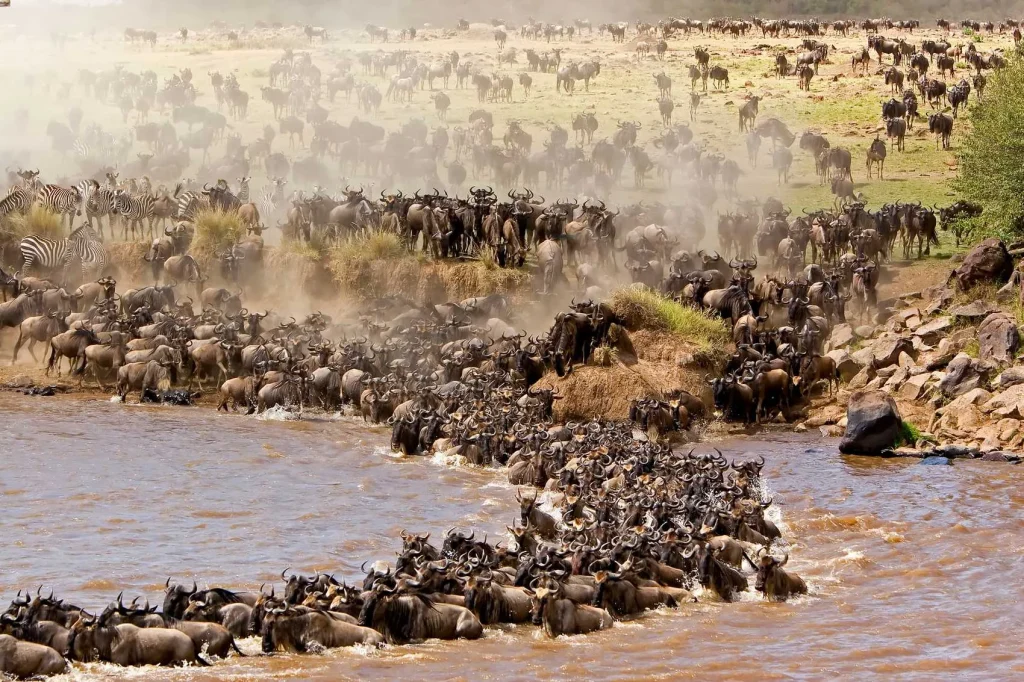
The western Serengeti is often associated with migration activity during May and June. Some herds move through the western corridor, and the Grumeti River may form part of their route. River crossings can occur, but they are not guaranteed. The western corridor also supports resident wildlife, so a safari can therefore be rewarding even when the main migratory herds are elsewhere.
Does Every Wildebeest Cross the Grumeti River?
No. Not every herd follows the same route. Some animals may move through other areas, and crossing behaviour depends on the route and local conditions.
July to October: Northern Serengeti and Masai Mara
During the middle and later part of the year, many migratory herds may occupy northern areas of the ecosystem. This stage is particularly associated with the Mara River and the Masai Mara. The exact timing varies: some herds may remain in Tanzania, others may cross into Kenya and movement can occur in both directions.
How Far Is the Serengeti from the Masai Mara?
The Serengeti and Masai Mara are adjoining parts of the same ecosystem. There is no single meaningful distance between them because both cover large geographical areas. The distance from one specific lodge to another can be substantial, and likewise the distance travelled by migrating animals depends on their starting and ending points. Travellers should not confuse the distance between tourist accommodation with the route used by wildlife.
November to December: Movement Towards Southern Areas
As rainfall and grazing conditions change, many herds begin moving towards central and southern parts of the Serengeti ecosystem. The timing varies, and some animals may travel in smaller groups while others may be spread across broad areas. The annual cycle continues without a formal starting line or finishing point.
How Fast Do Wildebeest Migrate?
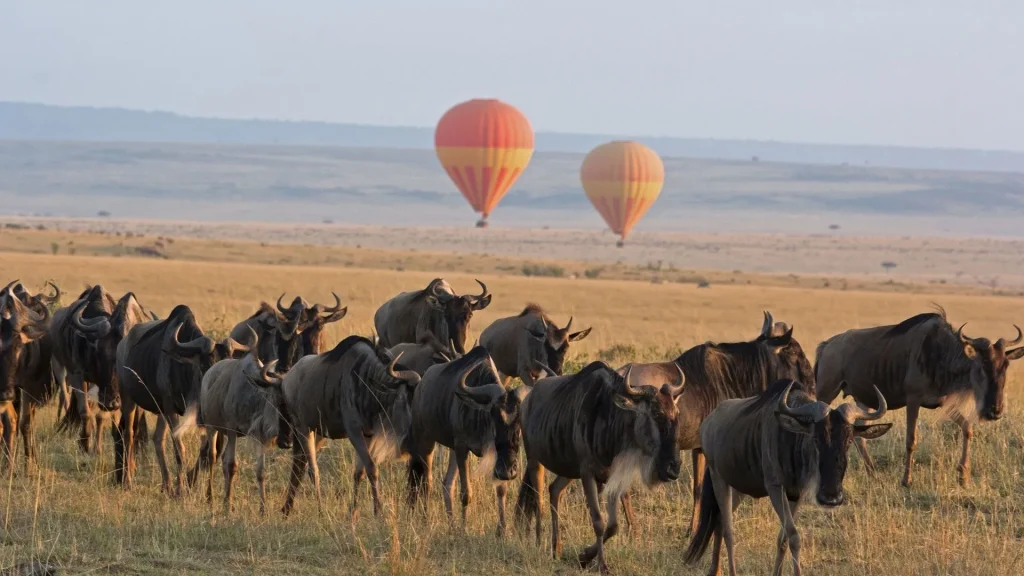
Wildebeest do not travel at one constant speed. Their movement varies according to terrain, weather, grazing conditions and other factors. At times, animals may spend extended periods grazing in one area; at other times, herds may move rapidly. During river crossings or when escaping predators, individual animals may run much faster than their normal travelling pace. However, maximum running speed should not be confused with average migration speed. The annual journey includes substantial periods of feeding, resting and local movement.
Do Wildebeest Migrate Every Day?
No. The migration is not a continuous march. Animals may remain in suitable grazing areas for days or longer, and they may move short distances between feeding and resting locations as movement patterns change with environmental conditions.
A safari visitor may therefore encounter a large stationary herd even during the migration season. This does not mean the migration has stopped; it reflects the natural rhythm of grazing animals.
Do All Wildebeest Migrate?
No. The Serengeti–Mara ecosystem supports migratory wildebeest, but not every wildebeest population in Africa follows the Great Migration route. Some wildebeest populations are more resident, and even within the migratory ecosystem, individual movements vary. It is therefore inaccurate to assume that every wildebeest travels the same annual circuit.
How Many Wildebeest Participate?
The Great Migration involves more than a million wildebeest, alongside large numbers of zebras and other grazing animals. Population estimates vary according to survey methods and time, and the enormous number of animals is one reason the migration is considered one of the world’s great wildlife spectacles.
However, the herds are not always gathered in one place. They may spread across extensive areas, and a traveller should not expect to see the entire migratory population during one game drive.
How Do Wildebeest Know Where to Go?
Wildebeest respond to environmental conditions. Rainfall and grass growth are important influences, and their movements also reflect social behaviour and the actions of other animals. The migration does not require every wildebeest to know a predetermined circular route; instead, large-scale movement emerges from animals responding to changing conditions across the landscape. Researchers continue to study the complex relationship between rainfall, vegetation and migratory behaviour.
What Obstacles Do Wildebeest Face?
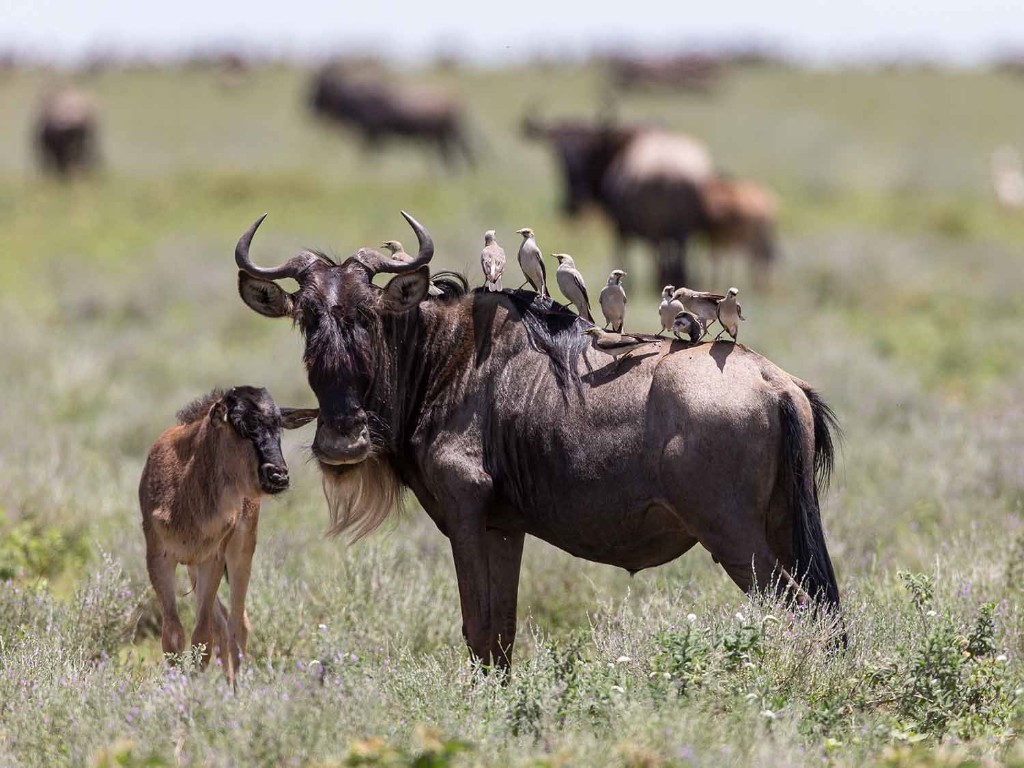
The annual journey involves numerous challenges.
Rivers
Some herds encounter rivers such as the Grumeti and Mara. Water depth, currents and riverbanks can make crossings difficult.
Predators
Lions, hyenas, crocodiles and other predators may prey on wildebeest. However, predators are not responsible for every death during migration.
Drought and Food Availability
Environmental conditions influence the availability of grazing and water.
Disease and Injury
Animals may face illness, exhaustion or injury during their movements.
Human Pressures
Habitat fragmentation and changes in land use can affect wildlife movement. Maintaining connected landscapes is important for migratory species.
How Far Do Zebras Migrate?
Zebras often accompany wildebeest during parts of the Great Migration, but their movements are not necessarily identical. Different species have different feeding preferences and behaviour. Zebras and wildebeest may use the same broad landscape while responding differently to vegetation conditions, and the distance travelled by individual zebras also varies.
Why Is the Migration Important to the Ecosystem?
The movement of large herbivore populations influences grazing patterns and nutrient distribution. Wildebeest consume vegetation across extensive areas, their movement affects plant communities and provides food for predators and scavengers, and the migration also connects different habitats within the Serengeti–Mara ecosystem. Protecting the ability of animals to move is therefore important for the wider ecological system.
What Does Migration Distance Mean for Safari Planning?
The large scale of the migration explains why choosing the correct region matters. A traveller interested in the calving season should consider southern Serengeti areas during the appropriate seasonal window. A traveller interested in the western corridor may consider the Grumeti region, and someone planning a Masai Mara migration safari should focus on the periods when herds are more likely to be present in Kenya. However, none of these seasonal patterns guarantees a particular sighting.
How Many Days Should You Allow for a Migration Safari?
Three Days
A three-day Masai Mara safari can provide an introduction to the reserve. However, travel time and herd movements limit flexibility.
Four to Five Days
Four or five days allows additional wildlife-viewing opportunities and may be particularly useful during migration season.
Seven Days or Longer
Longer itineraries can combine different areas or destinations. However, the route should be designed carefully to avoid excessive transfers.
Can You Follow the Entire Migration on One Safari?
A short safari cannot realistically follow the entire annual cycle. The migration unfolds over many months. Travellers can visit different regions during the seasons when herds are more likely to be present, and a longer Kenya–Tanzania itinerary may explore multiple parts of the ecosystem. However, it will still represent only a snapshot of the migration.
Migration Photography and Distance
Large herds can create dramatic photographs, but wildlife may be distant and a guide cannot guarantee close sightings. Responsible photography requires respecting wildlife and park regulations. Useful approaches include:
- A wide-angle lens may capture the scale of the landscape.
- A telephoto lens is useful for individual animals and behaviour.
- Plan compositions knowing that herds may be spread across extensive areas.
Frequently Asked Questions
How far do wildebeest migrate every year?
The annual circuit is often described as approximately 800 kilometres, but individual animals may travel different distances.
Do wildebeest migrate from Kenya to Tanzania?
Yes. Migratory herds move through the wider Serengeti–Mara ecosystem across both countries.
How long does the migration take?
The migration is a year-round cycle rather than a single journey completed over a few days.
Do wildebeest migrate in a straight line?
No. Herds move according to grazing and environmental conditions.
Do all wildebeest cross the Mara River?
No. Routes and crossing behaviour vary.
Why do wildebeest migrate?
They move primarily in response to grazing and water availability, with seasonal environmental conditions influencing their movements.
Can I see the migration in Kenya?
Yes. The Masai Mara is an important destination during periods when migratory herds are present.
Plan Your Great Migration Safari
Understanding how far wildebeest migrate reveals why the Great Migration is more than a dramatic river crossing. It is a year-round movement through a vast ecosystem, shaped by rainfall, grazing and the behaviour of millions of animals.
At Safari Trips to Kenya, we help travellers plan migration-focused safaris in the Masai Mara and explore suitable Kenya–Tanzania combinations. The best itinerary is based on realistic seasonal expectations, enough wildlife-viewing time and carefully selected accommodation.