

Great Wildebeest Migration Ecosystem Overview
Every year, vast numbers of wildebeest move across the grasslands of northern Tanzania and southwestern Kenya. From a distance, the animals can appear like a dark ribbon stretching across the horizon. As they move, they graze, rest, give birth, cross rivers and encounter predators. This is the Great Wildebeest Migration, one of the most remarkable large-scale wildlife movements remaining on Earth.
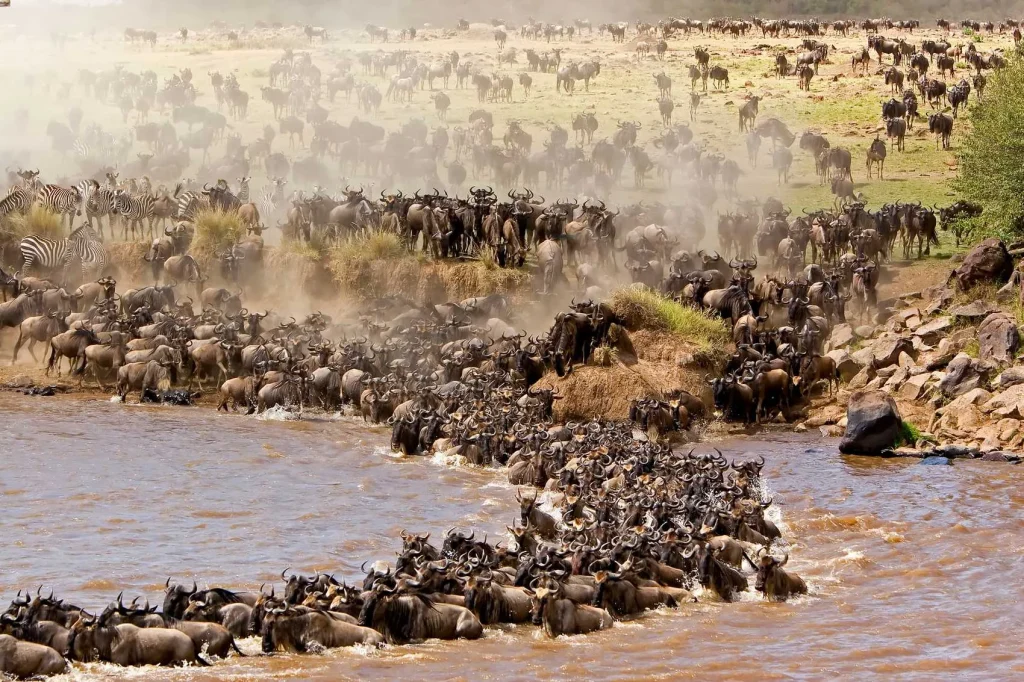
For many travellers, the migration is synonymous with dramatic Mara River crossings. Photographs of wildebeest plunging into crocodile-inhabited water have become some of the most recognisable images of African wildlife. Yet the river crossings represent only a small part of a much larger ecological story.
The migration is fundamentally connected to rainfall, grass growth, soil nutrients, reproduction, predator-prey relationships and the seasonal movement of animals across a vast landscape. The Serengeti–Mara ecosystem is not simply a collection of safari parks; it is a connected ecological system in which animals, vegetation, water and climate interact. Understanding this ecosystem helps explain why the migration occurs, why the herds change location and why protecting wildlife corridors is essential. It also helps travellers choose more meaningful safari experiences rather than focusing exclusively on one dramatic event.
What Is the Great Wildebeest Migration?
The Great Wildebeest Migration is a large-scale seasonal movement of grazing animals through the Serengeti–Mara ecosystem. Wildebeest form the most prominent component, while large numbers of zebras and other grazing animals also occupy and move through the landscape. The animals respond primarily to changes in pasture quality and water availability; as rainfall patterns change, suitable grazing areas shift and herds move to take advantage of these resources.
The migration does not have a single beginning or ending date. It is a continuous ecological process rather than a fixed annual parade.
Where Does the Migration Take Place?
The migration occurs across a connected landscape extending through northern Tanzania and southwestern Kenya. The two best-known protected areas are:
- Serengeti National Park, Tanzania
- Masai Mara National Reserve, Kenya
The wider ecosystem includes adjoining conservation areas, wildlife management landscapes and surrounding rangelands. The Serengeti covers much of the migration’s annual route, while the Masai Mara forms an important northern portion. The animals move according to ecological conditions rather than political boundaries.
Why Is the Serengeti–Mara Ecosystem Important?
The ecosystem supports one of the world’s most extraordinary concentrations of large mammals. Its grasslands provide grazing habitat for wildebeest, zebras, gazelles and other herbivores, while predators such as lions, cheetahs, leopards and hyenas depend on prey populations. Scavengers help process carcasses and recycle nutrients, and birds, insects and smaller mammals occupy different ecological roles.
The migration connects these relationships across a vast landscape. Its importance extends beyond the number of animals involved; it represents a functioning ecological process that depends on access to seasonal habitats.
The Role of Rainfall
Rainfall is one of the principal forces shaping the migration. When rain falls, grass may begin growing in areas that were previously dry, and fresh vegetation can provide valuable grazing. As conditions change, herds may move towards regions with suitable pasture.
However, rainfall is not uniform. One part of the ecosystem may receive substantial rain while another remains relatively dry, creating differences in vegetation growth. Consequently, different herds may occupy different areas at the same time, so the migration is more complex than a single circular procession.
Why Grass Quality Matters
Wildebeest are grazers, and the nutritional quality of grass influences where they feed. Young grass can provide important nutrients, while different soil types and rainfall conditions affect vegetation growth. The southern Serengeti’s short-grass plains are particularly important during the calving season because they can provide suitable grazing for breeding females.
As seasonal conditions change, animals move towards other areas. The migration is therefore closely linked to the productivity of the grasslands.
The Southern Serengeti Short-Grass Plains
The southern Serengeti and adjoining Ndutu region are central to the migration’s reproductive cycle. During suitable seasonal conditions, large concentrations of wildebeest gather on these plains, which are particularly associated with calving. The open landscape provides extensive grazing, although the exact distribution of animals varies according to rainfall.
For safari visitors, the southern Serengeti is especially relevant during January through March.
The Wildebeest Calving Season
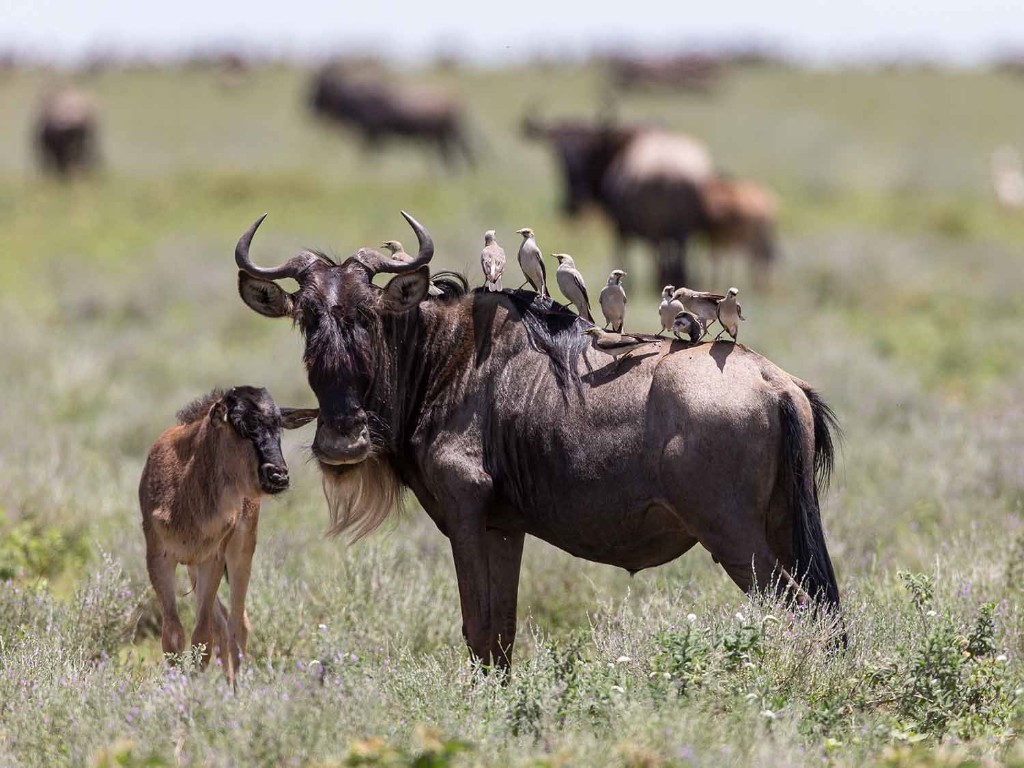
The wildebeest calving season is one of the most important phases of the migration. Large numbers of calves may be born within a relatively concentrated period, which can influence predator-prey interactions. Young calves are vulnerable to predators, although many are able to stand and move soon after birth.
The calving season is not simply a wildlife spectacle; it is essential to the continuation of the migrating population.
The Central Serengeti
The central Serengeti supports varied habitats, including grassland and woodland, and is an important area for resident wildlife. Lions, leopards, elephants, giraffes and other animals may be encountered, and migration herds may move through the region during parts of the annual cycle, although the exact timing depends on environmental conditions.
For travellers, the central Serengeti can provide rewarding wildlife viewing even when the main migration herds are elsewhere.
The Western Serengeti and Grumeti Corridor
The western Serengeti forms part of the broader migration landscape, and seasonal movements may bring substantial herds through this region. The Grumeti River and surrounding habitats are important features; crocodiles inhabit suitable river sections. However, visitors should not assume that every herd crosses the river at the same location or time.
The western corridor supports diverse wildlife beyond the migration, and its ecological importance includes habitats used by both migrating and resident animals.
The Northern Serengeti
The northern Serengeti is particularly important during the northern migration season, when large herds may occupy the region as grazing conditions change. The Mara River is a major landscape feature, and river crossings may occur, although they cannot be predicted precisely. The northern Serengeti also supports resident wildlife, and lions, elephants, giraffes and other animals may be encountered in suitable habitats.
The Masai Mara
The Masai Mara National Reserve forms an important northern component of the Serengeti–Mara ecosystem. During parts of the year, migrating herds may enter Kenya, and the reserve’s grasslands and river systems provide valuable wildlife habitat. The Masai Mara is also known for its resident predator populations, although migration activity varies between years and the timing and distribution of herds depend on grazing and rainfall conditions.
Why the Migration Crosses International Borders
The Kenya–Tanzania border is a political boundary, while wildlife movements developed in response to ecological conditions. Wildebeest do not recognise national borders; they move towards suitable grazing and water. This creates a conservation challenge because protecting the migration requires cooperation across national boundaries and surrounding landscapes. The ecological system must remain connected for large-scale seasonal movements to continue.
The Mara River’s Ecological Role
The Mara River is one of the most famous features of the migration ecosystem. It provides water and supports riverine habitats, and during the northern migration season wildebeest may attempt to cross it. Crossings can be dangerous because of currents, steep banks and crocodiles, but the river’s importance extends beyond dramatic crossings. It supports aquatic life, vegetation and wildlife throughout the year.
Crocodiles and River Crossings
Nile crocodiles inhabit suitable sections of the Mara River and are powerful aquatic predators. During some crossings, crocodiles may attack wildebeest, although not every crossing involves a visible attack. The risks faced by animals also include strong currents and difficult banks.
River crossings are natural events, and responsible safari guides should not interfere with herd movements.
Lions and the Migration
Lions are among the principal predators of large grazing animals and occur throughout suitable habitats in the Serengeti–Mara ecosystem. Many lions occupy established territories, and their hunting opportunities may change as migrating herds move through these areas. Lions may hunt wildebeest, zebras and other prey, although they do not hunt continuously; resting, grooming and social interactions are also important aspects of their behaviour.
Cheetahs and Open Grasslands
Cheetahs are adapted for speed and often use open habitats. They generally hunt smaller prey than lions, and young wildebeest may be vulnerable under certain circumstances. The southern Serengeti calving season can provide opportunities for observing predator behaviour, although sightings and hunts are never guaranteed. Cheetahs are an important part of the ecosystem’s predator community.
Leopards and Woodland Habitats
Leopards are solitary predators that use concealment and occupy suitable woodland, riverine and other habitats. Their diet is varied, and they may take young wildebeest or other prey when opportunities arise, although they are not exclusively dependent on the migration. Their presence demonstrates the diversity of predator strategies within the ecosystem.
Spotted Hyenas
Spotted hyenas are highly capable hunters and scavengers that live in complex social groups. They may hunt wildebeest and other grazing animals and also consume carcasses. Their ecological role includes predation, scavenging and nutrient recycling.
Hyenas are frequently misunderstood because of their reputation as scavengers, but in reality they are important predators.
Vultures and Nutrient Recycling
Vultures help consume carcasses and return nutrients to the ecosystem. They are an essential part of the scavenger community, and different species may feed at different stages. Their presence contributes to the breakdown of animal remains, which is important for ecosystem functioning.
The migration supports not only large predators but also scavengers and many smaller organisms.
Zebras and Wildebeest
Zebras and wildebeest often occupy the same grazing landscapes, although their feeding preferences and grazing behaviour differ. These differences can influence how they use vegetation; zebras may graze taller grasses, while wildebeest often favour shorter, nutritious growth. However, the relationship is more complex than a simple division of labour, and both species respond to changing environmental conditions.
Gazelles and Other Grazers
The Serengeti–Mara ecosystem supports several gazelle and antelope species. Their movements and habitat preferences differ from those of wildebeest, and some species remain in particular areas while others move seasonally. This diversity contributes to the complexity of the grassland ecosystem, and a safari focused only on wildebeest may overlook these important relationships.
Elephants and the Migration Landscape
Elephants are not part of the wildebeest migration, but they occupy suitable habitats within the wider ecosystem. Their feeding and movement can influence vegetation; elephants may browse trees, break branches and create pathways, which can affect habitat structure. Their ecological role differs from that of grazing wildebeest, and the presence of both species contributes to the diversity of the landscape.
Giraffes and Woodland Ecology
Giraffes feed mainly on leaves and other vegetation above ground level, so their browsing behaviour differs from the grazing habits of wildebeest. This allows different herbivores to use different parts of the vegetation. Giraffes are commonly encountered in suitable Serengeti and Masai Mara habitats and provide an example of how ecological diversity supports multiple large mammal species.
The Importance of Wildlife Corridors
The migration depends on access to seasonal grazing areas. If important movement routes become blocked, animals may lose access to resources. Road development, fencing, settlement expansion and changes in land use can create barriers, so conservation planning must consider more than protected-area boundaries. Maintaining connectivity across the wider landscape is essential; the migration cannot be protected solely by conserving one famous river-crossing location.
Human Communities and the Ecosystem
People live in and around the Serengeti–Mara landscape, where pastoralism, agriculture, tourism and conservation interact in complex ways. Local communities are important stakeholders in the future of the ecosystem, and conservation approaches must consider livelihoods, land rights and human-wildlife conflict.
Tourism can provide economic opportunities, but benefits need to be managed responsibly. Long-term conservation depends on cooperation between communities, authorities and other stakeholders.
Tourism’s Role in Conservation
Wildlife tourism generates revenue associated with protected areas and surrounding businesses, and it can support employment and conservation activities. However, tourism also creates environmental pressures: vehicle congestion, waste, infrastructure and inappropriate wildlife viewing can affect habitats.
Responsible operators follow park regulations and promote ethical observation, and travellers can contribute by choosing reputable providers and respecting wildlife.
Climate Variability and the Migration
Climate variability can influence rainfall and grazing conditions, and changes in rainfall timing or intensity may affect the distribution of suitable pasture. However, predicting long-term migration responses is complex because the ecosystem includes many interacting environmental factors. Conservation planning must consider uncertainty and changing conditions, and maintaining connected habitats can help wildlife respond to environmental variation.
Fire and Grassland Ecology
Fire is another ecological process affecting savannah landscapes. Natural and managed fires can influence vegetation structure and nutrient cycling, although their effects depend on timing, intensity and frequency. Grasslands are dynamic systems in which vegetation changes through interactions involving rainfall, grazing, fire and soil conditions, and the migration is part of this broader ecological context.
The Role of Soil Nutrients
Soil characteristics influence grass growth and nutritional quality. Different parts of the Serengeti–Mara ecosystem have different geological and soil conditions, which helps explain why certain grazing areas become especially important during particular seasons. The southern short-grass plains are a notable example. Understanding the relationship between soils and vegetation helps explain why the migration follows broad seasonal patterns.
Why Migration Maps Are Simplified
Most migration maps show a circular route with arrows. These maps are useful for understanding the broad annual cycle, but they can be misleading if interpreted literally. Herds do not move as one continuous group; different groups may occupy different regions simultaneously, and movements may change according to rainfall. A migration map should therefore be treated as a planning guide rather than an exact prediction.
The Annual Migration Cycle
January to March
The southern Serengeti and adjoining plains are particularly important, and the calving season is a major ecological event during this period.
April to June
Seasonal movements may occur through central and western areas, with rainfall and grazing conditions influencing herd distribution.
July to October
The northern Serengeti and Masai Mara become particularly relevant, and Mara River crossings may occur, although timing and location vary.
November to December
Changing rainfall conditions may encourage movements towards southern grazing areas, although this pattern varies between years.
How the Ecosystem Changes During the Year
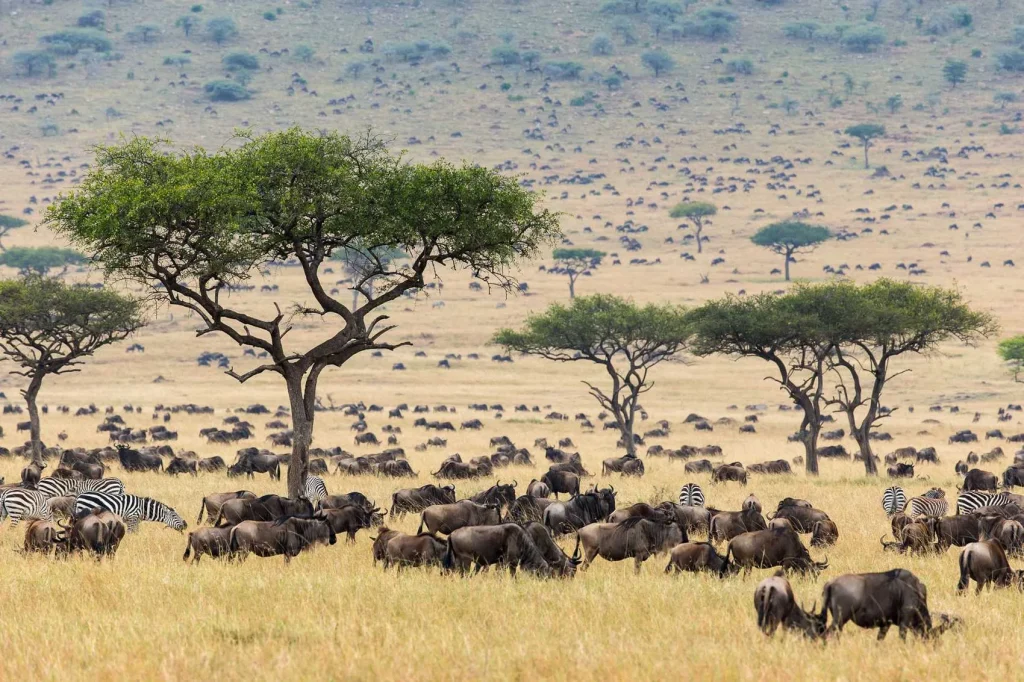
The Serengeti–Mara landscape is not static. Grasslands may be green during wetter periods and golden during drier months, while water availability changes and herd concentrations shift. Predators respond to prey distribution, and birdlife and other ecological activity also vary.
A visitor returning in a different season may experience a dramatically different landscape, and this seasonal variation is one of the ecosystem’s defining characteristics.
Why River Crossings Are Only One Part of the Story
River crossings attract enormous attention because they are visually dramatic, but the migration also includes grazing, reproduction, seasonal movement and predator-prey relationships. A visitor who witnesses no crossing may still observe important ecological processes.
For example, watching thousands of animals graze across the southern plains can reveal the scale of the migration, and observing mothers and calves during the calving season provides insight into reproduction and survival. The full ecosystem is more significant than any single event.
How to Experience the Ecosystem on Safari
A meaningful migration safari should explore different habitats rather than chasing isolated sightings. Spend time observing grazing herds, look for predator behaviour and notice how animals use grasslands, woodland and river systems. Ask your guide about seasonal movements and allow time for patient observation.
- Avoid rushing between sightings simply to collect photographs of different species.
- Understanding behaviour can make even a quiet game drive rewarding.
- Balance time on open plains with woodland and riverine habitats.
- Treat dramatic events as possibilities, not guarantees.
Best Safari Locations by Season
For January through March, consider the southern Serengeti and Ndutu region. For April through June, central and western Serengeti areas may be relevant. For July through October, the northern Serengeti and Masai Mara are particularly attractive. For November and December, consider seasonal movements towards central and southern regions.
These recommendations are broad; actual herd locations depend on current environmental conditions.
Combining Ecosystem Exploration With Other Parks
A migration safari can be combined with other East African destinations. In Kenya, Lake Nakuru provides opportunities to observe rhinos and varied birdlife, Amboseli offers elephants and views of Mount Kilimanjaro when conditions allow, and Samburu introduces northern Kenya’s distinctive habitats. In Tanzania, Ngorongoro Crater provides a different wildlife environment, and Tarangire offers baobab landscapes and seasonal elephant concentrations. These additions help travellers appreciate the diversity of East African ecosystems.
Recommended 7-Day Ecosystem-Focused Safari
Day 1: Arrival and Transfer
Arrive in the relevant safari gateway city, meet your guide and review the itinerary.
Day 2: Enter the Migration Ecosystem
Travel to the Serengeti or Masai Mara region appropriate to the season and enjoy an introductory game drive.
Day 3: Grassland Ecology
Explore open plains, observe grazing animals and discuss the role of rainfall and vegetation.
Day 4: Predator-Prey Relationships
Spend time in suitable habitats for predators and observe behaviour without disturbing wildlife.
Day 5: Riverine or Woodland Habitats
Explore a different habitat and learn how vegetation and water influence animal distribution.
Day 6: Seasonal Migration Movements
Focus on current herd activity and allow flexibility according to local conditions.
Day 7: Departure
Enjoy a final game drive if time permits, then return to the gateway city.
Photography and Ecosystem Storytelling
A strong photographic record of the migration should include more than dramatic action. Photograph wide landscapes, grazing herds and individual animals, and include predator behaviour, vegetation and weather conditions to show how animals occupy different habitats.
- Capture large herds and sky for scale.
- Include quieter grazing scenes, not only crossings.
- Record habitat context, not only close-ups.
- Build a varied sequence rather than many similar portraits.
A sequence of varied images can communicate the ecosystem’s complexity more effectively than a collection of similar close-ups.
Ethical Wildlife Viewing
Responsible safari practices are essential. The purpose of wildlife tourism is to observe natural behaviour, not manipulate it.
- Do not ask guides to approach animals too closely.
- Never block migration routes or crowd river-crossing points.
- Do not feed wildlife.
- Remain inside vehicles unless authorised to leave.
- Follow park regulations at all times.
Frequently Asked Questions
What Is the Serengeti–Mara Ecosystem?
It is a connected ecological landscape spanning northern Tanzania and southwestern Kenya, supporting the Great Wildebeest Migration and diverse resident wildlife.
Why Do Wildebeest Migrate?
They move primarily in response to changing grazing conditions and water availability.
Does the Migration Happen Every Year?
Yes. It is a recurring ecological process, although timing and herd distribution vary.
Are All Wildebeest in One Herd?
No. Different groups may occupy different areas simultaneously.
Why Is the Southern Serengeti Important?
Its short-grass plains provide important seasonal grazing and calving habitat.
Why Do Wildebeest Cross the Mara River?
River crossings occur as animals move through the wider landscape in search of suitable grazing.
Do Predators Follow the Migration?
Predators may benefit from seasonal prey concentrations, but many occupy established territories or home ranges.
Is the Masai Mara Part of the Serengeti Ecosystem?
Yes. The Masai Mara forms an important northern component of the wider Serengeti–Mara ecosystem.
Can You See the Migration Throughout the Year?
Yes, by visiting the region appropriate to the season.
Why Are Wildlife Corridors Important?
They allow animals to move between seasonal habitats and access important resources.
Discover the Great Wildebeest Migration as a Living Ecosystem
The Great Wildebeest Migration is far more than a dramatic wildlife spectacle. It is a large-scale ecological process connecting rainfall, grass growth, reproduction, predators, rivers and seasonal movement across Kenya and Tanzania. The migration depends on the health and connectivity of the entire Serengeti–Mara ecosystem, and understanding these relationships allows travellers to appreciate the migration beyond the famous river crossings.
Safari Trips to Kenya can arrange ecosystem-focused safaris in the Masai Mara and Serengeti, including private tours, photography itineraries and customised Kenya–Tanzania journeys. Share your travel dates, preferred accommodation category and wildlife interests, and a carefully designed safari can help you experience not only the movement of the herds but also the extraordinary ecological system that makes the migration possible.