
Great Migration Safari Guide
The first time you see a vast herd of wildebeest moving across the East African savannah, the landscape seems to change shape. Animals stretch across the grassland in every direction, occasionally stopping to graze before continuing towards another patch of pasture, while zebras mingle among them and predators watch from the surrounding plains.
This is the Great Wildebeest Migration, one of the most remarkable wildlife phenomena in Africa. The migration takes place across the Serengeti–Mara ecosystem, extending from northern Tanzania into southwestern Kenya, and is a continuous seasonal movement rather than a single event.
For travellers, the experience can take many forms. You might witness large grazing herds in the southern Serengeti, observe newborn calves during the calving season, search for predators in the central plains or spend several days exploring the Masai Mara during the northern migration period. The famous Mara River crossings are one possible highlight, but they are not guaranteed.
A successful safari therefore requires thoughtful planning. The travel month determines which region is most suitable; accommodation location affects how much time you spend watching wildlife; transport arrangements influence comfort and budget, while the number of game-drive days determines how much flexibility you have. This Great Migration Safari Guide explains the essential decisions involved in planning a migration holiday in Kenya or Tanzania.
What Makes the Great Migration Special?
The Great Migration involves enormous numbers of wildebeest and other grazing animals moving through a vast ecosystem. The animals respond to seasonal rainfall, fresh grass growth and access to water, and their movements influence the behaviour of predators and scavengers. Lions, cheetahs, leopards, hyenas and crocodiles may take advantage of opportunities created by the presence of migrating animals.
However, the migration is not simply about hunting. It is also about reproduction, grazing, ecological relationships and the changing landscape, and the scale of the movement makes it exceptional. Unlike a conventional game drive focused on finding individual animals, a migration safari may reveal entire landscapes occupied by grazing herds.
Where Does the Great Migration Take Place?
The migration occurs in the Serengeti–Mara ecosystem. Its two most famous safari destinations are:
- Serengeti National Park, Tanzania
- Masai Mara National Reserve, Kenya
The wider ecosystem also includes adjoining conservation landscapes. The Serengeti covers a substantial portion of the migration’s annual route, while the Masai Mara is particularly important during the northern migration season. The animals move across this ecosystem according to environmental conditions rather than international boundaries.
Best Time to See the Great Migration
There is no single best month for every traveller. The ideal time depends on the experience you want.
January to March: Calving Season
The southern Serengeti and adjoining Ndutu area are particularly attractive. Large concentrations of wildebeest may gather on the short-grass plains, many calves may be born during this period, and predators may be active, although hunting events cannot be guaranteed.
April to June: Seasonal Movements
Herds may move through central and western parts of the Serengeti. The Grumeti corridor becomes relevant during parts of this period, and rainfall can affect road conditions and herd distribution.
July to October: Northern Migration
The northern Serengeti and Masai Mara are particularly attractive. Large herds may occupy northern grazing areas, and Mara River crossings are possible but unpredictable.
November and December: Southward Movements
Herds may move towards central and southern regions as rainfall conditions change. The exact timing varies between years.
Masai Mara Migration Safaris
The Masai Mara is one of Kenya’s most celebrated wildlife destinations. Its rolling grasslands, riverine woodland and open landscapes support a wide variety of animals, and during the northern migration season substantial herds of wildebeest may enter the reserve.
Why Choose the Masai Mara?
The reserve is comparatively compact, which can make it convenient to explore different wildlife habitats during a shorter stay. The Mara also supports abundant resident wildlife: lions, elephants, giraffes, buffalo, antelope and other animals may be encountered, and cheetahs and leopards are also important attractions.
Best Duration
A three-day Masai Mara safari provides an introduction, although four or five days are preferable for a migration-focused visit because the additional time allows more game drives and flexibility.
Serengeti Migration Safaris
The Serengeti offers access to several phases of the migration, and its size means that accommodation location is particularly important.
Southern Serengeti
Best known for the calving season.
Central Serengeti
Offers varied resident wildlife and seasonal herd movements.
Western Serengeti
Associated with migration routes through the Grumeti corridor.
Northern Serengeti
Particularly attractive during the northern migration season and for possible Mara River crossings.
A Serengeti itinerary should focus on the region most suitable for the travel month. Trying to visit every region in a short trip can result in excessive driving.
Understanding Mara River Crossings
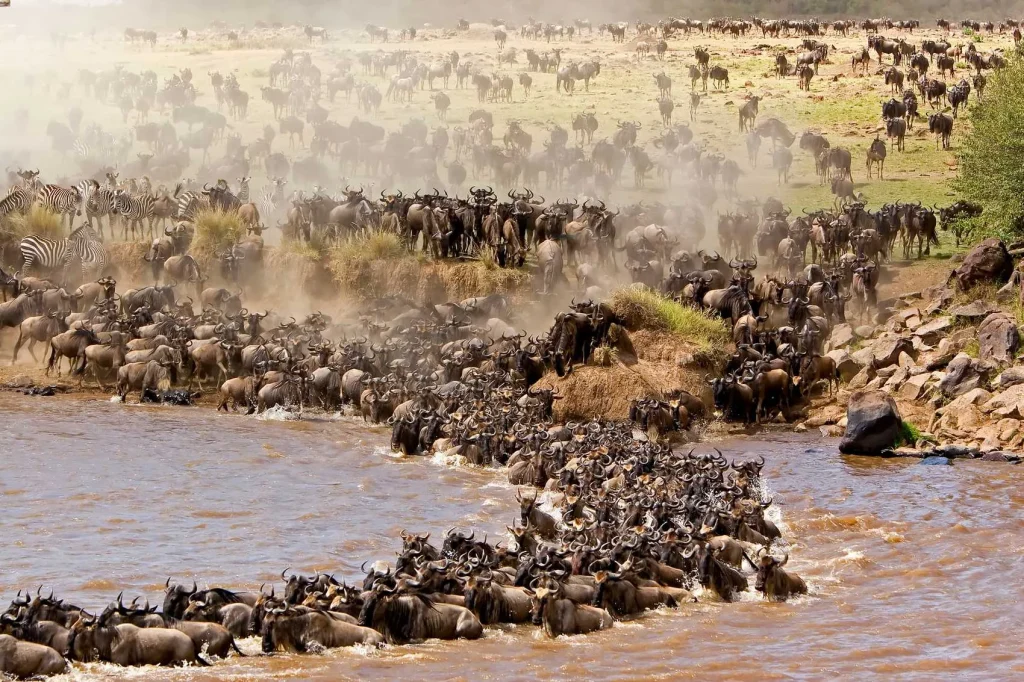
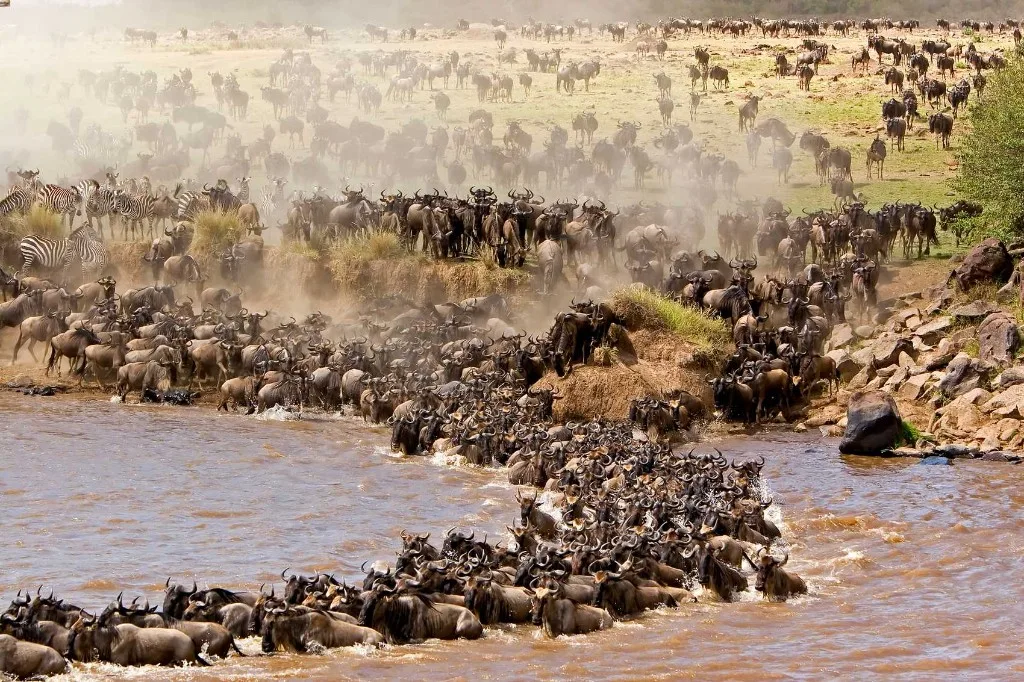
The Mara River crossings are among the most famous migration events. Wildebeest may gather along the riverbank before attempting to cross, and the presence of crocodiles, steep banks and strong currents can make crossings dangerous.
However, no guide can guarantee when or where a crossing will occur. Herds may hesitate for extended periods or move away without crossing. A good itinerary allows several days in a suitable region, and responsible guides do not pressure animals towards the river.
What Wildlife Can You See?
The migration ecosystem supports a wide range of wildlife. Wildebeest and zebras are the principal migrating animals; lions, cheetahs, leopards and hyenas may be encountered in suitable habitats; elephants, giraffes, buffalo, antelope and numerous birds also occur; crocodiles inhabit suitable river systems.
Rhinos are less commonly encountered in many migration-focused areas. Travellers interested in rhinos can consider adding Lake Nakuru or Ol Pejeta in Kenya.
Choosing the Right Migration Safari Package
Migration packages vary in duration, accommodation and transport. A good package should identify the actual destinations and game-drive arrangements. Avoid relying solely on a title such as “Great Migration Safari.”
- Check whether the itinerary visits the most appropriate region for the travel month.
- Confirm how many full game-drive days are included.
- Ask about accommodation location and transfer times.
A cheaper itinerary may provide less time in the principal wildlife area.
Private Great Migration Safaris
A private migration safari provides a dedicated vehicle and guide, offering flexibility in daily schedules and wildlife interests. Photographers can spend more time observing particular subjects, and families can adjust the pace according to their needs.
Private safaris may cost more for solo travellers or couples because transport and guiding costs are not shared, but they can provide excellent value for families and small groups.
Group Great Migration Safaris
A group migration safari allows travellers to share transport and guiding costs and can be an affordable way to visit the Masai Mara. Group departures generally follow fixed schedules, so travellers should confirm the maximum group size, vehicle seating arrangements and accommodation category. A good group safari should provide suitable wildlife-viewing access for every participant.
Road Safaris Versus Flying Safaris
Road Safaris
Road safaris can be economical and allow travellers to observe changing landscapes, although journeys between cities and wildlife destinations may be lengthy.
Flying Safaris
Domestic flights can reduce selected transfer times and are particularly useful for travellers with limited holiday time. However, flights may have luggage restrictions and require additional airstrip transfers.
Which Is Better?
The best choice depends on budget, available time and personal comfort. A combination of road and air transport may work well for longer itineraries.
How Much Does a Great Migration Safari Cost?
The cost depends on several factors. Travel season is important because demand is high during popular migration months, and accommodation category also affects the price. Other costs include park fees, transport, guiding and domestic flights, and the number of travellers matters because private vehicle costs can be shared.
A complete quotation should identify accommodation, meals, game drives, park fees and transfers. International flights, visas, optional activities and gratuities may be excluded.
Safari Accommodation Options
Migration accommodation ranges from practical camps to luxury lodges. Safari Trips to Kenya uses four categories:
- Essential: Affordable accommodation focused on practical comfort.
- Comfort: Established mid-range properties with good facilities.
- Premium: Higher-end accommodation with additional comfort and service.
- Signature: Distinctive luxury lodges and camps.
For migration viewing, location and guiding quality are often more important than luxury alone. A camp far from the relevant wildlife area may require long daily transfers.
Permanent Lodges Versus Mobile Camps
Permanent lodges remain in established locations and can provide reliable facilities and convenient access to resident wildlife. Some mobile migration camps relocate during the year to improve access to expected herd movements, which can be useful for travellers following specific migration phases.
However, mobile camps do not guarantee that the herds will be nearby. Always confirm the camp’s operating location for your dates.
Recommended 4-Day Masai Mara Migration Safari
Day 1: Nairobi to Masai Mara
Travel to the reserve by road or domestic flight and enjoy an afternoon game drive if arrival time permits.
Day 2: Full-Day Masai Mara Safari
Explore the reserve in search of wildlife. During migration season, visit suitable areas where herds have recently been observed.
Day 3: Additional Migration Game Drives
Spend another full day exploring different habitats. The extra time is valuable because wildlife movements are unpredictable.
Day 4: Return to Nairobi
Enjoy a final game drive if the schedule allows, then return to Nairobi for onward travel.
Recommended 7-Day Kenya Migration Safari
A seven-day itinerary can combine the Masai Mara with Lake Nakuru. Begin in Nairobi and travel to Lake Nakuru, explore the park’s woodland, grassland and lake environments, then continue to the Masai Mara for several days of game drives before returning to Nairobi on the final day. This combination provides varied wildlife viewing, including opportunities to observe rhinos at Lake Nakuru.
Recommended 8-Day Tanzania Migration Safari
An eight-day itinerary can combine the Serengeti with Ngorongoro. Begin in Arusha, travel to the Serengeti region appropriate to the season, spend several days exploring the selected area, continue to Ngorongoro for a crater game drive, and return to Arusha for departure. The itinerary should avoid unnecessary transfers between distant Serengeti regions.
Recommended 10-Day Kenya and Tanzania Migration Safari
A ten-day itinerary can include the Masai Mara, Serengeti and Ngorongoro. Begin in Nairobi, spend several days in the Masai Mara, continue towards Tanzania using authorised international transfer arrangements, explore the Serengeti region appropriate to the travel season, and finish with Ngorongoro before returning to Arusha. Cross-border logistics should be planned carefully, because the shortest distance on a map may not represent the practical travel route.
Combining the Migration With Other Kenya Destinations
Amboseli National Park
Amboseli is famous for elephants and views of Mount Kilimanjaro when weather conditions allow clear skies.
Lake Nakuru National Park
Lake Nakuru is an important rhino conservation destination.
Samburu National Reserve
Samburu offers distinctive northern Kenya wildlife and landscapes.
Diani Beach
Diani provides a relaxing Indian Ocean beach extension.
Watamu
Watamu offers coastal scenery and marine experiences.
Choose additional destinations according to the available number of days.
Combining the Migration With Tanzania Destinations
Ngorongoro Crater
Ngorongoro provides an impressive wildlife landscape and a popular addition to Serengeti safaris.
Tarangire National Park
Tarangire is known for elephants, baobab trees and seasonal wildlife concentrations.
Lake Manyara National Park
Lake Manyara offers varied habitats and birdlife.
Zanzibar
Zanzibar provides beaches, cultural attractions and opportunities to relax after a safari.
Migration Safari Photography
The migration offers opportunities for wildlife portraits, landscape photography and action scenes. A telephoto lens is useful for distant animals, while a wider lens can capture the scale of grazing herds. Early morning and late afternoon light often creates attractive conditions, although dramatic events may occur at any time.
Photographers should prepare for dust, rain and changing light. Wildlife welfare must take priority over photographs.
What to Pack
- Lightweight clothing suitable for warm days and cooler mornings, plus a warm layer, sun protection and comfortable footwear
- Binoculars to improve wildlife viewing
- A camera and spare batteries
- Personal medication and appropriate travel documents
If travelling by domestic flight, check luggage restrictions. A detailed packing list should reflect the season and accommodation style.
Entry Requirements and Travel Insurance
Kenya and Tanzania have separate immigration requirements. Travellers should verify current visa or electronic travel authorisation rules for their nationality and check passport validity requirements. Travel insurance is strongly recommended, and for cross-border safaris travellers should confirm any additional documentation or health requirements.
Responsible Great Migration Tourism
The migration depends on healthy wildlife habitats and functioning ecological corridors. Visitors should respect park regulations: vehicles should not obstruct animal movements or crowd river crossings, wildlife should never be fed, and guides should maintain appropriate distances. Responsible tourism supports conservation and surrounding communities.
Common Migration Safari Planning Mistakes
- Booking the wrong region for the month
- Expecting a guaranteed river crossing
- Underestimating road transfer times
- Choosing accommodation without checking its location
- Planning a crowded itinerary that reduces wildlife-viewing opportunities
The best approach is to prioritise suitable locations, realistic travel times and several full game-drive days.
Frequently Asked Questions
What Is the Best Month for the Great Migration?
July through September is popular for northern migration viewing. January through March is attractive for the southern Serengeti calving season.
Can You See the Migration All Year?
Yes, but the herds occupy different regions throughout the year.
Are River Crossings Guaranteed?
No. Crossings are unpredictable natural events.
How Many Days Do You Need?
Four or five days are useful for a migration-focused visit. Longer itineraries allow additional destinations.
Is Kenya or Tanzania Better?
The best choice depends on travel dates and wildlife interests.
Can You Combine Both Countries?
Yes, with carefully planned international transfers.
Is a Private Safari Better?
Private safaris offer flexibility, while group safaris may reduce shared transport costs.
Can You Add a Beach Holiday?
Yes. Diani, Watamu and Zanzibar are popular extensions.
Book Your Great Migration Safari With Safari Trips to Kenya
The Great Wildebeest Migration is one of Africa’s most extraordinary wildlife experiences, but its movements cannot be reduced to a fixed calendar. The best safari matches your travel dates with the most suitable region, provides enough time for wildlife viewing and uses experienced guides who understand the ecosystem.
Safari Trips to Kenya can arrange Masai Mara migration tours, Serengeti safaris and customised Kenya–Tanzania journeys. Share your preferred travel dates, number of travellers, accommodation category and whether your priority is river crossings, calving or general wildlife viewing, and a carefully designed itinerary will help you experience the migration as a complete wildlife phenomenon rather than relying on one unpredictable event.