

Great Migration Photography Guide
The first challenge of photographing the Great Wildebeest Migration is not choosing the right camera setting. It is deciding what story you want the photograph to tell. A tightly framed image of a wildebeest leaping into the Mara River conveys urgency and danger. A wide landscape photograph showing thousands of animals across the grassland communicates scale. A quiet portrait of a zebra standing beside its young captures a completely different aspect of the same ecosystem—and all three can be memorable photographs.
The migration takes place across Kenya’s Masai Mara and Tanzania’s Serengeti, where enormous numbers of wildebeest and other grazing animals move in response to rainfall and pasture conditions. Their movements create opportunities for landscape photography, wildlife portraits, predator behaviour and, occasionally, dramatic river-crossing scenes. However, successful Great Migration photography depends on much more than owning a long telephoto lens.
You need to choose the correct destination for the season, understand the light, prepare for dust and rain, and work with a guide who appreciates photography. You also need patience. Wildlife rarely positions itself perfectly, and the most famous migration events cannot be scheduled. This guide explains how to plan a photography-focused safari, select practical camera equipment, work with changing light, photograph movement and create a varied collection of images without disturbing wildlife.
1. Choose the Right Migration Photography Season
The most important decision is where to travel. The migration moves through the Serengeti–Mara ecosystem throughout the year, and different locations offer different photographic opportunities.
January to March: Southern Serengeti Calving
The southern Serengeti and adjoining Ndutu region are associated with the wildebeest calving season. During suitable conditions, large concentrations of animals may occupy the short-grass plains. Photographic subjects can include newborn calves, maternal behaviour, grazing herds and predators, and the green landscapes can provide attractive colour and contrast. However, calving and hunting encounters remain unpredictable.
April to June: Central and Western Serengeti
Seasonal herd movements may occur through central and western areas. Rainfall can create dramatic skies, green vegetation and atmospheric conditions, and the western corridor may offer river-associated wildlife opportunities. Road conditions can become challenging during wet periods.
July to October: Northern Serengeti and Masai Mara
This is the principal period associated with Mara River crossing photography. Large herds may gather in northern parts of the ecosystem, and photographers may encounter river crossings, grazing herds and predator activity. However, crossings cannot be guaranteed.
November and December: Changing Landscapes
As seasonal rainfall patterns change, herds may move towards central and southern areas. Fresh grass, dramatic cloud formations and changing animal distributions can provide rewarding photographic subjects. The best location depends on current conditions.
2. Masai Mara or Serengeti for Photography?
Both destinations offer exceptional photographic opportunities. The Masai Mara is comparatively compact and provides open grasslands, rolling landscapes and riverine habitats. It is particularly attractive for photographers interested in predators and northern migration activity.
The Serengeti offers greater geographical diversity. The southern plains are suitable for wide migration scenes and calving-related photography, the central Serengeti offers varied resident wildlife, and the northern region is associated with the Mara River. The best destination depends on the subject you want to photograph: a photographer interested in newborn wildebeest should generally consider the southern Serengeti during the calving period, while someone prioritising northern river-crossing opportunities may choose the Masai Mara or northern Serengeti during the appropriate season.
3. How Many Days Do Wildlife Photographers Need?
Wildlife photography rewards patience. A short safari can produce excellent images, but it offers limited flexibility. For a dedicated migration photography safari, four or five nights in the relevant wildlife area are a useful starting point, and a longer stay may be worthwhile for photographers interested in specific behaviour or changing light conditions.
River crossings are especially unpredictable. You may spend hours watching herds gather without a crossing occurring, while other days may offer unexpected opportunities elsewhere in the landscape. The goal is to create enough time for observation rather than rushing from one sighting to another.
4. The Best Camera for Migration Photography
You do not need the most expensive camera to photograph the migration. A modern mirrorless or DSLR camera with reliable autofocus and suitable lenses can produce excellent results. Useful features include:
- Continuous autofocus for moving animals
- A reasonably fast burst mode
- Good performance at higher ISO settings
- Weather resistance
- A comfortable grip and intuitive controls
- Sufficient battery life
The best camera is one you can operate confidently without spending too much time adjusting settings. Before travelling, practise tracking moving subjects such as birds, pets or vehicles. This helps build familiarity with autofocus modes and shutter speeds.
5. Choosing Wildlife Photography Lenses
Lens selection depends on the subjects and how close wildlife can be approached legally and safely.
Telephoto Zoom Lenses
A lens covering approximately 100–400mm or 150–600mm can be versatile for wildlife photography. It allows you to frame animals at different distances without changing lenses constantly. Longer focal lengths are useful for distant predators, birds and animals on the opposite side of a river, although very long lenses can be heavy and difficult to stabilise.
Mid-Range Zoom Lenses
A 70–200mm lens can be useful for larger animals, closer encounters and environmental portraits. It may also perform well in lower light if it has a wide maximum aperture.
Wide-Angle Lenses
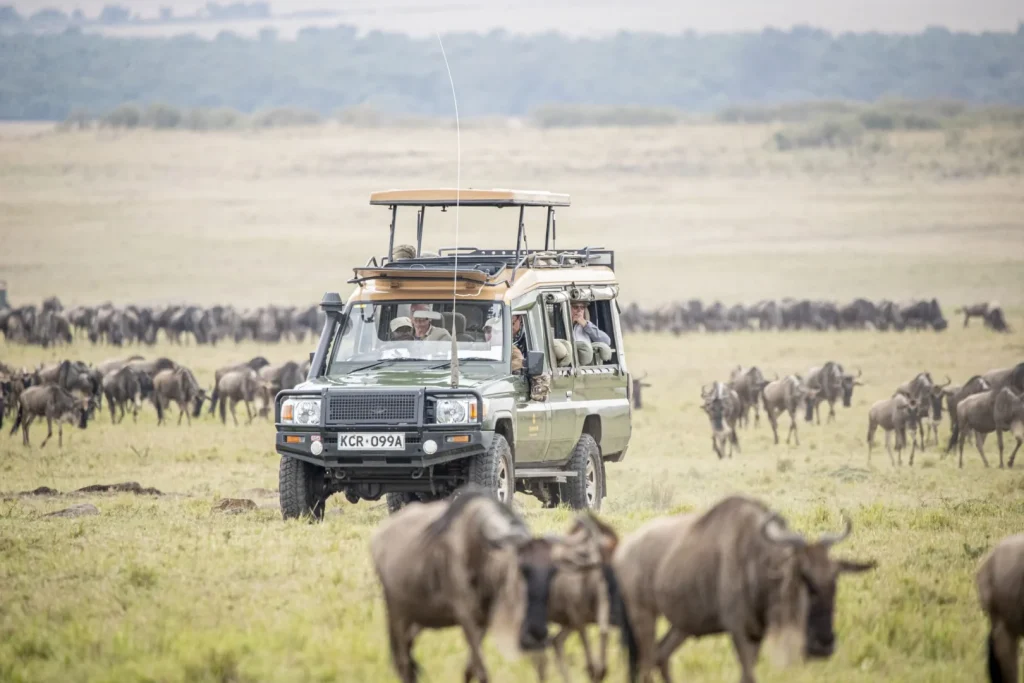
A wide-angle lens is valuable for showing the scale of migration herds and can capture grassland, dramatic skies and animals within the wider landscape. Some of the strongest migration photographs are not close-ups—a wide image showing the relationship between animals and habitat can tell a more complete story.
6. Practical Camera Settings for Moving Wildebeest
There is no single setting suitable for every wildlife encounter, but a few starting points can help. For a moving wildebeest in reasonably good light, a shutter speed around 1/1000 second may help freeze motion. For faster action, such as animals running or jumping, 1/1600 to 1/2500 second may be appropriate—these are starting points, not fixed rules.
Aperture depends on the desired depth of field and available light. A relatively wide aperture can help isolate an animal from the background, while a narrower aperture may be useful when photographing several animals at different distances. Auto ISO can help maintain a suitable shutter speed as lighting changes, and continuous autofocus and subject tracking are particularly useful for moving animals.
7. When to Use Aperture Priority or Manual Exposure
Aperture priority can work well for relatively stationary animals and changing light, but it is important to monitor shutter speed. If the camera selects a slow shutter speed, moving animals may become blurred. Manual exposure with Auto ISO is a useful alternative for action photography—you can select the shutter speed and aperture while allowing the camera to adjust ISO. Whichever mode you choose, practise before the safari. The best settings are those you can adjust quickly when an unexpected opportunity appears.
8. Photographing Mara River Crossings
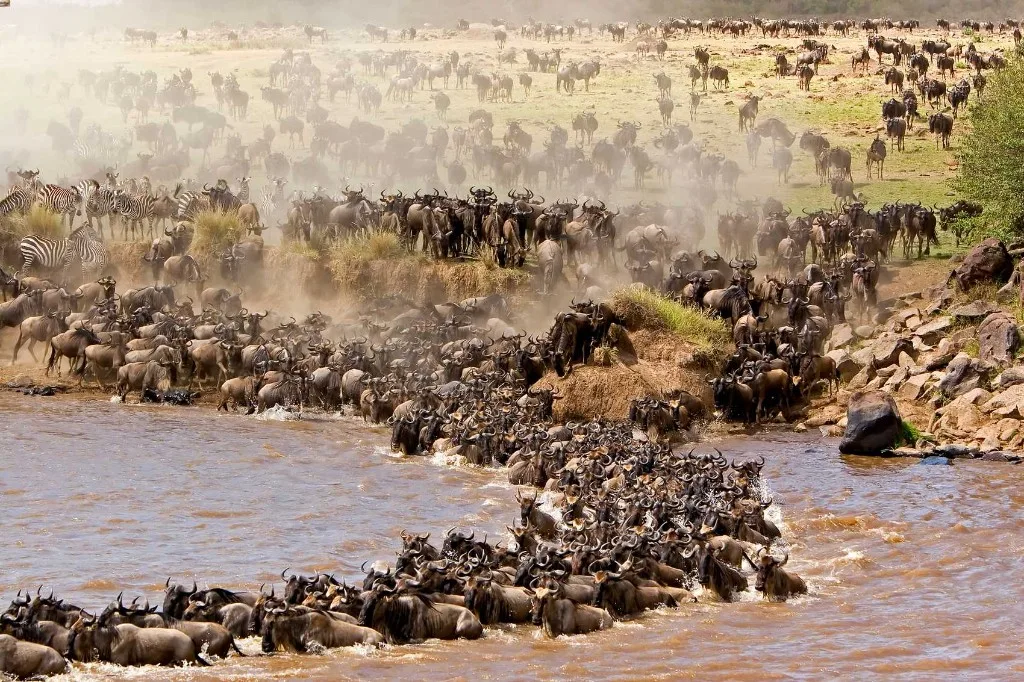
Mara River crossing photography is one of the most demanding forms of migration photography. The action can begin suddenly; animals may move quickly, splash through water and disappear behind other animals, and the lighting may also be difficult because bright water and dark animals create strong contrast.
Prepare Before the Action
If your guide identifies a suitable viewing location, set your camera before a crossing begins. Check the shutter speed, autofocus mode, exposure and available memory-card space, and avoid waiting until animals enter the water before adjusting settings.
Use a Fast Shutter Speed
A fast shutter speed helps freeze splashing water and jumping animals. Around 1/1600 second or faster can be a useful starting point in good light, although exposure conditions vary.
Follow One Subject
It can be tempting to photograph the entire crossing continuously. Instead, consider tracking one animal through part of the movement—this can create a more coherent image.
Capture Wide Scenes
A wider composition can show the number of animals, the river and the surrounding landscape. These images communicate the scale of the event.
Respect Wildlife
Never ask a guide to pressure animals towards the water or obstruct a crossing. The welfare of wildlife takes priority over photographs.
9. Photographing Wildebeest Calving
The southern Serengeti calving season provides a different photographic challenge. Young calves may be small, mobile and partly obscured by surrounding animals. Look for interactions between mothers and calves—photographs of a calf standing beside its mother can be more meaningful than a crowded image of the entire herd. Use a suitable telephoto lens to maintain distance, and do not attempt to approach newborn animals closely or separate them visually by disturbing the herd. Calving is a natural event, and photographers should allow animals to behave without interference.
10. Photographing Predators During the Migration
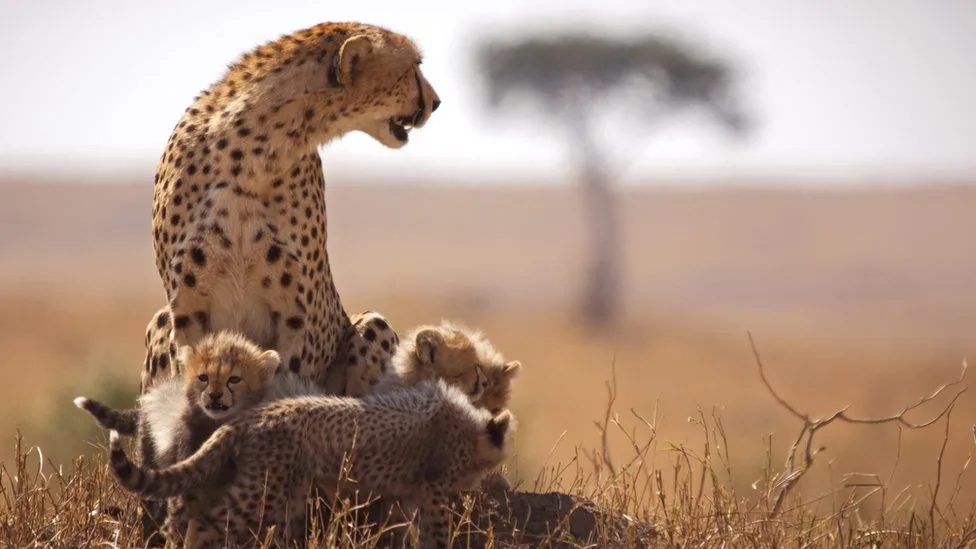
Predator photography requires patience and an understanding of behaviour. Lions may rest for long periods, cheetahs may scan the plains before moving, and leopards may remain partly concealed in vegetation. Rather than waiting exclusively for a hunt, look for expressive moments—a lion looking towards distant herds, a cheetah surveying the grassland or hyenas interacting can produce compelling photographs. If a hunt occurs, follow the guide’s instructions and avoid unnecessary vehicle movement. Wildlife should never be surrounded or pressured for a better camera angle.
11. The Importance of Morning and Evening Light
Early morning and late afternoon light can be especially attractive for wildlife photography. The lower angle of the sun may create softer illumination and longer shadows, and warm light can bring texture to grassland and animal coats. However, the best photographic opportunity does not always happen in ideal light—a rare wildlife interaction at midday may be more valuable than a routine scene at sunset. Learn to adapt to available conditions rather than waiting for perfection.
12. Working With Harsh Midday Light
Midday light can create strong shadows and bright highlights, and animals with dark coats may be difficult to expose correctly against pale grass or water. Review your histogram and highlight warnings if available, consider photographing subjects in open shade or using the strong light creatively, and avoid excessive exposure adjustments that remove natural texture from animal coats. High-contrast black-and-white images can work well in some conditions.
13. Creating Silhouette Photographs
Silhouettes can be effective when animals stand against a bright sky. Giraffes, zebras and wildebeest may create recognisable shapes when you expose for the brighter background to keep the subject relatively dark. Look for clean outlines and separation between animals—a crowded group of overlapping bodies may be less effective than two or three clearly defined subjects. Silhouette photography works particularly well near sunrise or sunset.
14. Capturing the Scale of the Migration
A common mistake is photographing every animal as a tight portrait. The migration is remarkable partly because of its scale, so include the landscape. Use a wider focal length to show herds extending across the plains, consider placing animals in the lower portion of the frame beneath a broad sky, and look for natural lines formed by moving herds. These compositions can convey the sense of movement and distance that makes the migration distinctive.
15. Composition Techniques for Wildlife Photography
Good composition helps viewers understand the subject.
Leave Space in the Direction of Movement
When photographing a running animal, leave room in front of it—this can make the image feel more natural.
Use Leading Lines
Animal trails, riverbanks and herd formations can guide the viewer’s eye through the photograph.
Include Habitat
An environmental portrait shows the animal in relation to its surroundings.
Watch the Background
Branches, vehicles and other distractions can weaken a photograph.
Photograph Behaviour
Interaction often creates a stronger story than a simple standing portrait.
16. Camera Support Inside Safari Vehicles
A safari vehicle is not always a stable platform. Engines, passenger movement and uneven roads can create vibration. A beanbag can provide practical support for a long lens on a suitable vehicle opening; some photographers use monopods, although these may be inconvenient in crowded vehicles. Tripods are often difficult to use during conventional game drives. Discuss your equipment with the operator before travelling—a private vehicle can provide more space and flexibility.
17. Protecting Camera Equipment From Dust
Dust is common during dry-season game drives. Keep unused equipment inside protective bags and avoid changing lenses unnecessarily in dusty conditions. Use a blower and suitable cleaning materials rather than wiping abrasive dust directly across a lens, keep camera bags closed when not in use, and use a rain cover or protective sleeve during sudden showers. At the end of the day, inspect equipment and clean it carefully.
18. Managing Batteries and Memory Cards
Wildlife photography can involve long periods of waiting followed by intense bursts of shooting. Carry spare batteries and charge equipment whenever reliable electricity is available. Use high-quality memory cards with sufficient capacity, back up photographs regularly, and if possible maintain copies on two separate devices or storage media—do not rely on a single memory card for the entire safari.
19. RAW Versus JPEG Photography
RAW files provide greater flexibility for adjusting exposure, white balance and colour during editing—they are particularly useful when photographing dark animals against bright backgrounds. JPEG files require less storage and may be convenient for quick sharing, and many photographers record RAW and JPEG simultaneously. The best choice depends on your editing workflow and available storage; for a dedicated photography safari, RAW capture is generally worth considering.
20. Smartphone Photography on Safari
Modern smartphones can produce attractive landscape photographs and images of nearby animals, although their limited optical reach can make distant wildlife difficult to photograph. Avoid excessive digital zoom when image quality matters, use the main camera for wide migration scenes and landscapes, and keep the lens clean and stabilise the phone when possible. A smartphone is also useful for short video clips, environmental details and behind-the-scenes memories.
21. Photographing Birds During the Migration
The Serengeti and Masai Mara support diverse birdlife. Raptors, vultures, bustards, secretarybirds and other species can provide excellent subjects. Bird photography often requires fast autofocus and longer focal lengths—a shutter speed of 1/2000 second or faster may be useful for birds in flight, depending on the species and conditions. For perched birds, slower shutter speeds may be sufficient with good support. Look for natural behaviour rather than simply collecting species photographs.
22. Choosing a Photography-Friendly Safari Vehicle
A photography-focused safari benefits from suitable vehicle arrangements. Ask about roof openings, window access and passenger numbers, because a crowded vehicle may make it difficult to move between viewing positions. A private safari provides greater flexibility, although vehicle design and park regulations differ between destinations—confirm the actual vehicle type rather than assuming all safari vehicles are identical.
23. Working With Your Safari Guide
An experienced guide is one of the most important elements of wildlife photography. Explain your interests before the game drive: if you prefer animal behaviour over simply seeing as many species as possible, communicate that, and ask for opportunities to observe subjects patiently. However, remain realistic—guides cannot control animals or guarantee particular encounters. The best collaboration is based on respect, clear communication and shared concern for wildlife welfare.
24. Should You Book a Dedicated Photography Safari?
A specialist photography safari can be valuable for experienced photographers. It may provide fewer passengers per vehicle, flexible game-drive schedules and additional time at sightings, and some programmes include photographic guidance or workshops. However, a private conventional safari can also work well when the guide understands photography. The best choice depends on budget, skill level and the desired amount of instruction.
25. Ethical Wildlife Photography
Photography should never compromise animal welfare. Do not ask guides to drive too close to wildlife, avoid blocking migration routes, do not pressure animals towards river crossings, do not use flash in situations where it may disturb wildlife, and follow park regulations and respect other visitors. A photograph is not worth causing unnecessary stress to an animal.
26. Editing Great Migration Photographs
Editing should enhance the image without misrepresenting the scene. Adjust exposure, contrast, white balance and sharpness carefully, avoid excessive saturation that makes grassland or skies look unnatural, and crop to improve composition while retaining enough context to tell the story. For documentary or conservation use, be particularly careful about altering the content of an image, and keep original files safely backed up.
27. Building a Complete Migration Photo Story
A strong photographic collection should contain more than dramatic action. Include establishing landscapes, photograph grazing herds, individual animals and predator behaviour, capture details such as tracks, dust, vegetation and changing light, and document quieter interactions. A sequence of varied images can communicate the migration’s ecology more effectively than a collection of similar river-crossing photographs.
Frequently Asked Questions
What Is the Best Lens for Migration Photography?
A versatile telephoto zoom is useful for most wildlife subjects. A wider lens is valuable for landscapes and large herds.
What Shutter Speed Should I Use for Running Wildebeest?
Around 1/1600 second or faster can be a useful starting point in good light, but settings depend on conditions.
Can I Photograph the Migration With a Smartphone?
Yes, particularly for landscapes and nearby animals, although distant wildlife may be difficult.
Is August the Best Month for Photography?
August is popular for northern migration photography. February is attractive for southern Serengeti calving.
Are River Crossings Guaranteed?
No. Crossings are unpredictable.
Is a Private Vehicle Worth It?
For dedicated photographers, a private vehicle can provide additional space and flexibility.
Should I Bring a Tripod?
A beanbag may be more practical inside a conventional safari vehicle. Confirm vehicle arrangements before travelling.
How Many Days Should I Spend?
Four or five nights in the relevant wildlife area are a useful starting point for a photography-focused safari.
Plan Your Great Migration Photography Safari
A Great Migration photography safari is most rewarding when it combines suitable seasonal locations, patient observation and responsible guiding. The Masai Mara and Serengeti offer opportunities to photograph vast herds, predators, landscapes and animal behaviour.
Safari Trips to Kenya can arrange private photography-focused safaris, suitable accommodation and itineraries that allow meaningful time in the field. Share your travel dates, camera interests, preferred accommodation category and whether you want to focus on river crossings, calving or general wildlife photography. The best photographs come from understanding the animals and their environment—not from trying to control the scene.