
Predators During Calving Season
Predators During Calving Season – Wildlife, Hunting Behaviour and Safari Planning
The annual wildebeest calving season is one of the most fascinating stages of the Great Wildebeest Migration. Each year, large numbers of wildebeest gather on the nutrient-rich grasslands of the southern Serengeti ecosystem, where females give birth over a relatively concentrated period. The arrival of thousands of vulnerable calves creates exceptional opportunities to observe the relationships between predators and their prey.
For travellers interested in predators during calving season, the attraction extends far beyond the possibility of seeing a dramatic hunt. The season reveals how lions, cheetahs, spotted hyenas, jackals and other carnivores respond to changing prey availability. It also shows how wildebeest protect their young, how calves develop mobility and how predator behaviour influences the movements of entire herds.
The main calving grounds lie in Tanzania, particularly around the southern Serengeti and Ndutu region. This geographical distinction is essential for travellers researching the Great Wildebeest Migration from Kenya. Although the Masai Mara forms an important part of the wider migration ecosystem, the principal annual wildebeest calving concentrations are normally found farther south.
Safari Trips to Kenya helps travellers understand the migration as a seasonal movement across Kenya and Tanzania rather than an event occurring in one park throughout the year. This guide explores the principal predators, the timing of calving, the best areas for observing wildlife and how to plan a responsible safari around this remarkable period.
Understanding the Wildebeest Calving Season
The Great Wildebeest Migration involves the seasonal movement of large numbers of wildebeest, accompanied by zebras and other grazing animals, through the Serengeti-Mara ecosystem.
The movement is primarily influenced by rainfall, fresh grazing and access to water. It is not a fixed circular procession in which every herd follows the same route on the same dates. Different groups may spread across extensive areas, and their distribution changes according to environmental conditions.
During the calving period, many pregnant wildebeest gather on the short-grass plains of the southern Serengeti. These grasslands provide nutritious grazing at a time when females have high energy requirements associated with giving birth and producing milk.
Calving is unusually synchronised compared with many other large mammals. Large numbers of calves are born within a relatively short period, creating a temporary abundance of young animals.
This concentration has important ecological consequences. Predators encounter abundant prey, but the sheer number of births can also reduce the probability that any individual calf will be taken.
When Does Calving Season Take Place?
The main Serengeti calving season generally occurs between January and March, with particularly intense calving activity often concentrated in late January and February.
The exact timing varies according to rainfall, grazing conditions and the distribution of the herds. Some calves may arrive earlier, while others are born after the principal peak.
Travellers should therefore avoid treating any particular week as a guaranteed calving period. A safari lasting several nights provides more opportunities to locate concentrations of animals and observe different stages of calf development.
The southern Serengeti and Ndutu region are particularly important during this season. However, wildlife movements are dynamic, and the best viewing areas may shift from one year to another.
Why Predators Are Attracted to the Calving Grounds
Predators respond to the availability, vulnerability and distribution of prey. During calving season, the presence of newborn wildebeest can create favourable hunting conditions for several carnivore species.
A newborn calf has less experience identifying danger and may struggle to keep pace with a moving herd during its earliest hours. Although wildebeest calves can stand and begin moving remarkably quickly, they remain vulnerable to predators.
The concentration of mothers and calves also creates opportunities for predators to select individuals that are separated, weakened or otherwise exposed.
However, abundant prey does not mean predators succeed in every hunt. Adult wildebeest can defend themselves, herds can react collectively to danger, and many calves survive the early period.
Predator behaviour is shaped by more than the presence of young wildebeest. Territorial boundaries, competition, habitat, weather and the availability of alternative prey all influence hunting decisions.
Lions During Wildebeest Calving Season
Lions during calving season are among the principal attractions for wildlife enthusiasts visiting the southern Serengeti.
Lions are powerful social predators that may hunt individually or cooperatively. Their hunting strategies depend on the size and behaviour of the prey, the terrain and the composition of the pride.
Although young wildebeest may be vulnerable, lions also target adult animals. A mature wildebeest provides a substantial meal, particularly when several pride members are feeding.
How Lions Hunt Wildebeest
Lions frequently rely on concealment, patience and relatively short bursts of speed. Unlike cheetahs, they are not specialised for prolonged high-speed pursuits across open ground.
A lion may approach through grass, use shallow depressions for cover or wait near routes regularly used by grazing animals.
Where several lions participate, they may approach from different directions, although cooperative hunting is not always highly coordinated.
For safari visitors, the most interesting part of a lion encounter may occur before any pursuit begins. Watching a lion assess a herd, change position or abandon an unsuccessful approach can reveal much about predator decision-making.
Lion Prides and Their Territories
Lions live in social groups commonly known as prides. These groups often include related females, their young and associated males.
Territory size and hunting opportunities depend on local prey availability and competition with neighbouring lions.
During calving season, resident prides may benefit from the arrival of large herds in their hunting areas. However, not every lion moves with the migration, and many remain associated with established territories.
Understanding this distinction helps travellers appreciate that the calving season is not simply a gathering of predators from every part of the ecosystem.
Lion Cubs and Family Behaviour
Calving season also provides opportunities to observe lion family behaviour, although lion reproduction is not synchronised with wildebeest births in the same way.
Visitors may encounter lionesses caring for cubs, adults interacting within a pride or young lions practising stalking behaviour.
Cubs are particularly sensitive to disturbance. Responsible guides maintain distance and avoid positioning vehicles where they could separate family members.
Cheetahs During Calving Season
Cheetah calving season safaris can be especially rewarding because the open plains of the southern Serengeti provide suitable hunting habitat for these specialised predators.
Cheetahs depend heavily on visibility, acceleration and the ability to identify manageable prey. Their slender bodies and flexible spines are adapted for rapid pursuits, but these hunts consume considerable energy.
A cheetah must balance the possibility of a successful hunt against the physical cost of chasing prey.
Why Open Grasslands Suit Cheetahs
The short-grass plains around Ndutu offer broad visibility and relatively open terrain. This can help cheetahs identify prey and select an approach.
Cheetahs often use termite mounds or slightly elevated ground to scan the surrounding landscape.
Their preferred prey may include gazelles and young antelopes, but wildebeest calves can also become targets when conditions are favourable.
Cheetahs generally avoid unnecessary confrontation with larger predators. Lions and hyenas may steal kills or threaten cubs, so choosing where and when to hunt is an important survival strategy.
Watching a Cheetah Hunt
A typical cheetah encounter may begin with a period of observation. The animal scans the grassland, changes position and studies potential prey.
If conditions are favourable, it may approach slowly before accelerating into a short pursuit.
Not every stalk develops into a chase, and many chases end without a kill. This is normal predator behaviour rather than a disappointing safari outcome.
For photographers, the best approach is to allow the animal sufficient space to behave naturally. Vehicles positioned too close to a cheetah or its prey can interfere with the hunt.
Cheetah Mothers and Cubs
Female cheetahs raise their cubs without the assistance of adult males. They must hunt while also protecting young animals from predators.
Cubs face threats from lions, hyenas and other carnivores. Their survival depends partly on the mother’s ability to select safe resting places and move them when necessary.
A cheetah family encounter should be observed with particular care. Repeatedly approaching cubs or crowding the mother can create unnecessary stress.
Spotted Hyenas During Calving Season
Spotted hyenas are among the most important predators in the Serengeti ecosystem. Despite their reputation as scavengers, they are capable and effective hunters.
Hyenas live in social groups known as clans, which can contain numerous individuals. Their social relationships are complex, and clan members may cooperate when hunting or defending food.
During calving season, hyenas can take advantage of vulnerable young wildebeest, weakened animals and carcasses left by other predators.
Hunting and Scavenging Behaviour
Spotted hyenas use a combination of hunting and scavenging strategies. The balance varies according to habitat, prey availability and opportunities.
They have powerful jaws and highly developed senses that help them locate food.
A hyena may hunt alone or in a group, depending on the prey involved. Larger prey can require cooperation, while smaller or vulnerable animals may be taken by individuals.
Safari visitors may observe hyenas moving between herds, investigating scent trails or interacting at a carcass.
Hyenas and Lions
Interactions between lions and hyenas are among the most compelling predator relationships in African savannah ecosystems.
Both species may compete for prey and carcasses. Lions can displace hyenas from food, while sufficiently large hyena groups may challenge individual lions.
These encounters are not always violent. Much of the competition involves assessing numbers, strength and the likely cost of confrontation.
Observing the behaviour of both species provides a better understanding of the ecosystem than viewing them as simple enemies.
Leopards During Calving Season
Leopards occur in the wider Serengeti ecosystem but are generally more difficult to observe on open calving plains than lions, cheetahs or hyenas.
Leopard safari sightings are often associated with riverine woodland, trees, rocky areas and other habitats that provide cover.
Leopards are solitary predators capable of taking a wide range of prey, from small mammals to medium-sized antelopes.
Although they may prey on young wildebeest where opportunities arise, their distribution and hunting behaviour are not as closely associated with the open calving concentrations as those of some other predators.
Where to Look for Leopards
Travellers interested in leopards should ask their guide about suitable wooded habitats and drainage lines.
Early morning and late afternoon can be productive observation periods, although leopards may be active at other times.
A leopard resting in a tree or moving through woodland can be a rewarding sighting even without visible hunting activity.
Because leopards are secretive, a dedicated wildlife itinerary should not depend on seeing one particular individual.
Jackals and Smaller Predators
The calving grounds also support smaller carnivores, including jackals and other opportunistic hunters.
Black-backed jackals are particularly interesting because they may hunt small animals, scavenge carcasses and investigate areas where larger predators have been feeding.
Their behaviour illustrates how food resources are shared across the predator community.
A large carcass may attract several species over time, including jackals, hyenas, vultures and other scavengers.
These animals play important ecological roles by consuming remains and redistributing nutrients through the ecosystem.
Why Smaller Predators Matter
Safari attention often concentrates on lions and cheetahs, but smaller predators can provide equally interesting observations.
Jackals may show territorial behaviour, pair bonding and coordinated movements.
Their interactions with larger carnivores reveal how animals assess risk and exploit opportunities.
For travellers interested in ecology, spending time with these species adds depth to a Great Migration safari.
African Wild Dogs and the Wider Ecosystem
African wild dogs are highly social predators that hunt cooperatively and can travel over extensive distances.
However, they are not a reliable target for a typical Ndutu calving safari. Their distribution is patchy, and sightings depend on the location of active packs.
Travellers should be cautious about itineraries that imply wild dogs are commonly encountered throughout the calving grounds.
A safari focused specifically on African wild dogs requires current information about pack movements and appropriate destinations.
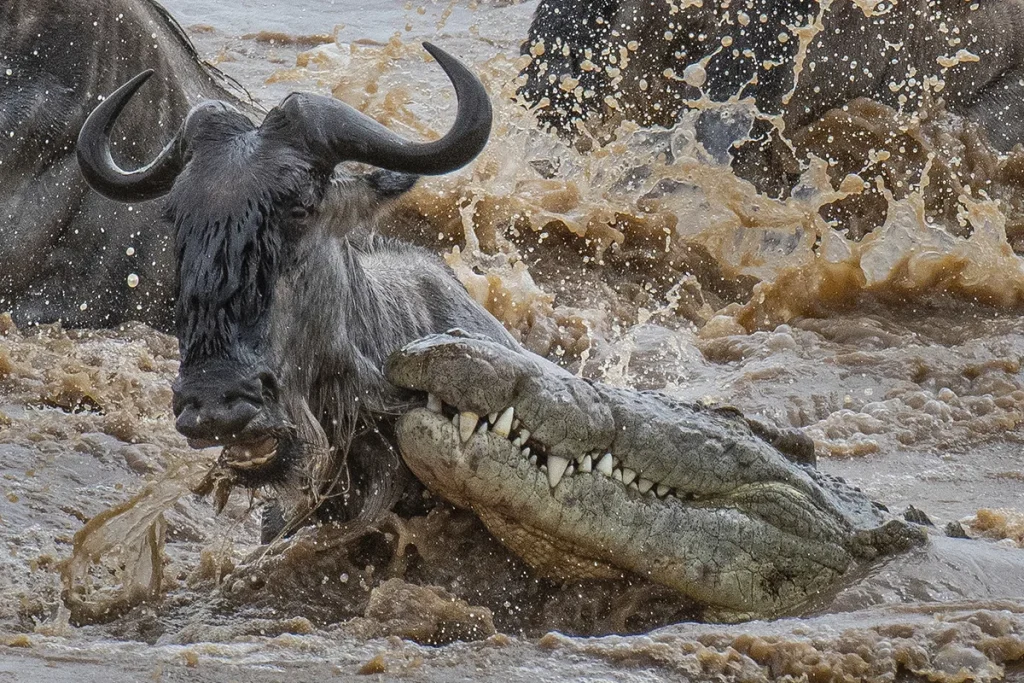
Crocodiles and the Difference Between Calving and River Crossings
One common misunderstanding about the Great Wildebeest Migration is that every stage involves crocodiles attacking wildebeest.
Crocodiles are particularly associated with river crossings, including those occurring farther north in the Serengeti-Mara ecosystem.
The main calving season takes place on southern grasslands rather than at the famous Mara River crossing points.
Consequently, travellers booking a January or February calving safari should primarily expect opportunities to observe terrestrial predators.
Those interested in crocodile encounters during river crossings should consider a different seasonal itinerary, while recognising that crossing activity is never guaranteed.
How Wildebeest Protect Their Calves
Wildebeest have evolved several strategies that help their young survive in predator-rich environments.
One of the most important is synchronised calving. When many females give birth over a relatively short period, predators cannot capture every vulnerable calf.
This phenomenon is sometimes described as predator swamping, because the number of available young animals exceeds what predators can consume.
Rapid Development After Birth
Wildebeest calves are capable of standing and beginning to move soon after birth.
This rapid development is essential for animals living in open landscapes where herds may need to move in response to grazing conditions or danger.
A calf that remains close to its mother has a better opportunity to receive milk, protection and guidance.
Nevertheless, the first days remain dangerous, particularly when calves become separated or exhausted.
Herd Behaviour and Vigilance
Large groups of wildebeest provide many opportunities for detecting predators.
Individuals may respond to alarm behaviour, sudden movement or the actions of nearby animals.
However, herd size does not guarantee safety. Predators can exploit confusion, separation or the movement of animals through difficult terrain.
Watching the reactions of wildebeest before a hunt can be as informative as observing the predator itself.
Best Places to Observe Predators During Calving Season
Ndutu Region
The Ndutu region is one of the best-known destinations for calving-season safaris.
It lies within the wider southern Serengeti ecosystem, including areas associated with the Ngorongoro Conservation Area and neighbouring Serengeti landscapes.
The region combines open grasslands, woodland and seasonal habitats that support a wide variety of wildlife.
Its location makes it particularly relevant for travellers visiting during the principal calving months.
Southern Serengeti Plains
The southern Serengeti plains provide extensive grazing areas where wildebeest may gather after seasonal rains.
The open landscape can offer excellent visibility for observing large herds and predators.
However, the precise distribution of animals changes according to rainfall and vegetation.
A knowledgeable local guide should use current information rather than relying on an assumption that herds remain in one place.
Kusini and Surrounding Areas
Parts of the southern Serengeti around Kusini can also be relevant during the broader calving period.
Wildlife concentrations may vary across these landscapes, and accommodation selection should reflect expected herd movements.
Travellers should discuss the balance between camp location, driving distances and the flexibility of their safari schedule.
Best Time for Predator Photography
The most attractive light for Serengeti wildlife photography often occurs early in the morning and late in the afternoon.
Low-angle sunlight can illuminate dust, highlight animal outlines and create pleasing contrast across the grasslands.
Midday light is generally harsher, but it can still provide useful opportunities when predators are active.
Rain clouds can create dramatic backgrounds, although photographers should protect equipment from moisture and dust.
Photography Equipment
A telephoto lens is useful for photographing predators at responsible distances.
A second camera body or a wider lens can help capture environmental portraits showing animals within the landscape.
Fast shutter speeds are important when photographing running cheetahs or other rapid movements.
Photographers should also carry spare batteries, memory cards and suitable protection against dust.
Ethical Wildlife Photography
Never ask a guide to drive between a predator and its prey.
Avoid surrounding animals with vehicles or blocking escape routes.
Do not encourage off-road driving where prohibited, and never pressure guides to approach cubs or den sites.
The welfare of wildlife must take priority over obtaining a dramatic image.
Planning a Calving-Season Safari from Kenya
Travellers beginning in Nairobi can incorporate the southern Serengeti into a broader Kenya and Tanzania safari.
However, the distances involved require careful planning. The Masai Mara and Ndutu are not neighbouring safari areas, and a direct road journey between them may involve long travel days and border formalities.
A practical itinerary may include the Masai Mara, a suitable transfer into Tanzania and several nights in the Serengeti ecosystem.
Alternatively, travellers can begin the Tanzanian portion through an appropriate international arrival point and focus on the southern Serengeti.
Suggested Six-Day Calving Safari
Day 1: Arrival in Tanzania. Arrive at the agreed airport, meet your guide and transfer to your accommodation. The schedule should allow for flight timing and any necessary overnight rest.
Day 2: Travel towards Ndutu. Continue into the southern Serengeti ecosystem, with wildlife viewing where permitted. The route and overnight location depend on the selected accommodation.
Day 3: Full-day calving safari. Explore areas where wildebeest herds are concentrated. Spend time observing mothers, calves and predator behaviour.
Day 4: Predator-focused game drives. Begin early to look for lions, cheetahs, hyenas and other carnivores. Allow sufficient time for prolonged observations.
Day 5: Additional wildlife exploration. Adjust the day’s route according to herd movements, weather and recent sightings.
Day 6: Departure. Return to the appropriate airport or continue to another destination.
This is a proposed itinerary. Travel times, accommodation and activities must be confirmed according to the final route.
Accommodation During Calving Season
Accommodation choices include mobile seasonal camps, permanent tented camps and lodges in the wider Serengeti ecosystem.
Mobile camps may be positioned to provide access to seasonal wildlife concentrations, although their exact locations and operating periods vary.
Permanent accommodation can offer a wider selection of facilities, but guests should consider the distance to the expected calving grounds.
Safari Trips to Kenya can help travellers compare Essential, Comfort, Premium and Signature safari accommodation according to their preferences.
The most expensive camp is not automatically the best choice for wildlife viewing. Location, guiding quality and the amount of time available for game drives are often more important.
Private Versus Group Calving Safaris
A private migration safari is particularly useful for wildlife enthusiasts who want to spend extended periods observing individual animals.
A private guide can adjust the schedule around predator activity, photography conditions and the interests of the travelling party.
Group safaris may offer cost advantages but generally involve shared decisions and a more structured timetable.
Photographers should ask about vehicle occupancy, window access and whether the programme allows enough time at sightings.
Practical Advice for Calving-Season Visitors
Expect a mixture of warm sunshine, possible rain and variable road conditions.
Carry neutral-coloured clothing, a lightweight waterproof jacket, sun protection and comfortable footwear.
Bring binoculars, camera protection and any necessary medication.
Travellers should also be prepared for emotionally difficult wildlife encounters. Predation is a natural part of the ecosystem, and observing it can be challenging.
A responsible guide should explain animal behaviour without interfering in natural events.
Frequently Asked Questions
When is the best time to see predators during calving season?
Late January and February are often particularly productive, although the precise timing varies with rainfall and herd movements.
Where does wildebeest calving mainly happen?
The principal calving concentrations are normally found in the southern Serengeti ecosystem, especially around Ndutu and nearby plains in Tanzania.
Can I see calving season in the Masai Mara?
The Masai Mara is part of the wider migration ecosystem, but the main annual wildebeest calving grounds are generally in Tanzania.
Which predators are most commonly associated with calving season?
Lions, cheetahs and spotted hyenas are among the principal predators visitors may encounter. Jackals and other carnivores also take advantage of available food.
Are hunts guaranteed?
No. Predators may spend long periods resting or observing prey, and many hunting attempts fail.
Is calving season suitable for photography?
Yes. The concentration of animals and the open landscapes can provide excellent photographic opportunities, particularly for travellers willing to spend several days observing wildlife.
How many nights should I spend near Ndutu?
Three or four nights can provide a useful balance between wildlife viewing and travel time. Dedicated photographers may prefer a longer stay.
Can I combine calving season with a Kenya safari?
Yes. A combined Kenya and Tanzania itinerary is possible, provided the route allows realistic travel times and appropriate border arrangements.
Book a Wildebeest Calving and Predator Safari
Predators during calving season offer an extraordinary opportunity to understand the natural processes that shape the Serengeti-Mara ecosystem.
The experience is not simply about witnessing a hunt. It is about watching wildebeest mothers protect their calves, observing cheetahs assess opportunities, understanding lion pride behaviour and recognising the important roles played by hyenas and smaller carnivores.
At Safari Trips to Kenya, we can help plan a Great Wildebeest Migration safari that reflects the season, the expected location of the herds and your particular wildlife interests.
Contact us with your preferred dates, number of travellers and accommodation requirements to explore a tailored Kenya and Tanzania safari programme.
END-OF: https://www.safaritripstokenya.com/wildebeest-migration/calving-season/predators-during-calving-season/