
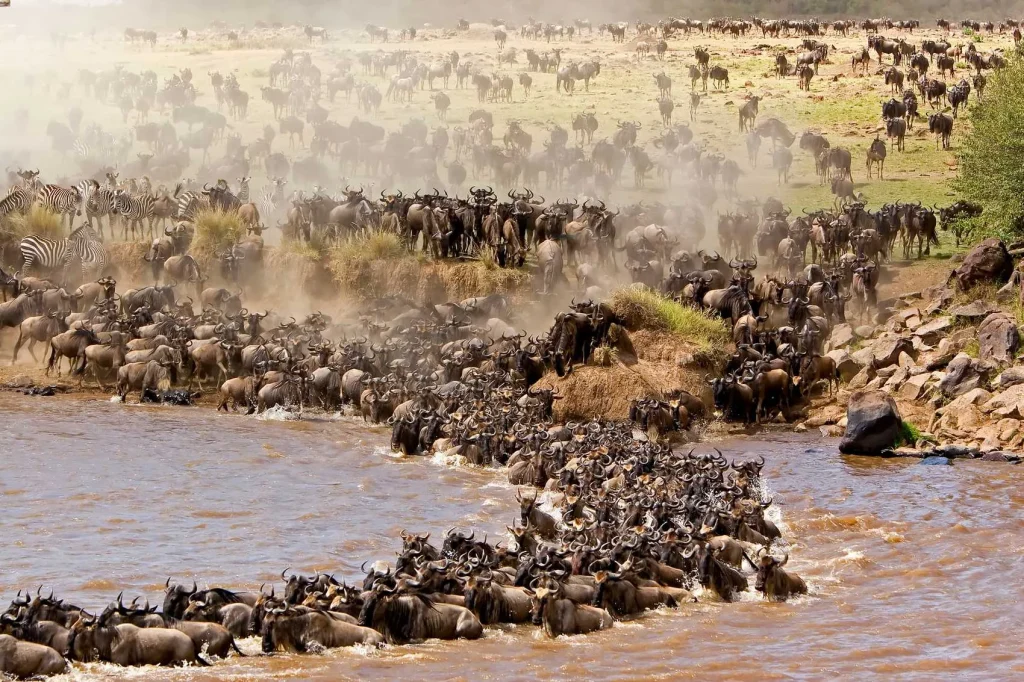
Masai Mara Wildebeest Migration
The Masai Mara Wildebeest Migration is one of the most famous wildlife events associated with Kenya. Each year, vast numbers of wildebeest move through the wider Serengeti–Mara ecosystem, accompanied by zebras and other grazing animals, following seasonal rainfall, fresh grass and water.
The migration is not a single event that happens on one fixed date. It is a continuous cycle of movement through Tanzania and Kenya, and the timing can shift from year to year depending on rainfall patterns and grazing conditions. When migratory herds reach the Masai Mara, the landscape can change dramatically. Open plains may fill with wildebeest and zebra, predator activity can intensify and sections of the Mara River may become the stage for dramatic crossings.
For many travellers, this is the defining image of an East African safari. However, the best migration safari is built around realistic expectations, enough time in the ecosystem and an understanding that wildlife movements cannot be guaranteed. Individual species, river crossings and mountain views can never be guaranteed.
What Is the Masai Mara Wildebeest Migration?
The Masai Mara wildebeest migration is the Kenyan phase of the wider Great Migration, a continuous movement of herbivores through the Serengeti–Mara ecosystem. The migration is driven mainly by:
- Rainfall
- Fresh grass
- Water availability
- Seasonal grazing conditions
- Herd movement
The principal migrating animals are:
- Wildebeest
- Plains zebra
- Thomson’s gazelles
- Other grazing herbivores
The exact number of animals changes from year to year, but the migration remains one of the largest terrestrial wildlife movements in the world.
Why Do Wildebeest Migrate?
Wildebeest migrate because they depend on grazing and water. As rainfall changes across the ecosystem, fresh grass develops in different areas, and the herds respond by moving towards better grazing conditions. This creates a cycle of movement through:
- Southern Serengeti
- Central Serengeti
- Western Serengeti
- Northern Serengeti
- Masai Mara
- Back south through Tanzania
The route is influenced by weather rather than national borders.
When Does the Migration Reach Masai Mara?
The Masai Mara is generally associated with migration activity between July and October, although this should be treated as a broad seasonal guide rather than a fixed timetable. Some years, substantial herds may arrive earlier. In other years, rainfall patterns may delay or alter movement. The migration can therefore vary in:
- Arrival time
- Herd concentration
- River crossing locations
- Length of stay
- Departure timing
Travellers should avoid booking a safari based on claims that a crossing will happen on a particular date.
Masai Mara Migration Month by Month
Masai Mara Migration in July
July often marks the beginning of stronger migration activity in the northern Serengeti and Masai Mara region. Depending on rainfall, some herds may begin moving into the Mara. Possible experiences include:
- Growing wildebeest concentrations
- Zebra herds
- Increased predator activity
- Early river-crossing opportunities
Exact herd locations vary.
Masai Mara Migration in August
August is traditionally one of the most popular months for migration safaris. Large herds may be present in different parts of the Mara ecosystem. Visitors may encounter:
- Wildebeest-filled plains
- Zebra herds
- Lions following prey
- Hyenas
- Cheetahs
- Mara River activity
August can also be busy, particularly around major sightings.
Masai Mara Migration in September
September can offer excellent migration viewing. Herds may remain distributed across the greater Mara ecosystem, depending on grazing and rainfall, and predator activity can remain strong. This is also a popular period for travellers hoping to witness Mara River crossings.
Masai Mara Migration in October
Some migratory herds may remain in the Mara during October, while others may begin moving back towards northern Serengeti areas. Movement depends heavily on changing rainfall. October can therefore be excellent, but migration locations should never be assumed.
Can the Migration Arrive Before July?
Yes. Wildlife does not follow a tourism calendar. If rainfall and grass conditions favour earlier movement, some herds may arrive sooner than expected, while some animals may remain farther south for longer. This is why current conditions matter when planning a migration-focused safari.
Can Wildebeest Stay in Masai Mara After October?
Yes. Some animals may remain in the broader ecosystem depending on rainfall and grazing, and resident wildebeest are also present. However, the largest migratory concentrations generally begin moving south again as seasonal conditions change.
The Mara River and the Migration
The Mara River is the most famous geographical feature associated with migration safaris in the Masai Mara. Large herds may reach the river and gather near traditional crossing areas. Crossings can be dramatic because animals must deal with:
- Steep riverbanks
- Strong currents
- Large crowds of other wildebeest
- Nile crocodiles
- Confusion within the herd
However, the river is only one part of the migration story. Much of the migration experience takes place on open plains away from the river.
Are Mara River Crossings Guaranteed?
No. A river crossing can never be guaranteed. A herd may approach the river and:
- Turn around
- Wait for several hours
- Move upstream
- Move downstream
- Cross suddenly
- Cross after visitors have left
This unpredictability is part of what makes the migration a natural wildlife event.
Why Do Wildebeest Cross the Mara River?
Wildebeest cross because their seasonal movement may require them to move between grazing areas separated by the river. They do not cross for entertainment, nor do they follow a fixed tourism schedule. Crossing behaviour is influenced by:
- Herd movement
- Pressure from animals behind them
- Riverbank conditions
- Water levels
- Grazing on the opposite side
What Happens During a River Crossing?
Before a crossing begins, large numbers of wildebeest may gather close to the riverbank. The herd can appear hesitant. One animal may eventually enter the water, causing others to follow, and the crossing may then become intense as hundreds or thousands of animals enter the river. Possible challenges include:
- Slippery banks
- Strong current
- Crowding
- Crocodiles
- Injuries
- Separation of calves from adults
Some crossings are brief, while others can continue for a long period.
Nile Crocodiles and the Migration
Large Nile crocodiles live in the Mara River and are one of the most famous predators associated with wildebeest crossings. Crocodiles may wait near river channels and crossing areas. However, not every crossing involves successful crocodile attacks. Their hunting success varies according to:
- Crossing location
- Water depth
- Herd density
- Individual opportunity
Lions During the Wildebeest Migration
Lions benefit from the seasonal increase in prey, and prides may position themselves near areas used by migrating herds. Possible prey includes:
- Wildebeest
- Zebras
- Young animals
- Injured animals
The abundance of prey can produce excellent predator-viewing opportunities.
Cheetahs During the Migration
Cheetahs generally target smaller or younger animals rather than healthy adult wildebeest. The migration can increase opportunities to hunt:
- Young wildebeest
- Gazelles
- Other smaller herbivores
Open plains provide ideal hunting habitat.
Hyenas During the Migration
Spotted hyenas are among the main predators and scavengers benefiting from migration activity. They may:
- Hunt wildebeest
- Hunt zebras
- Feed on carcasses
- Compete with lions
- Follow large herds
Hyena activity can be particularly interesting around dense prey concentrations.
Leopards During the Migration
Leopards are less directly dependent on the migrating wildebeest than lions and hyenas. They generally remain within established territories and continue hunting smaller prey, although migration activity can still indirectly influence their environment.
Vultures and the Migration
Vultures play an important role by consuming carcasses. Large wildlife concentrations naturally produce:
- Predation
- Injuries
- Natural deaths
Vultures help recycle nutrients and reduce the persistence of carcasses.
Is the Migration Only About Wildebeest?
No. The migration is an ecosystem-wide event. It involves:
- Wildebeest
- Zebras
- Gazelles
- Predators
- Scavengers
- Crocodiles
- Grasslands
- Rivers
The movement of herbivores affects many other species.
Wildebeest and Zebra Migration
Wildebeest and zebras frequently move together, partly because they use grass differently. Zebras can feed on taller grass, while wildebeest often prefer shorter growth, so their combined grazing patterns help them use the landscape efficiently. They also benefit from increased group vigilance against predators.
Migration Calves
Young wildebeest are typically born in large numbers earlier in the migration cycle, primarily in the southern Serengeti. By the time many herds reach the Masai Mara, calves have grown substantially. However, young animals can still be vulnerable to:
- Lions
- Hyenas
- Cheetahs
- River-crossing hazards
Best Areas to See the Migration
The best location changes according to herd movement. Important areas may include:
- Mara River region
- Mara Triangle
- Central plains
- Northern sections
- Conservancy areas
- Wildlife corridors connecting the Mara and Serengeti
A good guide monitors current conditions rather than following a fixed migration route.
Migration in the Mara Triangle
The Mara Triangle is particularly important during parts of migration season. Its proximity to the Mara River and productive grazing areas can attract substantial wildlife concentrations. Possible sightings include:
- Large wildebeest herds
- Zebras
- Lions
- Hyenas
- Crocodiles
- Elephants
- Buffaloes
Migration in Private Conservancies
Migratory animals can also move into areas outside the core reserve, and some conservancies may experience significant herd activity depending on seasonal conditions. Staying in a conservancy can provide:
- Lower vehicle density
- Additional activities
- Access to different habitats
However, migration location should be checked rather than assumed.
Best Time for a Masai Mara Migration Safari
For travellers whose main objective is migration activity, the broad July to October period is generally the most relevant. However, different months offer slightly different expectations.
| Month | General Migration Potential |
|---|---|
| July | Herds may begin entering the Mara region |
| August | Strong migration potential |
| September | Strong migration and river-crossing potential |
| October | Herds may still be present before moving south |
These are patterns, not guarantees.
How Many Days for a Migration Safari?
Migration-focused travellers should avoid extremely short visits.
2 Days
Too limited if witnessing migration activity is your main objective.
3 Days
Provides some opportunity but remains relatively short.
4 Days
A stronger option.
5 Days
Provides better flexibility.
6 Days or More
Excellent for photographers and travellers particularly focused on migration behaviour. For river-crossing hopes, four to five nights or longer can be especially useful.
Why Longer Migration Safaris Are Better
The herds move constantly, and weather can also affect visibility and road conditions. More days provide:
- Greater geographical flexibility
- More game drives
- More opportunities near the river
- Better photography options
- Less pressure to chase sightings
A longer stay allows the safari to follow natural conditions.
Where to Stay for the Migration
Accommodation choice should consider the likely location of the herds. Options include:
- Camps inside the reserve
- Mara Triangle properties
- Camps near the Mara River
- Private conservancies
The best location varies according to season and current migration movement. A beautiful lodge far from migration activity may require long daily drives.
Migration Camps
Some safari camps position themselves to take advantage of seasonal wildlife movements. When choosing a migration camp, consider:
- Exact location
- Access to river areas
- Driving distances
- Reserve entry arrangements
- Game-drive rules
- Season of operation
Migration Safari by Road
A road safari from Nairobi offers several advantages:
- Dedicated safari vehicle
- Private guide
- Flexible daily programme
- More affordable transport
It works particularly well for travellers spending several days in the Mara.
Fly-In Migration Safari
Flying from Nairobi reduces transfer time. This is ideal for:
- Short holidays
- Luxury travellers
- Honeymooners
- Photographers wanting more time in the field
Light-aircraft flights serve several airstrips across the Mara ecosystem.
Private Migration Safari
A private safari is highly recommended for travellers focused on migration. Benefits include:
- Flexible departure times
- Ability to remain at sightings
- Freedom to follow current herd information
- Better photography conditions
- No need to compromise with unrelated passengers
Photography During the Migration
The migration offers exceptional photographic opportunities. Possible subjects include:
- Huge wildebeest herds
- Zebra patterns
- River crossings
- Predators
- Dust
- Storm clouds
- Sunrise silhouettes
- Herds across open plains
A private vehicle is especially useful for photographers.
Photographing River Crossings
River crossings can be difficult to photograph because:
- They happen suddenly
- Animals move quickly
- Vehicle positions may be restricted
- Crowding can occur
- Light conditions may vary
Photographers should prepare equipment in advance. Useful equipment may include:
- Telephoto lens
- Mid-range zoom
- Fast memory cards
- Spare batteries
- Beanbag or support
Responsible Migration Viewing
Migration season can attract many safari vehicles, so responsible wildlife viewing is essential. Visitors should:
- Follow guide instructions
- Avoid blocking animals
- Give herds space
- Respect riverbank rules
- Avoid excessive noise
- Never pressure guides to chase wildlife
- Avoid interfering with crossing routes
Vehicles should never influence whether animals cross the river.
Vehicle Crowding at Crossings
A large number of vehicles may gather when herds approach the river. Good operators should follow local rules regarding:
- Vehicle positioning
- Distance
- Access routes
- Number of vehicles
- Wildlife corridors
The objective is to watch natural behaviour without disrupting it.
Migration Safari With Children
Families can experience the migration, but parents should consider the nature of some encounters. River crossings and predator activity can involve:
- Injuries
- Hunting
- Death
- Crocodile attacks
These are natural ecological events, and parents may wish to prepare younger children in advance.
Luxury Migration Safaris
Luxury migration safaris can include:
- Fly-in transfers
- Premium camps
- Private vehicles
- Bush breakfasts
- Sundowners
- Balloon safari
- Conservancy stays
Location should remain the main priority. A premium camp should ideally provide convenient access to the areas relevant to your travel period.
Budget Migration Safaris
Budget travellers can also experience migration season. A budget trip may use:
- Road transport
- Simpler camps
- Accommodation near reserve gates
- Shared vehicles
However, accommodation location should be chosen carefully. Long daily transfers can reduce actual migration-viewing time.
Migration and Balloon Safaris
A hot-air balloon safari can provide a spectacular view of the Mara landscape. When herds are in suitable areas, large concentrations may sometimes be visible from the air. However, balloon routes depend on:
- Wind
- Launch site
- Weather
A balloon flight cannot guarantee migration sightings.
Migration Outside the Mara River
One common mistake is to focus entirely on river crossings. The open-plains migration experience can be equally impressive. Travellers may see:
- Endless columns of wildebeest
- Zebra herds
- Calves
- Predator interactions
- Dust clouds
- Large feeding groups
These scenes represent the broader migration more accurately than the river alone.
Is a River Crossing Necessary for a Great Migration Safari?
No. A migration safari can be exceptional without witnessing a river crossing. Seeing thousands of animals moving across the grasslands can be equally memorable, and the migration is a continuous ecological event rather than a single dramatic moment.
What Happens After the Herds Leave Masai Mara?
As rainfall patterns change, migratory herds generally begin moving south towards Tanzania. They may pass through:
- Northern Serengeti
- Central Serengeti
- Southern areas later in the annual cycle
The broader migration continues throughout the year.
Are There Wildebeest in Masai Mara All Year?
Yes. The Mara also supports resident wildebeest. However, the enormous concentrations associated with the Great Migration are seasonal, and this is an important distinction.
Masai Mara Outside Migration Season
The Mara remains one of Kenya's best wildlife destinations after migratory herds move away. Resident wildlife includes:
- Lions
- Leopards
- Cheetahs
- Elephants
- Buffaloes
- Giraffes
- Resident wildebeest
- Zebras
- Hippos
- Hyenas
Visitors therefore do not need the Great Migration to have an excellent safari.
Migration Safari vs Regular Masai Mara Safari
A migration safari places greater emphasis on:
- Herd locations
- River areas
- Migration corridors
- Predator activity associated with herds
A general Masai Mara safari focuses more broadly on resident wildlife and landscapes. Both can be excellent.
Masai Mara vs Serengeti for the Migration
Both destinations are essential parts of the same migration cycle, and the best choice depends on your travel month. The Serengeti hosts different migration phases during much of the year. The Masai Mara is most closely associated with the northern phase, particularly during the July-to-October period. Travellers with enough time can combine both destinations.
Combining Masai Mara and Serengeti Migration Safaris
A combined Kenya and Tanzania safari can follow different parts of the ecosystem. Possible route:
Nairobi → Masai Mara → Northern Serengeti → Central Serengeti → Ngorongoro → Arusha
Cross-border logistics require careful planning.
Migration Safari and Kenya Coast
The migration can also be combined with a beach holiday. A popular structure is 4–5 Nights Masai Mara + 4–6 Nights Kenya Coast. This works particularly well for:
- Honeymoons
- Couples
- Families
- Longer holidays
What to Pack for Migration Season
Useful items include:
- Neutral-coloured safari clothing
- Light jacket
- Sun hat
- Sunglasses
- Sunscreen
- Binoculars
- Camera
- Spare batteries
- Memory cards
- Dust protection
- Personal medication
Early morning drives can be cold, even during generally warm periods.
Choosing a Migration Safari Operator
Ask potential operators:
- Where will we stay?
- How far is the camp from likely migration areas?
- Is the vehicle private?
- Are park fees included?
- How many game-drive hours are planned?
- Can we do full-day game drives?
- Can the itinerary respond to current herd movements?
- Are river crossings guaranteed?
Any operator guaranteeing a specific river crossing should be treated cautiously.
Common Migration Safari Mistakes
Booking Too Few Nights
Migration movements are unpredictable.
Expecting a Guaranteed Crossing
No one can schedule wildlife behaviour.
Staying Too Far Away
Long transfers reduce field time.
Focusing Only on the River
The wider migration experience is equally important.
Choosing Accommodation Only for Luxury
Location can matter more than room design.
Ignoring Vehicle Arrangements
Private vehicles provide far more flexibility.
Planning a Masai Mara Migration Safari
A strong migration itinerary should prioritise:
- Enough nights.
- Suitable accommodation location.
- Experienced guide.
- Flexible game drives.
- Realistic expectations.
- Private vehicle where budget allows.
- Current information about herd movements.
For many travellers, four to five nights is an excellent starting point. Photographers and serious wildlife enthusiasts may prefer longer.
Frequently Asked Questions About the Masai Mara Wildebeest Migration
What is the Masai Mara Wildebeest Migration?
It is the seasonal movement of large wildebeest and zebra herds into the Kenyan part of the Serengeti–Mara ecosystem.
When is the migration in Masai Mara?
The main period is generally associated with July through October, although exact timing varies annually.
Is July a good month for the migration?
Yes. Herds may begin moving into the greater Mara region during July depending on rainfall.
Is August good for migration?
Yes. August is traditionally one of the strongest months for migration viewing.
Is September good?
Yes. September can offer excellent herd concentrations and river-crossing potential.
Is October too late?
Not necessarily. Some migratory herds may still be present, but movement south can begin as conditions change.
Are river crossings guaranteed?
No. Crossings are completely unpredictable.
How many days should I spend?
Four to five nights is a strong starting point for a migration-focused safari.
Can I see the migration without a river crossing?
Yes. Large herds moving and grazing across the plains are a major part of the migration experience.
Where is the best place to stay?
The best location depends on current herd movements and the period of travel.
Is Mara Triangle good for migration?
Yes. The Mara Triangle can be an important area during parts of migration season.
Do crocodiles attack wildebeest?
Yes. Nile crocodiles may prey on animals during river crossings, although not every crossing involves crocodile attacks.
Do lions follow the migration?
Resident lions can benefit from the increased prey availability when migratory herds enter their territories.
Are cheetahs active during migration?
Yes. Cheetahs can benefit from increased numbers of young and smaller prey.
Do hyenas hunt wildebeest?
Yes. Spotted hyenas are capable hunters and may target wildebeest and other herbivores.
Are wildebeest in Masai Mara all year?
Resident wildebeest occur year-round, but the largest migratory concentrations are seasonal.
Is Masai Mara worth visiting outside migration season?
Absolutely. Resident wildlife remains excellent throughout the year.
Is a private vehicle better?
Yes, especially for migration-focused travellers who want greater flexibility.
Can families see the migration?
Yes, although parents should be aware that predator and river-crossing scenes can sometimes be graphic.
Can I combine the migration with Serengeti?
Yes. Masai Mara and Serengeti can be combined in one East African itinerary.